How do you maintain a Wikipedia page over time?
Wikipedia maintenance is continuous, not a one-time task. Four ongoing streams keep an article accurate: real-time monitoring via WikiAlerts, periodic content review to catch stale facts, Talk-page dispute engagement when contested content arises, and structured-data upkeep across Wikidata and linked language versions.
A Wikipedia article created three years ago is not the same article today. Because anyone can edit the page, content drifts, disputes arise, and the structured-data layer that feeds Knowledge Panels and AI engines can fall behind the article itself. Maintenance runs four continuous streams at once.
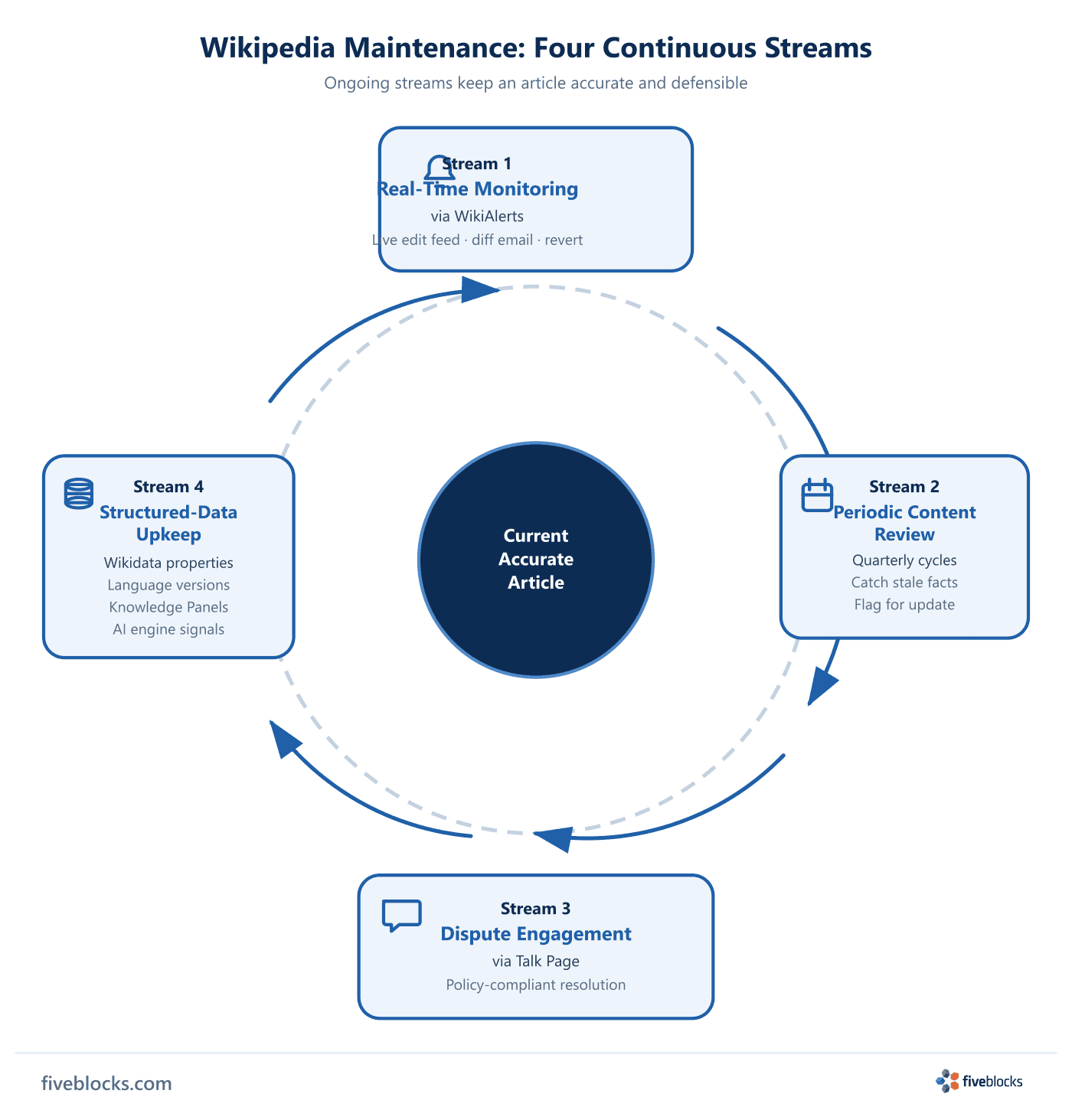
Step 1: Real-time monitoring
- WikiAlerts™ subscribes to Wikipedia’s live edit feed for every page you are watching: the corporate article, executive biographies, and brand pages.
- The moment a watched page is edited, an email delivers a diff view showing what changed, which editor account made the change, and the edit summary they provided.
- A one-click revert handles clear vandalism before the change is cached by AI engines or quoted in search results.
Step 2: Periodic content review
- Content goes stale on its own, without any hostile editing: a former CEO still described in the present tense, an outdated financial figure, a company description that no longer matches the current business.
- Scheduled review cycles catch this stale content and flag it for Talk-page update requests backed by current reliable sources.
Step 3: Dispute engagement via the Talk page
- When a contested claim, a difficult editor, or an NPOV concern comes up, the right channel is the article’s Talk page, not a direct revert.
- A clear Talk-page post cites the applicable policy, proposes a policy-compliant fix, and lets uninvolved community editors evaluate and implement it.
- That builds a transparent record and avoids an edit war.
Step 4: Structured-data upkeep
- The Wikidata entry for the entity, and the linked language versions of the article, need maintenance alongside the English article.
- Drift in the structured-data layer, such as outdated property values, broken sameAs links, or missing identifiers, feeds directly into Google Knowledge Panels and the AI engines that read from both.
- Keeping Wikidata current closes the gap between the article’s accuracy and the entity signals AI engines rely on.
Run continuously across all four streams, the article stays accurate and defensible. Leave one stream unattended and you get a specific failure: vandalism that goes undetected, facts that stay stale for months, a dispute that escalates because no one engaged early, or structured-data drift that corrupts AI outputs while the article text still looks fine.
Last reviewed: 19/05/2026
