How do Trustpilot reviews affect business reputation?
Trustpilot shapes consumer-brand reputation through three channels: its pages rank for brand-name queries, AI engines ingest its reviews as third-party evidence, and the rating acts as a direct trust signal at the point of purchase. The discipline underneath is a structured response strategy plus compliant, authentic review generation.
Trustpilot influences consumer-brand reputation through three channels, and the work underneath them is the same disciplined response-and-generation practice that holds across review platforms.
Three channels
- Brand-query ranking
- Trustpilot pages rank well for brand-name queries, so a shopper researching a company often lands on its Trustpilot profile early in the search results.
- AI summary ingestion
- AI engines ingest Trustpilot reviews as third-party evidence and paraphrase the recurring themes when they summarize a brand, treating Trustpilot, alongside sources like Reddit and G2, as a trusted platform.
- Point-of-purchase trust signal
- The rating is a direct trust signal at the moment of decision, where a low score tends to create hesitation that marketing does not easily offset.
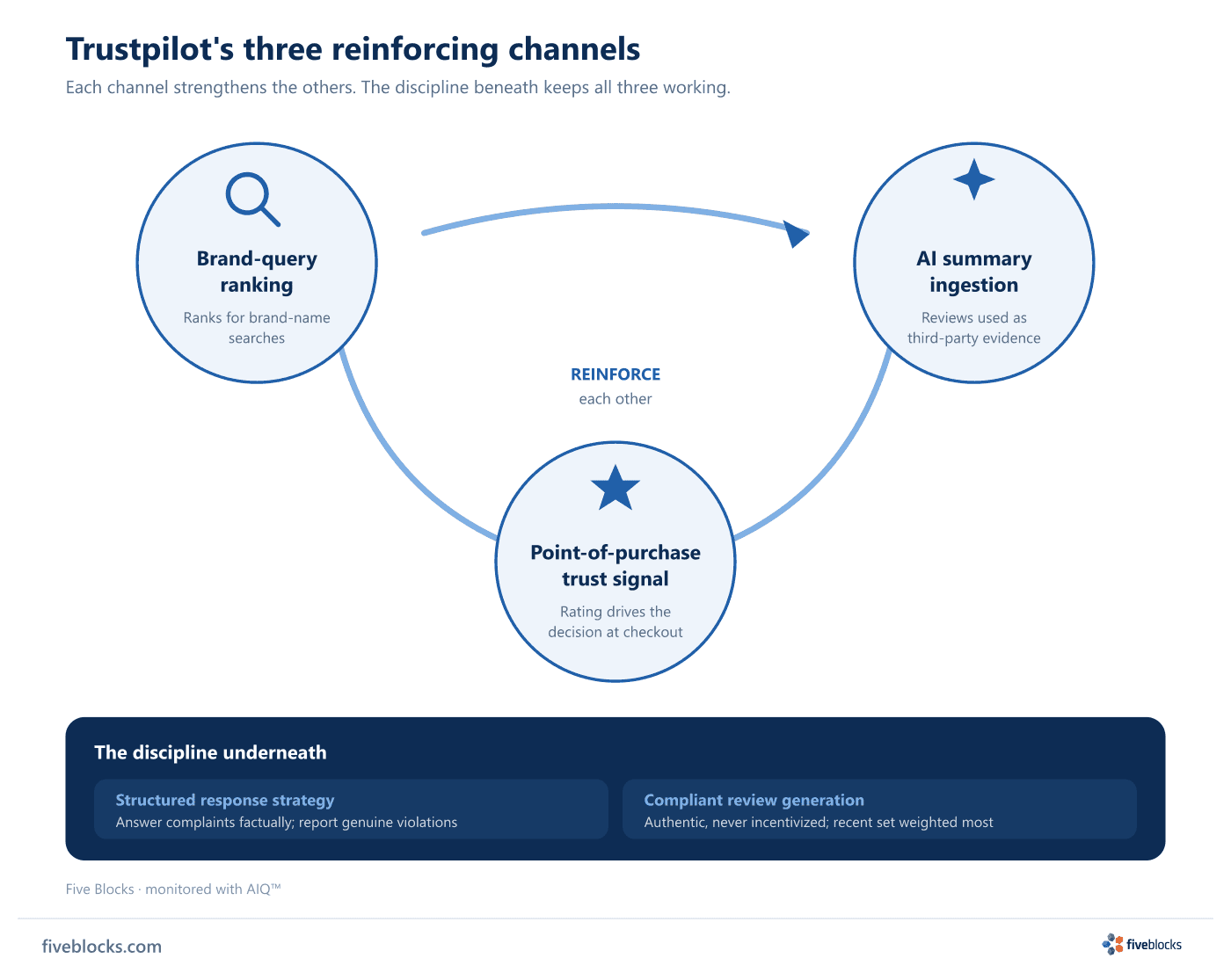
The discipline underneath
None of those channels improves on its own. The work is standard practice: a structured response strategy that addresses substantive complaints factually and reports genuine policy violations for removal, plus a compliant review-generation program that keeps the recent set populated with authentic reviews, never with incentives, which Trustpilot’s guidelines prohibit. The recent set matters most, because readers and review-ranking algorithms weight the most recent reviews most heavily.
We monitor how AI engines fold Trustpilot content into their brand summaries with AIQ. For a consumer brand, the synthesized ‘customers say’ line is often the first verdict a buyer encounters.
Last reviewed: 20/05/2026
