How do Yelp reviews affect business reputation and search results?
Yelp shapes local-business reputation through three channels: search and local results, the AI engines that ingest its reviews, and consumers who read its ratings before they buy. Yelp is distinct because of its strict no-solicitation policy - its recommendation software filters reviews it judges to be prompted, so the standard "ask every customer" playbook can backfire.
Yelp affects reputation strongly for local and consumer-facing businesses, through three channels. The first is search: Yelp content surfaces in the branded and local result set, so a Yelp page is often one of the first things a prospective customer sees. The second is AI: the engines ingest Yelp reviews and fold them into the answers they build about a business. The third is direct trust: consumers read the rating and the recent reviews before deciding where to spend.
Yelp differs from other review platforms in how it treats solicitation.
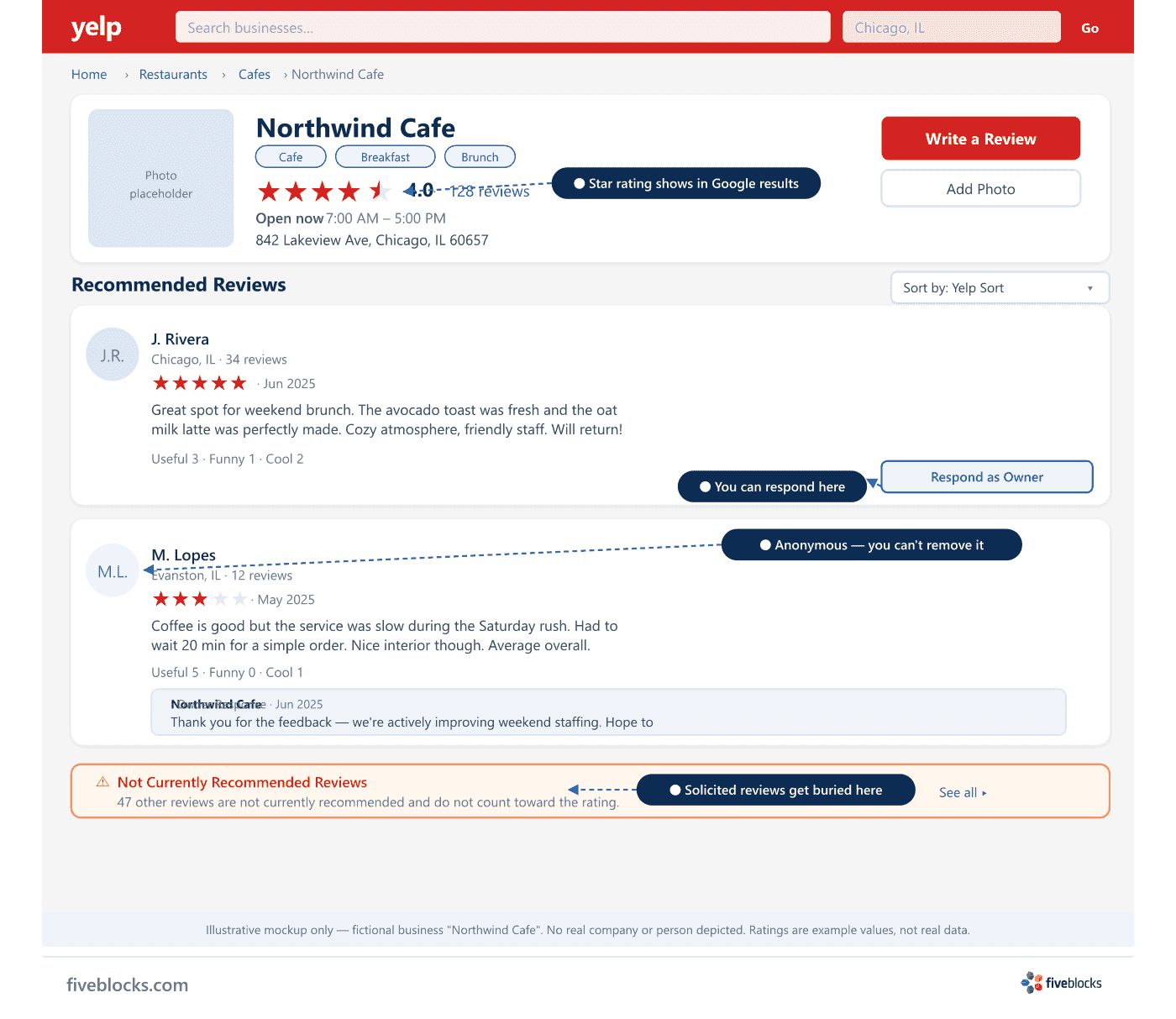
The Yelp difference: solicited reviews get suppressed
Yelp does not want businesses asking customers for reviews, and its recommendation software targets reviews that appear to have been solicited or prompted. Yelp’s own guidance is explicit: proactively asking for reviews may hurt your rating, because the automated software may decline to recommend reviews that seem encouraged by the business. This is the opposite of how Google and most other platforms behave, and it is why the standard “ask every happy customer” playbook backfires on Yelp – the reviews you generated are the ones the filter is most likely to bury.
How to run a Yelp program that the filter rewards
Because the filter penalizes orchestration, a Yelp program has to be built around earning reviews rather than soliciting them:
- Improve the underlying experience so customers review on their own, instead of prompting them.
- Claim and complete the business profile – accurate information, categories, photos, and hours.
- Respond professionally to reviews, positive and negative, without steering who reviews or what they say.
Yelp rewards genuine experience more than it rewards review generation, so the work is to deserve the reviews rather than manufacture them.
Why this matters beyond Yelp itself
For a local business, Yelp is often one of the most-read sources, so it is worth watching on both fronts. We track how Yelp content appears across the branded and local result set with IMPACT™, and how the AI engines summarize it with AIQ. Because the engines pull aggregated review content from platforms like Yelp into what they say about a business, a single Yelp presence can shape the answer well beyond its own traffic.
Last reviewed: 20/05/2026
