How do reviews on third-party platforms affect AI-generated answers about your business?
Directly. AI engines ingest third-party reviews as authoritative evidence and quote the recurring themes in their answers, so a body of reviews can shape what the engines say about your business even when no individual review is the result a searcher would have found first.
Third-party reviews feed AI answers because the engines treat aggregated, independent review content as some of the strongest evidence available about a business. It is third-party, high-volume, and current, which is the profile a model weights for evaluative questions. When a user asks an AI engine about a business, the model does not surface one review. It synthesizes the recurring themes across review platforms and states them plainly, often as “customers report” or “common complaints include.”
The path from review platforms to a synthesized verdict
- Ingestion: the engine pulls aggregated review content from multiple independent platforms and weights it above brand-owned pages for evaluative queries.
- Theme synthesis: rather than quoting any single review, the model identifies the patterns that recur across that body, a cluster of complaints about one issue, a repeated point of praise.
- Answer to the user: those patterns surface as a paraphrased verdict, “customers report,” “common complaints include,” that reaches the user directly.
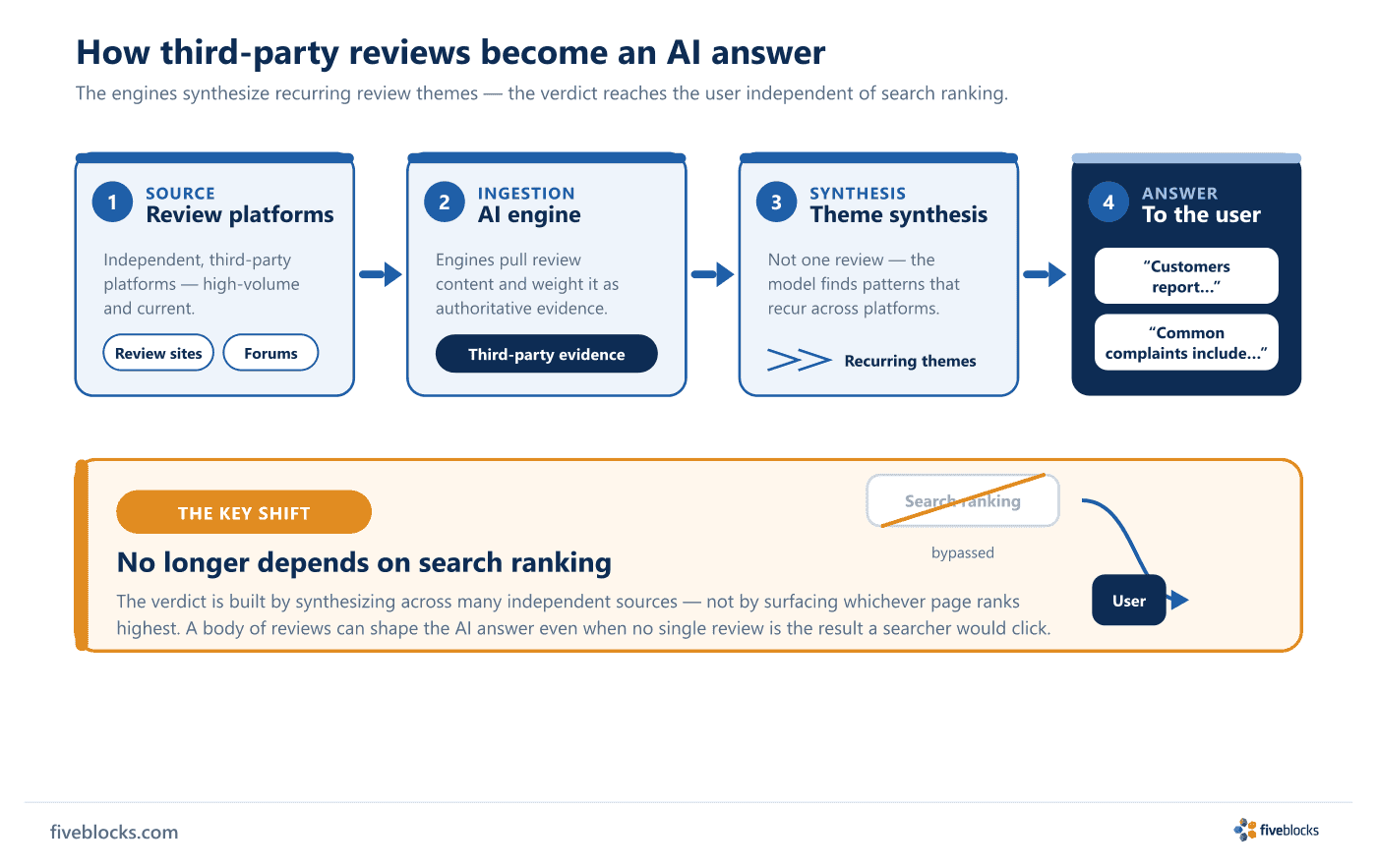
The shift: synthesis, not search ranking
The engines build an answer by synthesizing across many independent sources weighted by authority and recency, not by surfacing whichever page ranks highest. So a brand can rank well on Google for a query yet be characterized quite differently inside the AI synthesis of the same query. A body of reviews can shape that synthesis even when no single review is the result a searcher would have clicked first. Managing reviews is now partly about managing what the engines extract from them, not only the visible star average.
We monitor that with AIQ: which review themes the engines are pulling and how they characterize the business across the major models, so the work targets the synthesized answer, not just the star rating a human sees.
Last reviewed: 20/05/2026
