What role do online reviews play in shaping AI narratives about a business?
Reviews reach AI narratives two ways: directly, when retrieval-first engines pull from review platforms such as Trustpilot, G2, and Google reviews and condense recurring themes into confident summaries; and indirectly, when third-party articles and aggregators that summarize those platforms get ingested as independent corroboration. Because AI engines treat aggregated, independent review content as more credible than brand-owned content for evaluative queries, review-platform health is now a direct input to AI reputation, not a separate channel.
Reviews enter the AI narrative about a business through two paths, and both end in the same place: the answer an engine gives when a user asks whether your company is worth working for, buying from, or partnering with.
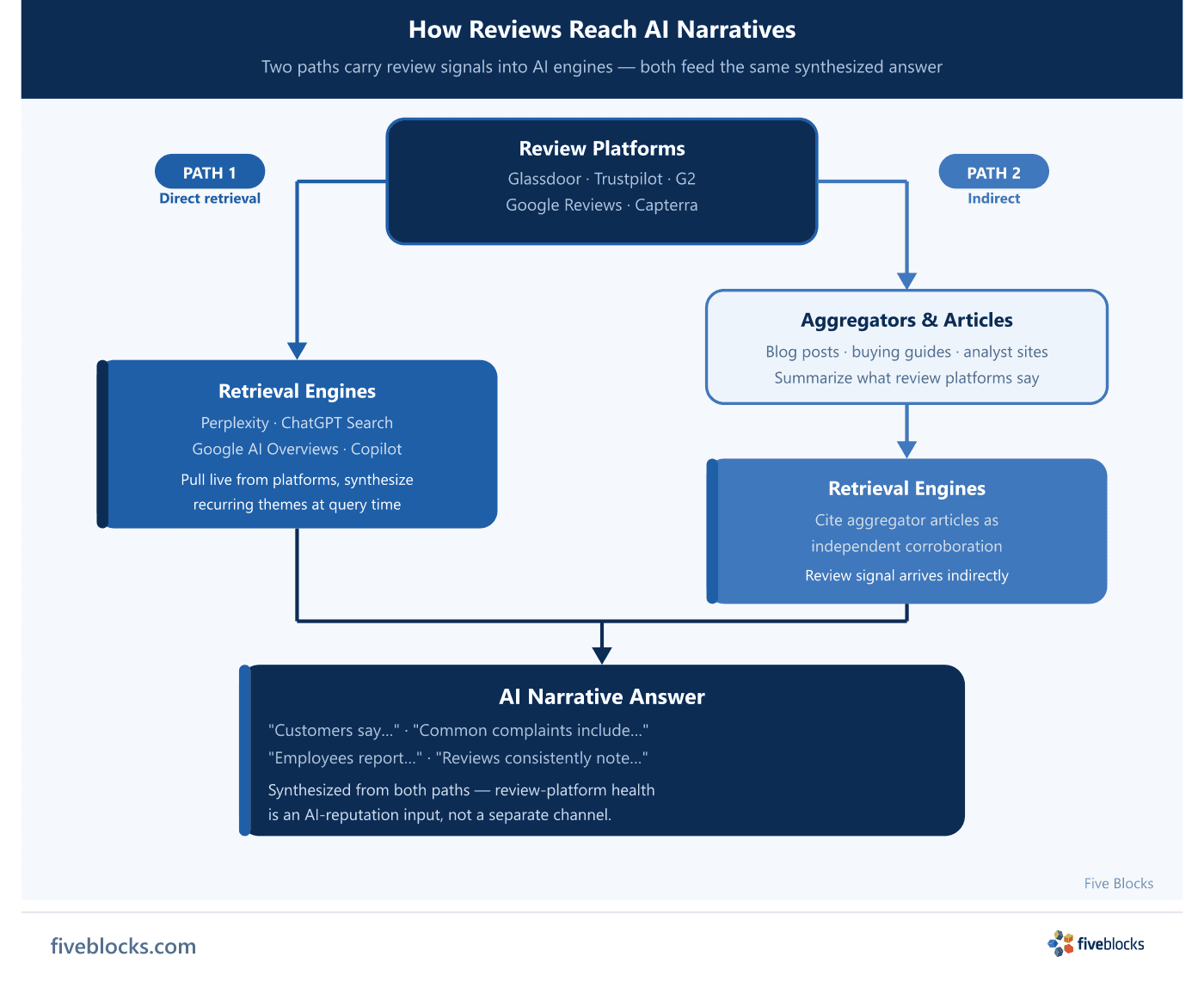
Path 1, Direct retrieval from review platforms
Retrieval-first engines (Perplexity, ChatGPT Search, Google AI Overviews) pull live from the web at query time. When a user asks an evaluative question about an employer, product, or service, these engines retrieve from review platforms and condense the recurring themes into a summary phrased as “customers say,” “customers report,” or “common complaints include.” The summary draws across many reviews rather than quoting a single one, which is why a pattern of reviews carries more weight than any individual post.
Review platforms rank so highly in this retrieval step because of independence. AI engines treat aggregated, user-validated third-party review content as more credible than brand-owned content for evaluative queries. A G2 review page or a Trustpilot profile carries an independence signal that a brand’s own About page cannot match. For B2B software brands, for example, G2 is cited more often than most other software-focused sources in AI-generated answers about product comparisons. Nearly half of B2B software buyers say citations from review sites are the most confidence-inspiring signal in an AI-generated response.
Path 2, Indirect summarization through aggregators
The second path does not require the engine to retrieve directly from Glassdoor or G2. Third-party articles, blog posts, buying guides, and aggregator sites routinely summarize what review platforms say about a brand, and those summaries get ingested as independent sources in their own right. Because engines combine information from many sources, a review signal can reach the final answer even when the original review platform is not the cited source; it arrived through the article that described what those reviews said.
This indirect path amplifies the direct one. A damaging pattern of reviews is not contained to the review platform itself. It spreads into the secondary content layer, and from there into the engine’s answer.
What this means for review-platform health
Review-platform health is an AI-reputation input, not a separate channel. A Glassdoor profile dominated by a small set of dated negative reviews can shape what an AI engine tells a senior candidate about an employer, one survey found 54% of senior candidates ask AI to judge whether a company is worth pursuing, even when the company’s earned media coverage looks strong elsewhere. Trustpilot pages consistently land on the first page of branded search results, so what appears there feeds directly into what retrieval engines summarize and cite.
How to improve review-platform health
The levers fall into four groups:
- Volume and velocity. AI engines and review algorithms both weight recency: 74% of readers seek reviews written in the last three months, and a steady stream of reviews (rather than sudden bursts) signals an active business. The legitimate path is structured review solicitation through normal post-purchase or post-service touchpoints. Review gating, screening customers before soliciting, or soliciting only those you expect to be satisfied, violates platform policy and risks removal of the solicited content.
- Response posture. Responding to reviews is the one lever you have on existing content. Glassdoor lets employers post official responses of up to 5,000 characters to any review. Responding does not remove the original review, but engagement on a review can raise its visibility and pull it into AI summaries, so the content of the response matters: keep it factual, specific, and representative of the organization’s actual position, not defensive or dismissive.
- Policy-violation reporting. Review platforms provide a process to report reviews that break platform policy: fake reviews, competitor-authored reviews, content with confidential information, slurs, or demonstrably false claims. This is the right path for clearly illegitimate content. Results are inconsistent and removal is not guaranteed, but it is the appropriate first step before any other escalation.
- Platform-specific optimization. Each major review platform has its own sourcing relationship with the AI engines. G2 and Capterra are ingested heavily for B2B software comparisons; Trustpilot is structured specifically for AI and search engine ingestion; Glassdoor and Indeed have very high domain authority (Glassdoor’s domain rating reaches 91) and rank prominently on company-name queries. Claiming and maintaining accurate profiles on the platforms that matter to your category comes before the rest of the work.
Last reviewed: 19/05/2026
