How should law firms approach reputation management?
Law firm reputation rests on practice-area authority and the standing of individual partners. The base assets are credentialed partner bios marked with Person schema, plus presence and ranking in the legal directories Chambers and Legal 500, which clients treat as credible third-party validation. Thought leadership published under named lawyers builds practice-area authority, and AI monitoring covers the practice-comparison prompts in-house counsel now use to screen firms.
Law firm reputation has two linked pillars: demonstrated practice-area authority and the standing of individual partners. The work is about making both legible to clients and to the AI engines that now produce firm comparisons on demand.
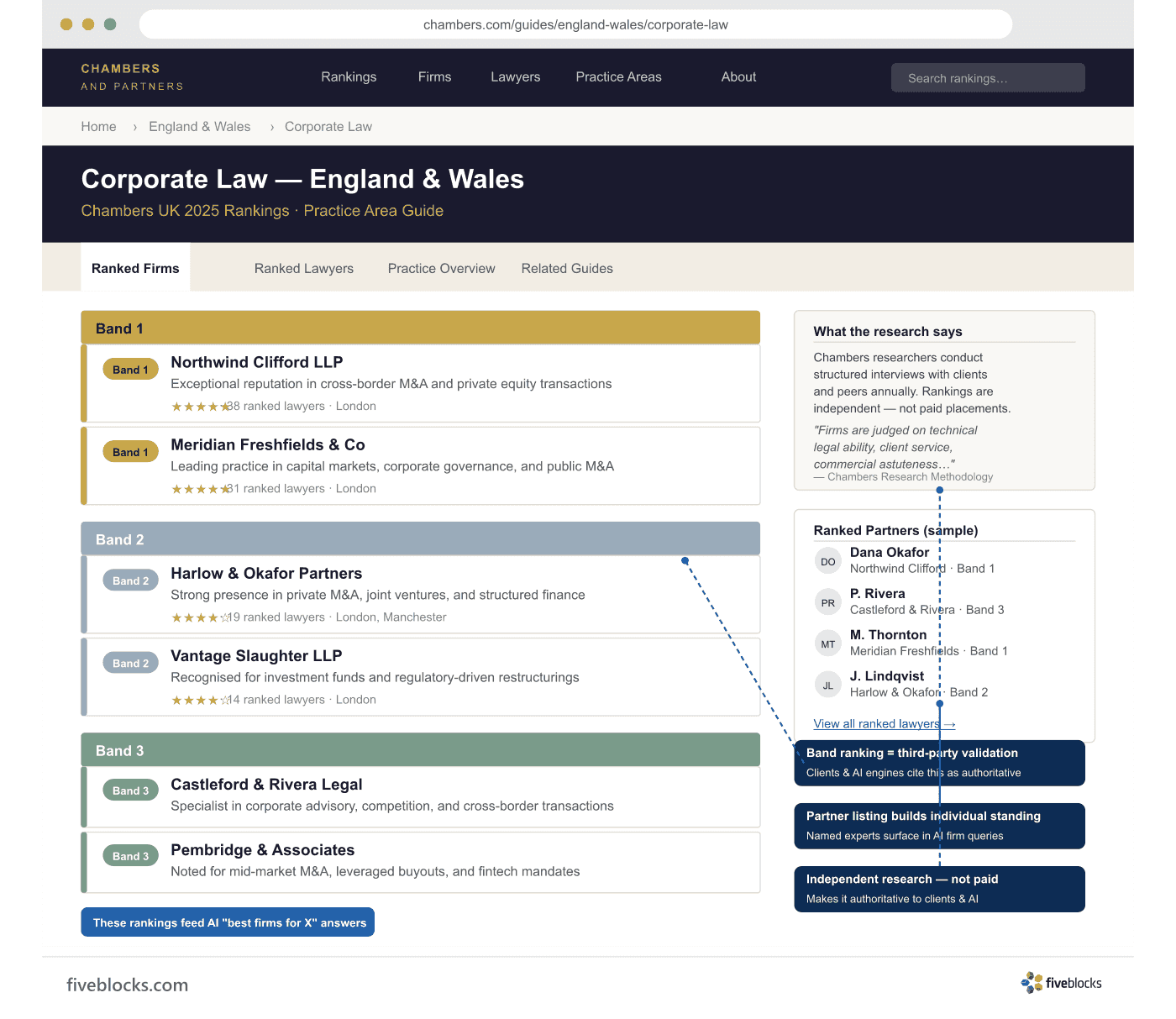
The core reputation signals
- Partner bios
- Credentials, notable matters, and practice focus, marked with Person schema so the right lawyer renders for the right query. A complete, schema-marked bio is where both search accuracy and AI engine accuracy start.
- Legal directory presence and ranking
- Presence and ranking in Chambers and Legal 500 carry disproportionate weight because clients treat them as credible third-party validation of a firm’s standing. The directories assign rankings through their own independent research, which is why self-published content alone cannot replicate the signal.
- Named thought leadership
- Published work attributed to named lawyers (articles, alerts, commentary, speaking records) builds practice-area authority in a way generic firm content cannot. The attribution is the point: it ties expertise to specific people.
- AI engine monitoring
- In-house counsel and clients now ask AI models ‘best firms for X’ or compare firms directly. The synthesized shortlist a model returns is a soft referral. We monitor those practice-comparison prompts with AIQ™ to track how the engines characterize a firm’s strongest practice areas against the actual market.
Where the AI layer fits
A firm the engines do not associate with its strongest practice area is losing consideration it has already earned in the market. Monitoring shows where that gap is. The same signals that build client-facing reputation (partner bios, directory rankings, published thought leadership) are what the engines draw on, so strengthening them serves both audiences.
Last reviewed: 20/05/2026
