How should accounting firms manage their digital reputation?
Accounting firm reputation rests on trust and technical credibility, built under professional conduct rules that limit what a firm can claim. The work centers on credentialed partner bios marked with Person schema, presence in the professional directories and listings clients consult, and thought leadership on regulation, audit, tax, and reporting. AIQ™ monitoring covers the firm-comparison and screening prompts buyers now use to research and shortlist accounting firms.
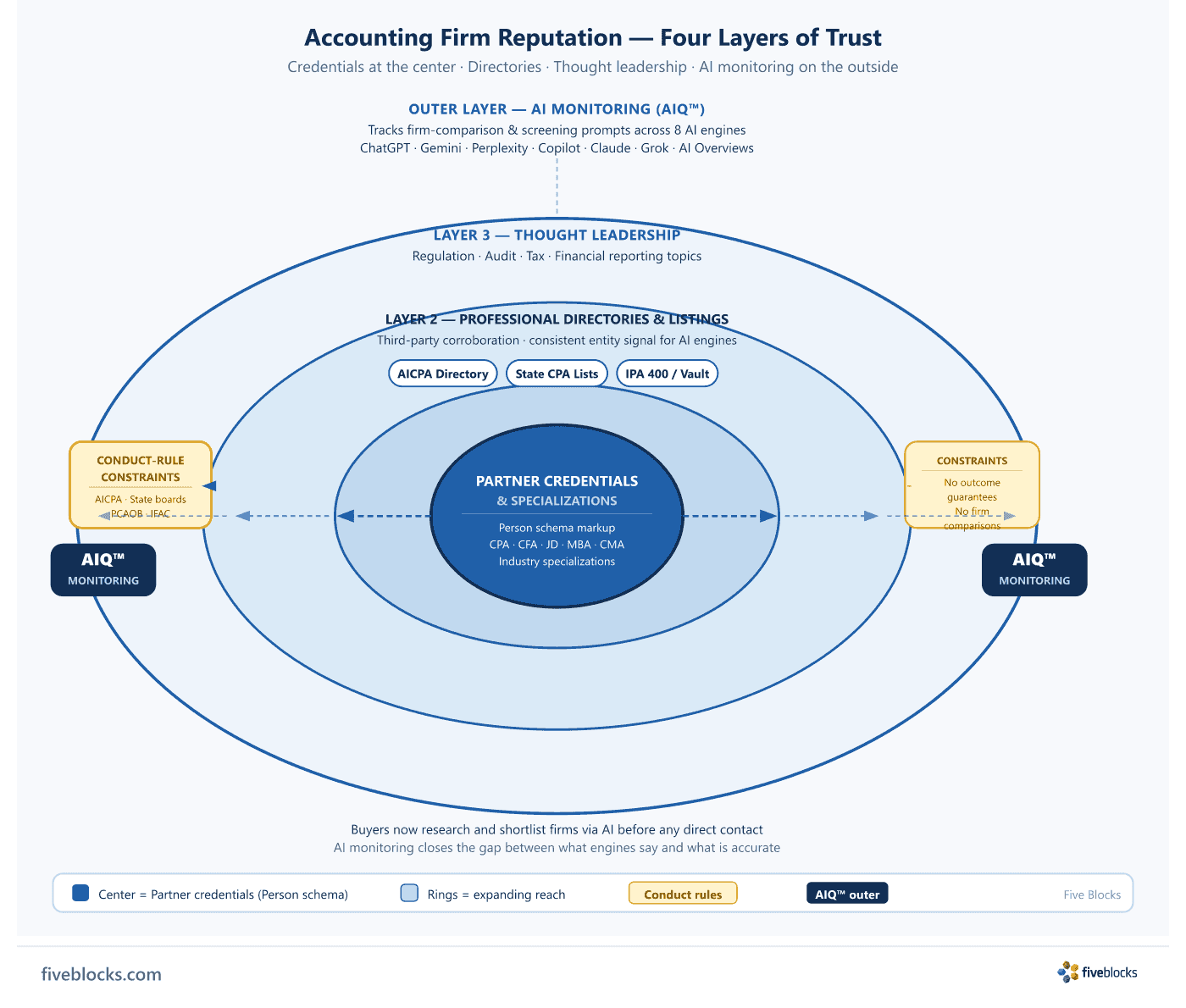
Accounting firms run on trust and technical credibility, and they do it under professional and regulatory standards that shape how reputation can be built. The result is a layered program: credentials at the center, directory and listing presence around that, thought leadership constrained by conduct rules beyond that, and AI monitoring on the outside, where buyers screen firms before any direct contact.
The core reputation signals
- Partner bios and credentials
- Credentials, specializations, and industry focus, marked with Person schema so the right facts appear in search and AI answers for the right query. A complete, schema-marked bio is the foundation. It tells prospective clients and the AI engines which partner covers which discipline.
- Professional listings and directories
- Presence in the directories and professional listings clients consult reinforces the firm’s standing and gives the engines a consistent, third-party-corroborated entity signal. What counts is coverage on the platforms buyers in this sector actually check when they screen firms.
- Regulatory and audit thought leadership
- Published work on regulation, audit, tax, and reporting establishes real expertise and gives the engines current, on-message material to cite. The constraint is real: professional conduct rules governing accountant communications shape what can be said and how, so the work stays inside those boundaries while still building a substantive published record.
- AI engine monitoring
- Businesses and individuals now use AI models to research and compare accounting firms. We track those firm-comparison and screening prompts with AIQ™ to see how the engines characterize each firm and whether they tie it accurately to real areas of expertise. A firm the engines describe accurately, and associate with genuine depth, has an advantage in a market where the buying decision comes down to whether you can be trusted with the numbers.
The conduct-rule constraint
Accounting thought leadership is not open-ended marketing. Professional conduct rules, which vary by jurisdiction and licensing body, limit claims about services, outcomes, and comparisons with other firms. A program that ignores those limits creates compliance risk alongside whatever reputational benefit it delivers. So the work is calibrated: expert and substantive in voice, compliant in every specific claim.
Last reviewed: 20/05/2026
