How does reputation management work for consulting firms?
Consulting firm reputation is the accumulated evidence of expertise. Named-author published research is the strongest single signal because it ties specific insight to specific people; partner-level authority, sector-relevant directory presence, and AI monitoring on industry recommendation prompts sit beneath it. The real test is whether AI engines connect the firm's name to its strongest practice areas when a prospective client asks.
Consulting firms sell judgment, which cannot be inventoried, so their reputation is the accumulated evidence of expertise. The work is to make that expertise easy to find and verify: by prospective clients, by the directories and platforms those buyers consult, and by the AI engines that now shape the shortlist before an RFP is written.
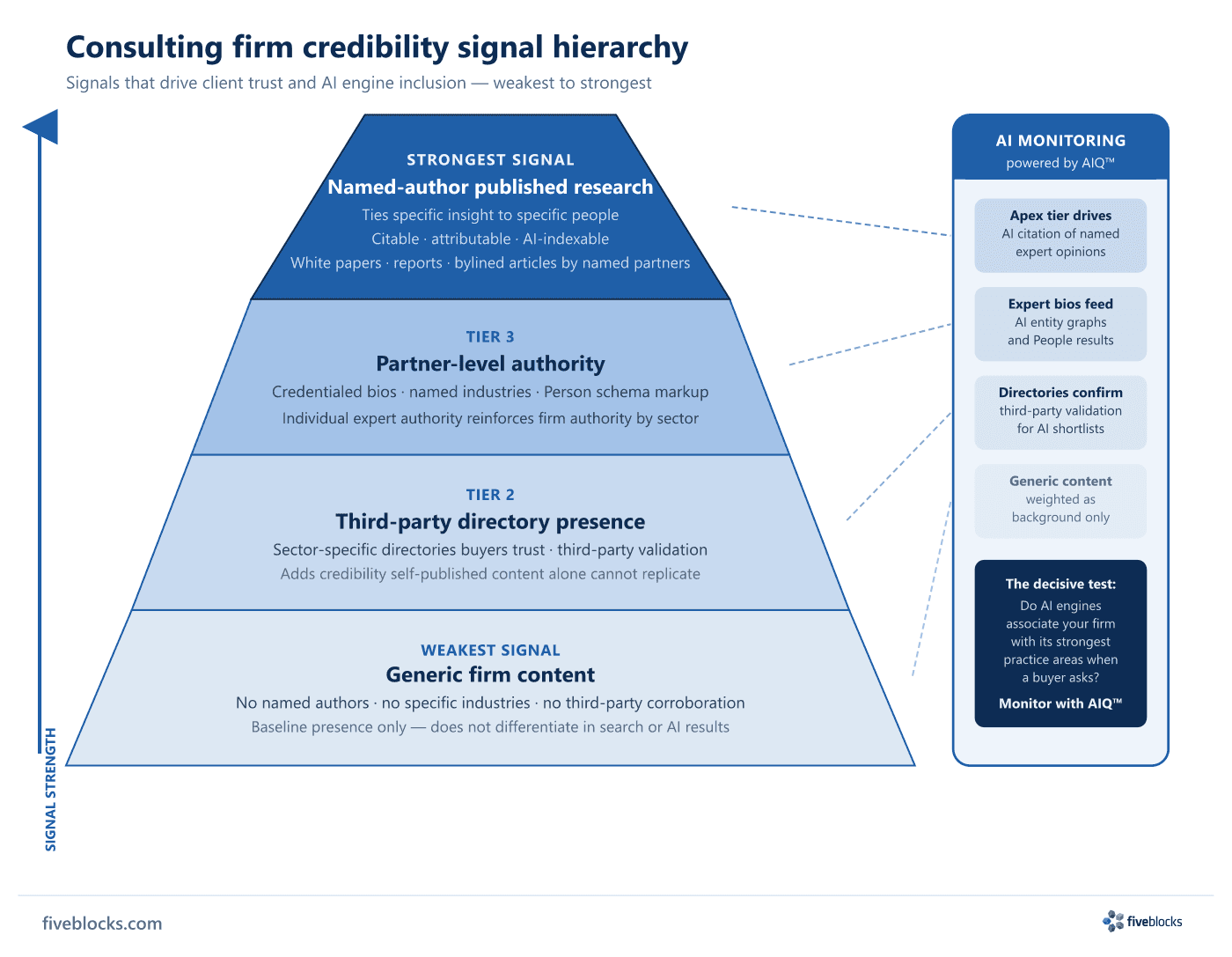
Credibility signals, from strongest to weakest
- Named-author published research
- The strongest signal a consulting firm can put into the record. It ties specific insight to specific people and gives clients and AI engines citable, attributable proof of capability. A white paper or report authored by named partners carries more authority than the same content published without a byline, because the attribution lets search engines and AI models assign the expertise to identifiable people.
- Partner-level authority
- Credentialed bios with visible track records in named industries, marked with Person schema, back up named-author content and help the right expert surface for the right query. Individual authority and firm authority build each other. A firm known for strong partners in a sector earns authority in that sector, and that authority makes the partners themselves easier to find.
- Directory and platform presence
- Presence in the directories and platforms that buyers in a given sector treat as credible adds third-party validation self-published content cannot replicate. Which directories count depends on the sector. Legal, financial, and technology buyers consult different platforms, so this work is sector-specific rather than blanket directory coverage.
- Generic firm content
- The weakest signal. Content that describes the firm’s capabilities without named authors, specific industries, or third-party corroboration gives you a baseline and nothing more. Search engines and AI engines treat it as background, not as evidence of expertise in any particular domain.
The AI monitoring layer
Prospective clients now ask AI models ‘best firms for this kind of problem’ or ‘who are the experts on this industry,’ and the synthesized answer often decides who makes the list. We track those industry and recommendation prompts with AIQ™. Having the expertise is one thing; getting the engines to name you when a buyer asks is another. The signals that drive AI inclusion are the ones that build client-facing credibility anyway: named-author research, partner bios with real credentials, and directory presence buyers respect.
Last reviewed: 20/05/2026
