How do you manage reputation for a tech startup that receives negative press coverage?
Negative press hits a startup harder than an established company because one critical story can dominate an otherwise empty search and AI footprint. The fix is accurate volume and context: a measured factual response, founder thought leadership, refreshed entity signals, and steady authoritative content on real product and team progress. The bad story then sits as one data point among many instead of the only source the engines can cite.
Negative press hits a startup harder than an established company for a structural reason: the startup has so little existing coverage that one critical story can dominate its entire search and AI footprint. An established company has hundreds of indexed articles, a full Wikipedia page, a detailed Knowledge Panel, and years of third-party coverage to dilute a single bad story. A young company has almost none of that, so the negative piece becomes the majority of what the engines see and cite.
The response is to add accurate volume and context rather than fight the single story head-on.
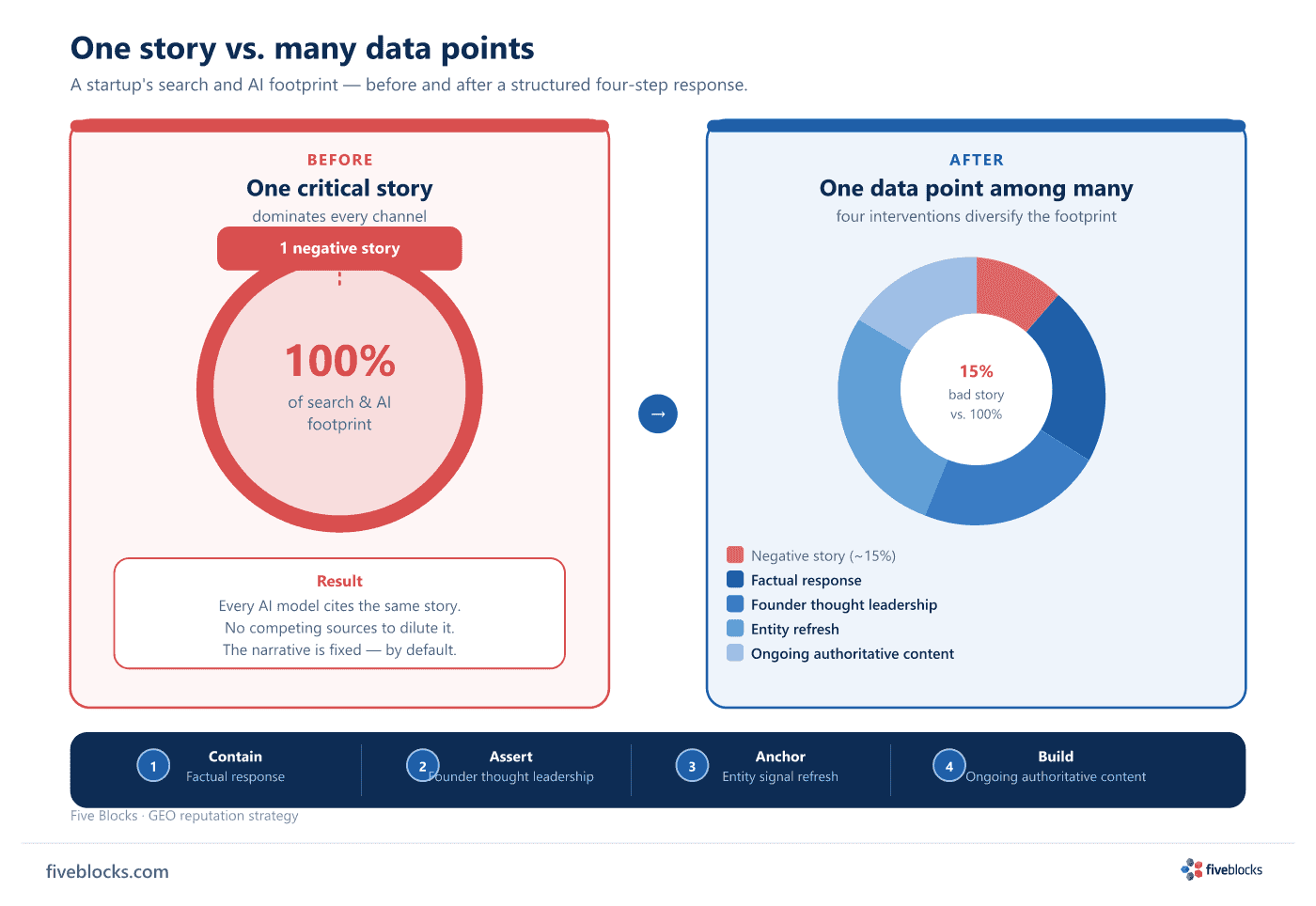
Step 1 (contain): a measured, factual response
- A brief, factual on-the-record response keeps the story from generating a second news cycle. It does not have to argue every point. It has to exist in the public record as the company’s voice.
- Saying nothing leaves the negative piece as the only account. Overreacting extends the coverage. A measured statement is the minimum credible action.
Step 2 (assert): founder thought leadership
- Published, bylined founder content tied to the company and its actual point of view gives AI engines a credible voice to weigh alongside the negative coverage.
- At the startup stage the founder is often the only named entity the engines associate with the company, so a published point of view from that person is one of the highest-signal additions available.
Step 3 (anchor): refresh the entity signals
- Accurate organization facts in structured directories (Crunchbase, AngelList), schema markup on the company’s own web properties, and a clean Wikidata entry where applicable keep the canonical facts current and machine-readable.
- When entity signals are outdated or missing, the engines have no structured baseline to anchor to, which makes the negative coverage proportionally heavier in the synthesis.
Step 4 (build): steady authoritative content on real progress
- Ongoing authoritative content on real product milestones, team additions, partnerships, and customer outcomes builds out the broader public record. As that material accumulates, AI engines have more recent and more varied sources to weigh.
- The negative story then reads as one data point instead of the defining headline. Engines synthesize across sources weighted by authority and recency, so adding accurate, current material is the mechanism that shifts the balance.
Why AIQ monitoring matters here
- For a young company, a model that leads with the bad story for every prospect and candidate does outsized damage relative to what the same answer would do to an established firm. That harm stays invisible unless someone is monitoring what the engines actually say.
- AIQ™ tracks what eight major AI models say about the company on a consistent cadence. It shows which sources are shaping those answers and how the narrative moves as the source layer changes, so the response can be targeted rather than guessed at.
Last reviewed: 20/05/2026
