How do you manage reputation for a tech company during a layoff round?
A layoff round produces a concentrated burst of employee posts, press coverage, and anonymous reviews that ranks fast and feeds AI engine summaries for months. The response is to lead immediately with factual context and visible leadership, watch Glassdoor and Blind where talent-market damage concentrates, track AI narratives with AIQ™, and keep publishing forward-looking content so the layoff is not the only current story the engines can cite.
A layoff round produces a concentrated burst of negative content: employee posts, press coverage, anonymous reviews. It ranks fast, and it feeds AI engine summaries for months. Without a credible company voice, the most aggrieved accounts write the whole story. The job is to keep the moment proportionate so it does not become the company’s defining narrative.
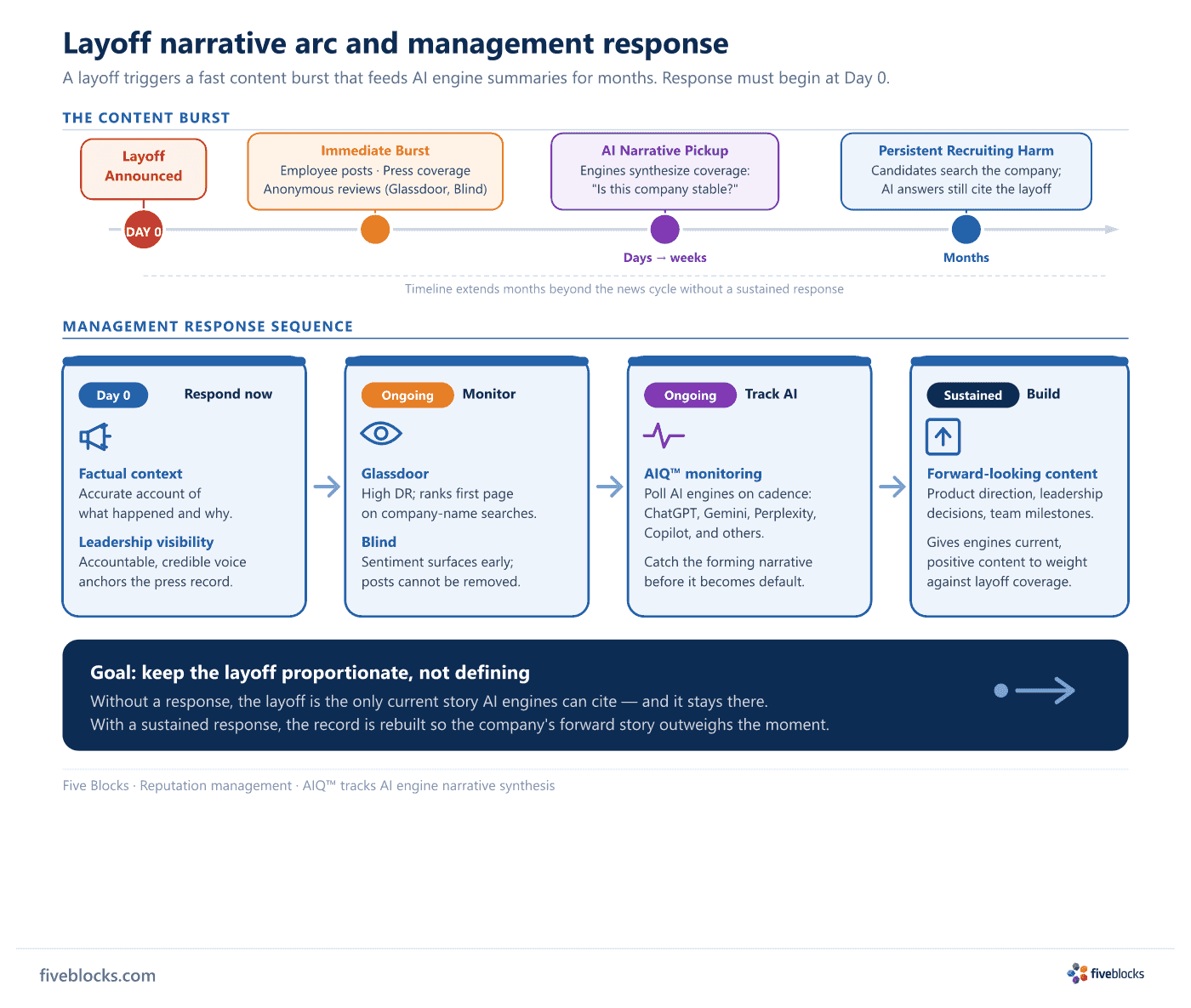
The response sequence
-
Lead immediately with factual context and visible leadership.
With no authoritative company voice, the loudest negative accounts define the story. A credible statement from a named leader, accurate about what happened and why, is the first and most time-sensitive move. It sets what the press and the AI engines have to work with from the moment the news breaks. -
Monitor Glassdoor and Blind closely.
This is where talent-market damage concentrates. Glassdoor has high domain authority and routinely ranks on the first page of company-name searches, so a forming cluster of negative employer ratings raises the cost of every subsequent hire. Blind sentiment often shows up before it reaches Glassdoor or recruiting outcomes, and companies cannot remove posts from Blind; the only lever is catching the signal early and responding where the platform allows. Both need a structured, credible engagement strategy. Suppression attempts rarely work. -
Track AI engine narratives with AIQ™.
AI engines pick up layoff coverage and can repeat it in answers to prompts like “is this company stable” or “should I work there” long after the news cycle has moved on. Monitoring those answers on a consistent prompt cadence across ChatGPT, Gemini, Perplexity, Copilot, and others shows what narrative is forming in the engines and where the source layer needs correcting or augmenting. -
Keep forward-looking content flowing.
Once the news cycle passes, search and AI engines weight the most current authoritative content they can find. Publishing substantive material on the company’s path forward, such as product direction, leadership decisions, and team milestones, gives them something current to set against the layoff coverage. The balance shifts over time. Skip this step and the layoff remains the most recent, most-cited account on the record.
Why the AI layer outlasts the news cycle
Press coverage lives on news domains and loses search prominence over time. AI engines draw from an archived source pool rather than the current news feed, so they can surface layoff content in answers to employer and stability prompts for much longer. Monitoring with AIQ™ is about catching that synthesis while it is still forming, before it hardens into the default answer a candidate or investor gets.
Last reviewed: 20/05/2026
