How should startups build reputation before they have significant media coverage?
Build the entity layer before the press exists. Put Organization and Person schema on your own properties from day one, keep Crunchbase and AngelList accurate and complete, and add founder thought leadership, structured case studies, and podcast appearances for early third-party signal. That gives AI engines accurate material to cite when the first real query arrives.
A startup with no press coverage is a near-empty entity to search engines and AI models. That is a problem and an opening at the same time: empty means inaccurate or missing, and it also means the founder writes the first draft. The work is to build the entity layer deliberately before the media catches up, in the order the engines use to assemble a picture of an entity.
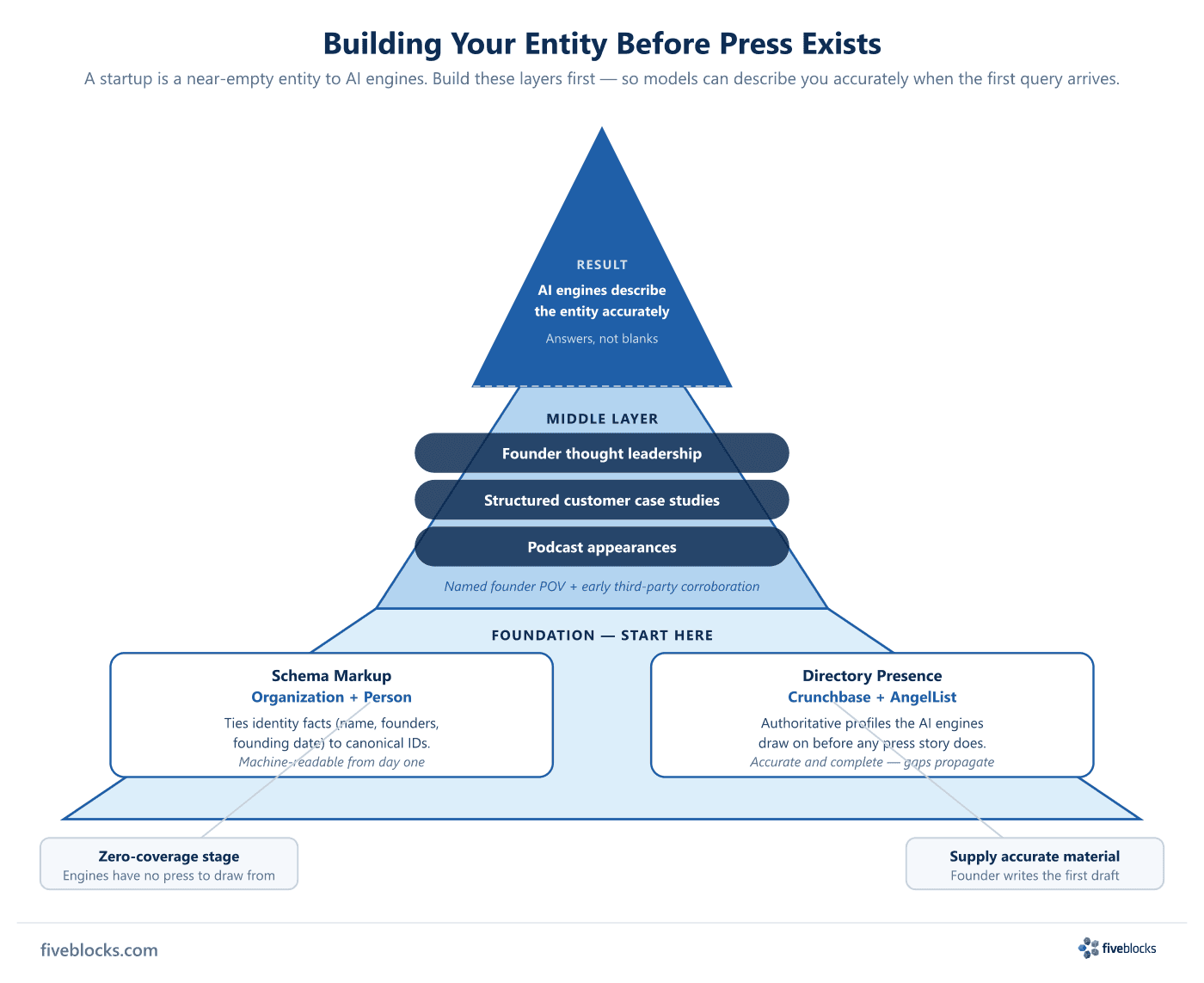
Step 1 (foundation): schema markup and directory presence
- Organization and Person schema from day one. Schema markup on the company’s own web properties ties identity facts (name, founding date, industry, founders, location) to canonical identifiers and makes them machine-readable. Without it, the engines have no structured signal to anchor to.
- Crunchbase and AngelList profiles, accurate and complete. These are the directories the tech and investor world treats as baseline facts. They are among the first sources AI engines draw on to describe an early-stage company, so gaps or errors here reach AI answers before any press story does.
- Purpose: gives AI engines reliable, structured facts to attribute to the entity while coverage is still at zero.
Step 2 (middle layer): founder thought leadership and early proof points
- Founder thought leadership, published and bylined, tied to the company. A bylined article or a documented point of view establishes that a named person with real expertise is building this company. Humans and AI engines can both attribute it.
- Structured customer case studies. Early customers willing to go on record supply the first citable third-party evidence that the product works and that real buyers trust it. AI engines extract a structured case study more readily than a general testimonial.
- Podcast appearances. AI engines ingest podcast content (transcripts, show notes, episode pages) as a source type. A founder who appears on an industry or investor podcast creates a citable reference that predates press coverage.
- Purpose: gives AI engines a named founder point of view and early third-party corroboration, so answers go beyond the bare entity facts.
Step 3 (result): AI engines can describe the entity accurately
- With the foundation and middle layer in place, a model asked “who is [Startup X]” or “what does [Founder Y] do” can answer accurately and with substance, drawing on the startup’s own structured signals, its directory presence, and early third-party cites, rather than returning a blank or a hallucination.
- Whoever supplies the engines with accurate material at this stage is the company a model can describe correctly when the first real query arrives from a prospective customer, investor, or partner.
Last reviewed: 20/05/2026
