How do media and entertainment companies manage executive reputation?
In media and entertainment, individual reputation drives deals and talent relationships, and the signal that carries the most weight is authoritative third-party coverage rather than self-description. A credentialed bio marked up with Person schema anchors the entity record, outside coverage from credible outlets supplies the proof the industry trusts, and AIQ monitoring of AI engine answers shows whether what dealmakers and talent see matches reality.
Media and entertainment runs on individual reputation: an executive’s standing affects which deals get done, which talent says yes, and which rooms they get into. Reputation work for executives here carries unusual weight, and the order of signals below follows how the industry forms its judgment.
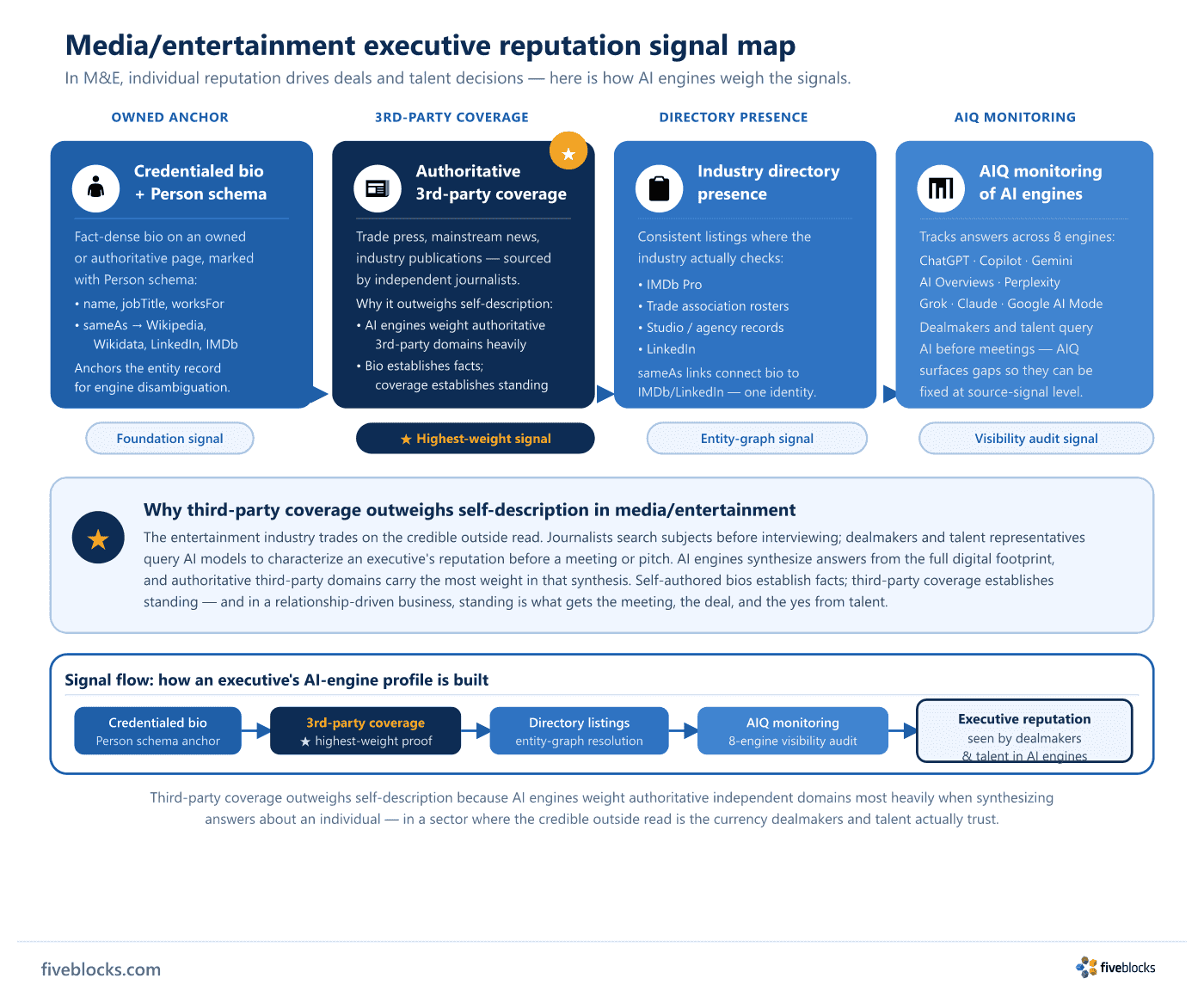
Foundation: credentialed bio with Person schema
- What it is
- An accurate, fact-dense executive bio on an owned or authoritative page, marked up with
Personschema, specifyingname,jobTitle,worksFor, andsameAslinks to Wikipedia, Wikidata, LinkedIn, and IMDb where applicable. - Why it matters
- Person schema with
sameAslinks connects the executive’s bio to their Wikipedia article and Wikidata Q-ID. That gives search and AI engines a disambiguation anchor for resolving the entity correctly across references. AI engines also weight content with credible, named authorship more heavily, because identifiable expertise is a trust signal.
Credible outside read: authoritative third-party coverage
- What it is
- Coverage in mainstream news outlets, trade press, and credible industry publications that describes the executive’s work, track record, and standing, written by journalists or editors independent of the executive.
- Why it outweighs self-description
- The entertainment and media industry trades on the credible outside read. Journalists search subjects before interviewing them, and AI engines weight authoritative third-party domains heavily when they synthesize answers about an individual. Self-authored bios establish facts; third-party coverage establishes standing. AI engines build answers from the full digital footprint, and third-party coverage is the signal that carries the most weight in that mix.
Industry directory presence
- What it is
- Consistent, accurate listings in the directories the industry actually checks: IMDb Pro, trade association rosters, studio and agency alumni records, and LinkedIn.
- Why it matters
- Directory facts feed the entity graph.
sameAslinks within Person schema can connect an executive bio to IMDb and LinkedIn profiles so engines resolve scattered references to one identity. Inconsistent directory data creates disambiguation failures that suppress or distort AI-generated profiles.
AIQ monitoring: tracking what AI engines say
- What it is
- Ongoing monitoring of how the eight AI engines AIQ currently tracks (ChatGPT, Copilot, Gemini, AI Overviews, Perplexity, Grok, Claude, and Google AI Mode) answer prompts about an executive’s reputation and track record.
- Why it matters in this sector
- Dealmakers, talent representatives, and journalists increasingly query AI models to characterize an executive’s reputation and recent history before a meeting or pitch. AI-driven due diligence is now standard practice on the buyer side of institutional transactions. That synthesized answer shapes how the executive is positioned in a relationship-driven business, and it can differ from engine to engine or lag behind recent developments. AIQ surfaces those gaps so they get addressed at the source-signal level instead of after the fact.
Last reviewed: 20/05/2026
