How does reputation management work for sports teams and entertainment properties?
Quick answer
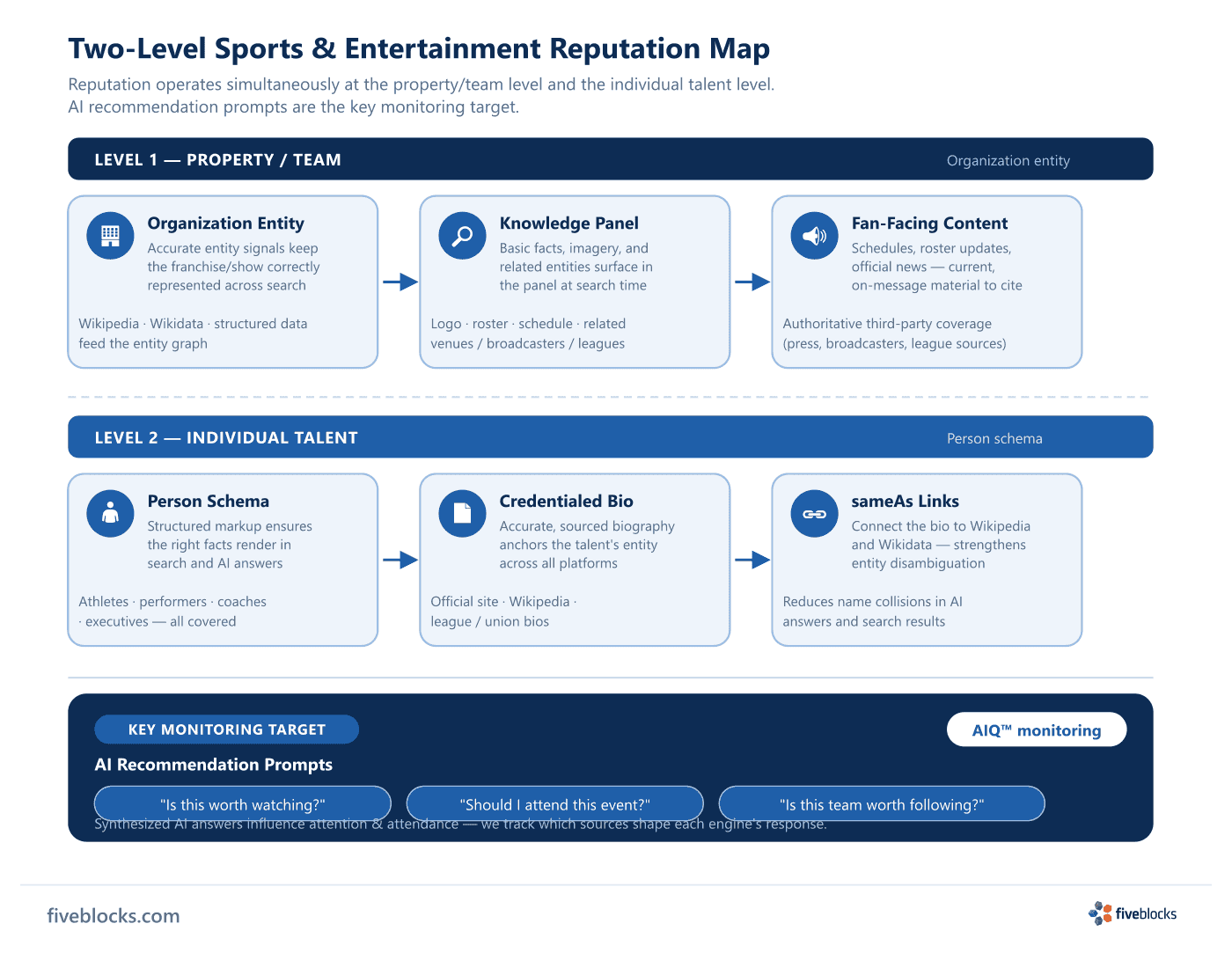
Sports and entertainment reputation runs at two levels: the property or team (Organization entity, Knowledge Panel, fan-facing content) and the individual talent (Person schema, credentialed bio). Both need active AI monitoring across recommendation and attendance prompts, because audiences now ask models what to watch, follow, or attend.
Sports teams and entertainment properties carry two reputations at once: the organization’s and the individual talent’s. Their audience now asks AI engines what to watch, follow, or attend. Reputation work has to run on both levels at the same time.
- Property and team level
- The franchise, show, or team is an Organization entity. Accurate entity signals keep it correctly represented across search and in the Knowledge Panel, where basic facts, imagery, and related entities appear. Fan-facing content (schedules, roster updates, official news) gives the engines current, on-message material to surface and cite. Authoritative third-party coverage from press, broadcasters, and league sources reinforces the entity, and in entertainment an outside voice carries more weight than self-description.
- Individual talent and principal level
- Athletes, performers, coaches, and executives are searched and described constantly. Accurate, credentialed bios marked up with Person schema put the right facts in front of search and AI answers.
sameAslinks connect the bio to a Wikipedia article and Wikidata entry where those exist, which helps the engines disambiguate the entity. - AI recommendation monitoring
- Audiences now ask models “is this worth watching,” “is this team worth following,” or “should I attend this event.” The synthesized answer shapes attention and attendance decisions the property never sees being made. We monitor those recommendation and review prompts with AIQ™ and track what each engine says and which sources are shaping the answer. That is where intervention is actionable.
Last reviewed: 20/05/2026
