How does reputation management work for consumer brands?
Quick answer
Consumer brand reputation is driven by reviews and sentiment: review platforms rank for the brand name and feed AI answers, social listening catches sentiment shifts early, and well-documented product and executive content gives shoppers and AI engines an accurate account. The behavior that decides purchases now is the recommendation prompt. Consumers ask models "what is the best X" or "is this brand good," and the synthesized answer steers purchases the way shelf placement once did.
Consumer brands are judged at scale by people forming quick impressions, so the work is built around the channels where those impressions accumulate.
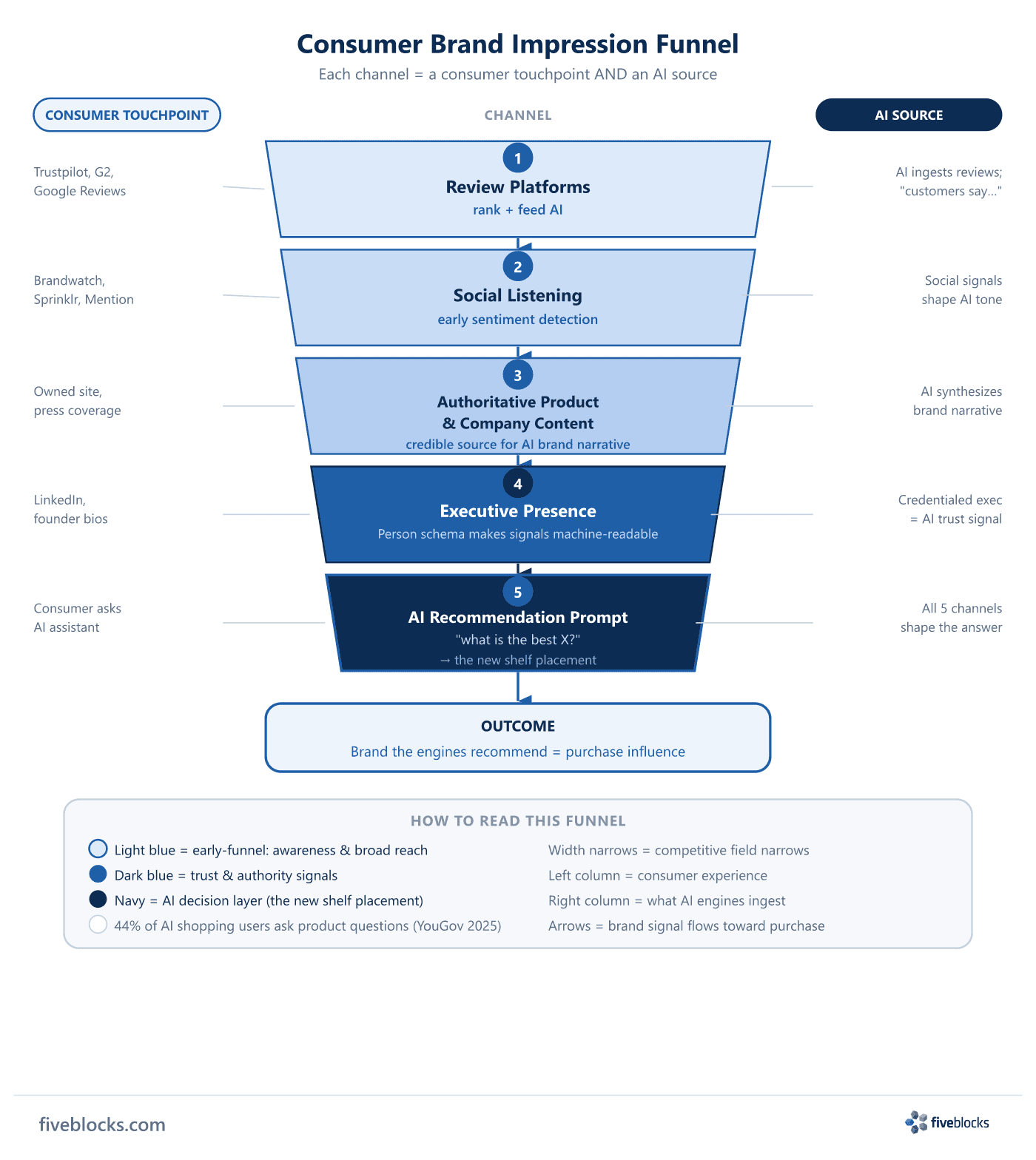
- Review platform management
- Review platforms come first for consumer brands because they rank prominently for brand-name searches and feed AI engine answers. Trustpilot pages rank on the first page of brand-name queries, and AI engines ingest Trustpilot and similar review content, then paraphrase recurring themes into confident summaries phrased as “customers say” or “common complaints include.” In practice the work is a structured response process, real remediation of the underlying issues, and steady effort to earn fresh reviews from satisfied customers so the body of evidence reflects the current product.
- Social listening
- Sentiment shifts usually show up here first. Consumer narratives move fast, and a brand often learns about a problem from social before it surfaces anywhere else. Tools such as Brandwatch, Sprinklr, and Mention track brand mentions, identify trending content, and detect sentiment shifts in real time.
- Product and company content
- Well-documented content on product quality, sourcing, and the company behind the brand gives shoppers and AI engines a credible account that reviews alone cannot supply. It is the layer the engines draw on when they assemble a brand narrative.
- Executive presence
- Executive visibility adds trust, particularly for founder-led brands where the founder’s credibility is part of the product story. Credentialed executive bios marked with Person schema make those signals machine-readable.
- AI monitoring on recommendation prompts
- The behavior that decides purchases now is the recommendation prompt: consumers ask models “what is the best X” or “is this brand good,” and the synthesized answer steers the sale. YouGov research (2025) found that product recommendations are among the top use cases for AI shopping assistants, with 44% of users getting answers to product questions. We monitor those prompts with AIQ™: being the brand the engines recommend accurately is the new shelf placement.
Last reviewed: 20/05/2026
