What is the role of Google Discover in reputation management?
Google Discover is a personalized mobile feed that surfaces content based on a user's search and browsing history. For reputation work, Discover is a downstream amplification channel, brand content can appear there when the underlying content is strong, but it cannot be directly targeted and matters less than AI Overviews and the Knowledge Panel as a primary reputation layer.
Discover is the personalized feed in the Google mobile app, and on the Google homepage in some configurations, that shows content the algorithm predicts a given user will engage with based on their Web and App Activity. For reputation work, Discover is a downstream amplification channel, not a primary layer. Brand content can reach relevant audiences through Discover, but the channel responds to content quality, not to direct targeting.
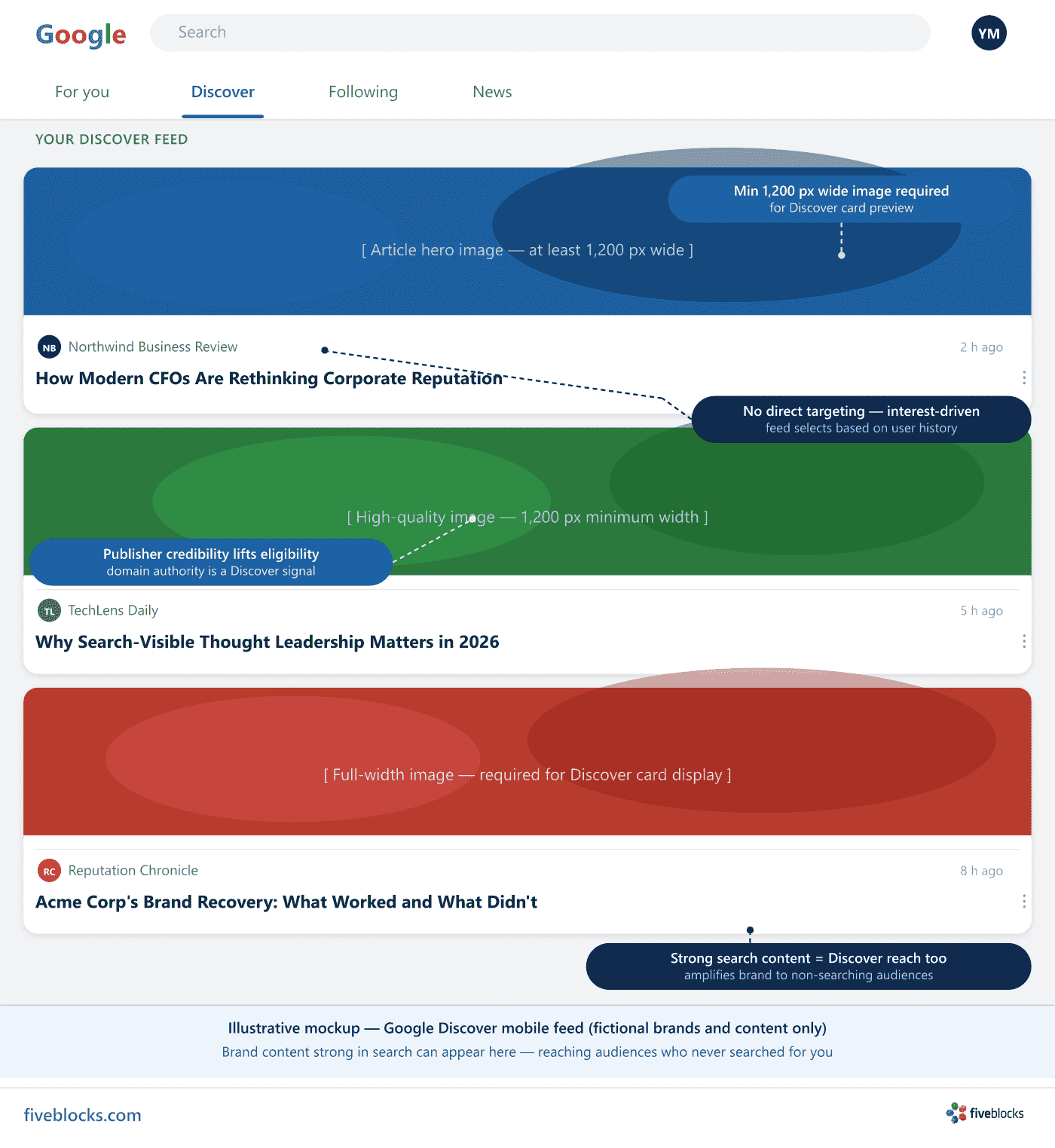
What Discover is and how it works
Standard search is query-driven; Discover is interest-driven. Google’s systems use a user’s Web and App Activity to predict which content they will find relevant, and the feed shows that content without the user searching for it. The pool of eligible content comes from the broader indexed web, not from a separate submission system. There is no way to target a specific user segment or guarantee that content appears in the feed.
Why it matters for reputation work
When brand content already performs well in standard search, Discover can extend its reach to audiences who did not search for the brand but whose interest profile matches the content. A company that has published strong thought leadership, earned credible coverage, or produced high-quality video or article content gets additional impressions from Discover at no additional content cost. Its reputation weight is modest next to deliberate primary-layer work. AI Overviews, the Knowledge Panel, and branded SERP composition shape the first impression for people who are actively researching the brand; Discover adds to total exposure when the underlying content qualifies.
Content signals tied to Discover eligibility
Google’s own guidance names a few factors tied to Discover eligibility: content must be indexed (the basic crawl-and-index requirement), mobile-friendly, and timely or evergreen depending on how the algorithm scores interest fit. High-quality images help the visual presentation in the feed, and Google specifies a minimum width of 1,200 pixels for image previews. Beyond these documented requirements, Google does not fully disclose the combination of signals that drives Discover selection (engagement history, domain trust, content-type weighting). Treat claims that specific schema types or credentialing patterns reliably predict Discover appearance as practitioner hypotheses, not verified mechanisms.
How to run Discover in a reputation program
Keep brand content broadly qualified for Discover, mobile-optimized, fast-loading, properly structured, published on credentialed domains, rather than building a Discover-specific content track. Content that earns featured snippets, AI Overview citations, and strong branded SERP positions will generally be Discover-eligible too. Discover is a bonus channel when the underlying program is strong. It is not a substitute for primary entity-layer and source-layer reputation work.
Last reviewed: 19/05/2026
