What is Google’s approach to the right to be forgotten?
Google's right to be forgotten (RTBF) is a delisting remedy, not a deletion remedy, available only in EU/UK jurisdictions: a successful request removes a URL from Google search results for queries on your name but leaves the underlying article intact, accessible directly, and indexable by other search engines. Eligibility requires the content to be inaccurate, inadequate, irrelevant, or excessive relative to its original purpose, weighed against public interest, and public figures and matters of ongoing public concern face high hurdles.
Google’s right to be forgotten (RTBF) is often misunderstood. It is a delisting remedy, not a deletion remedy: a successful request causes Google to stop returning the URL in EU/UK search results when someone searches your name, but the underlying article stays online, remains directly accessible via its URL, and stays indexed by other search engines and by Google for searches other than your name.
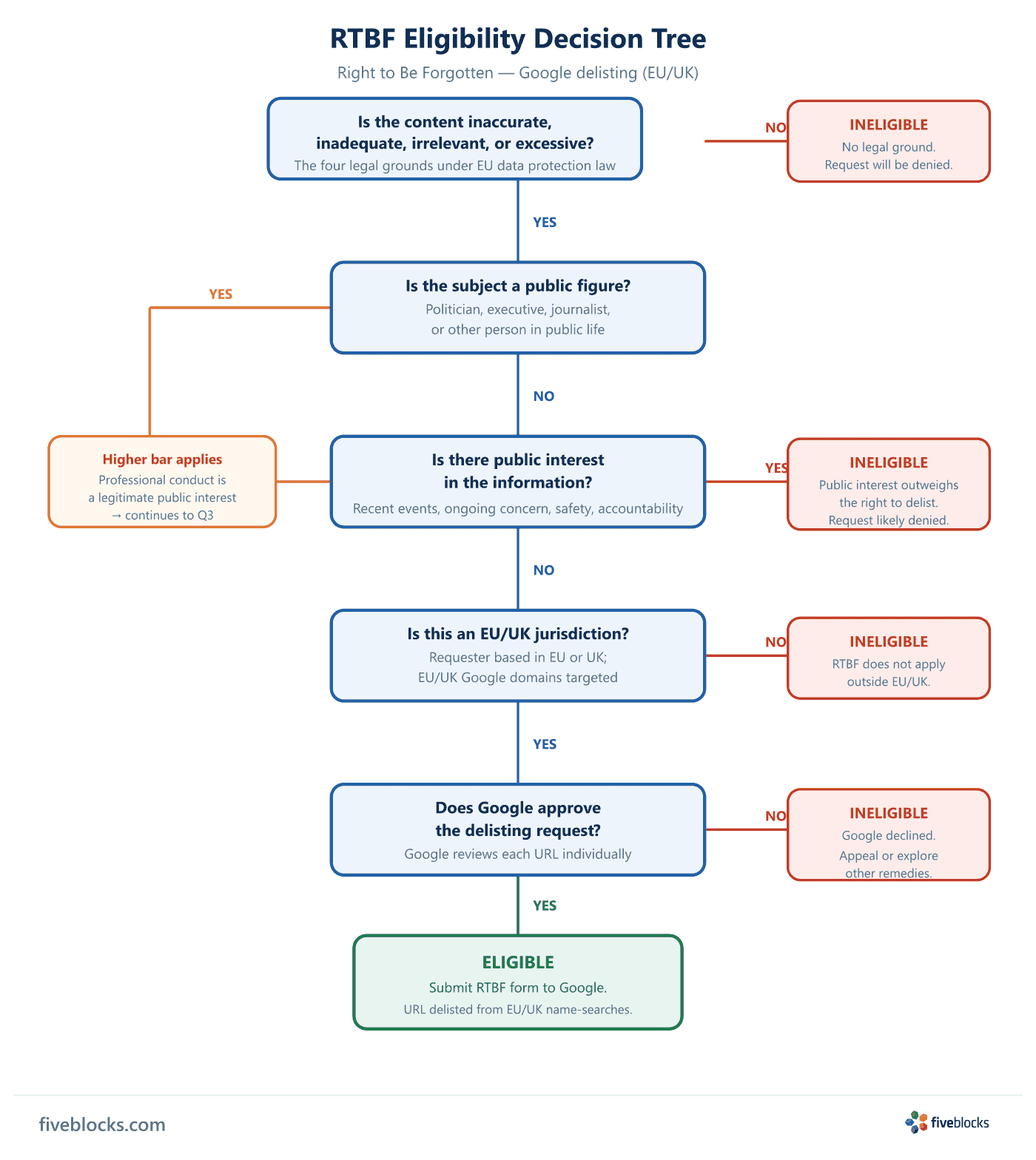
Who can make an RTBF request
- EU/UK individuals can submit RTBF requests under European data protection law. The mechanism is not available for US-only situations.
- Private individuals generally have stronger claims than public figures. Journalists, politicians, executives, and others who have voluntarily entered public life face a higher bar, because their professional conduct is a legitimate matter of public interest.
- The request must be made by, or on behalf of, the individual named in the content, not a company or brand.
Eligibility criteria
Google weighs each request against a legal standard. To qualify, the content must be one or more of the following relative to the purposes for which it was originally processed:
- Inaccurate, factually wrong or misleading
- Inadequate, insufficient or out of context
- Irrelevant, no longer pertinent given the passage of time or change in circumstances
- Excessive, disproportionate to the legitimate aim served
Even where one of these grounds applies, Google weighs it against the public interest in the information staying accessible. Recent matters, ongoing stories, and content about public figures in their public roles routinely fail this test.
What a successful request achieves, and what it does not
- Google will delist the URL for name-based searches in EU/UK Google versions (e.g., google.fr, google.co.uk).
- The content stays on the publisher’s website and can be reached directly.
- Other search engines (Bing, DuckDuckGo, etc.) are unaffected.
- Google’s own index for non-name searches is unaffected, so the article may still surface for topic-based queries.
- Google.com and non-EU/UK versions of Google are generally not covered.
How to submit a request
- Gather the specific Google search URLs (not article URLs) where the content appears when your name is searched.
- Identify the legal basis: state which criterion, inaccurate, inadequate, irrelevant, or excessive, applies and explain why.
- Submit via Google’s official RTBF form at support.google.com/legal/answer/10769224.
- Google reviews each URL individually. Complex or borderline cases may require additional information or escalation.
Realistic expectations
RTBF is a targeted, case-by-case mechanism, not a broad content-removal tool. The strongest candidates are private individuals, outdated information with no continuing public relevance, and content that contains verifiable factual errors. It is rarely the right primary tool for public figures or for recent events. Where the criteria genuinely fit, RTBF can be one part of a wider reputation program, but it should not be your default first move.
Last reviewed: 19/05/2026
