How long until the reputational damage subsides?
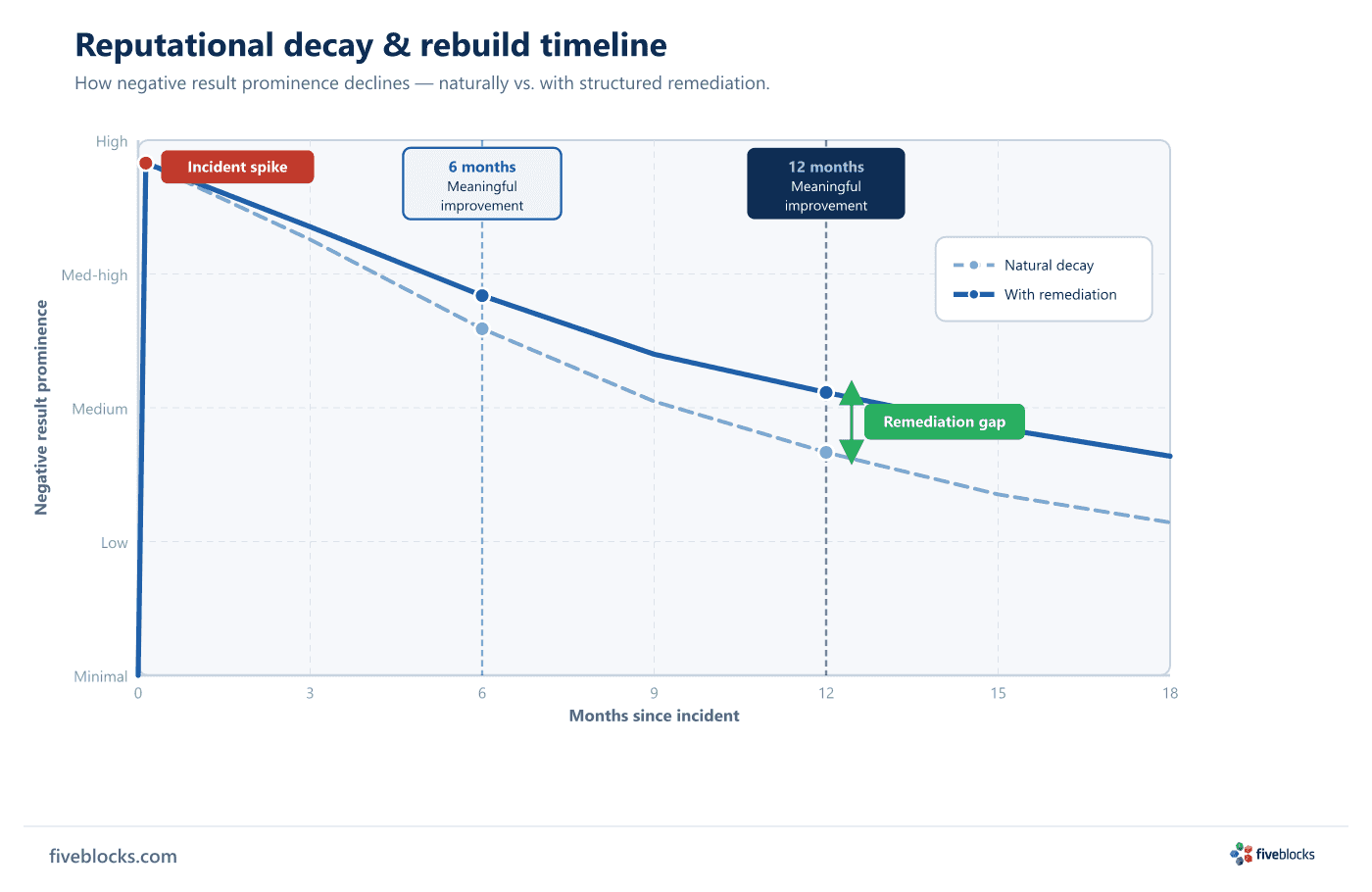
Reputational damage does not resolve on a fixed schedule. Freshness signals on a negative article decay over time, but an unaddressed major-outlet piece can hold a prominent search position for years. Remediation (authoritative content, entity-layer corrections, source-level fixes) speeds up the natural decay. How fast depends on the source's authority, whether the content is factually contestable, and how sustained the program is.
Reputational damage does not subside on a clock. It subsides as the authoritative content around it accumulates, as Google’s freshness signals on the negative article decay, as source-level corrections take effect, and as the entity layer reasserts the correct picture across search and AI engines. The question is not when a clock runs out but which lever moves the curve fastest in a given situation.
What drives the timeline
- Source authority. A Wall Street Journal article from this month is harder to displace than a regional blog from 2019. Higher domain authority means more durable ranking, and Google’s own systems weight authority and entity recognition heavily when ranking results about a specific subject. An unaddressed major-outlet negative article can hold a page-one position for years without active remediation.
- Freshness signal decay. Google runs freshness systems that favor newer content for news-type queries. Over time, the freshness component of a negative article’s ranking fades. New authoritative positive content speeds that up by competing for the same query with stronger recency signals.
- Factual contestability. Clear inaccuracies can be corrected at the source (most major publications have correction policies) or addressed through entity-layer fixes (Wikidata, schema, Knowledge Graph). Unflattering but accurate coverage has to be displaced rather than corrected, which takes longer.
- Remediation structure and continuity. Programs that hold up run long enough for the work to build on itself. A single content push rarely moves a high-authority negative result; a sustained authority-building program does. The IMPACT platform tracks page-level SERP position changes daily across keywords, so the trajectory shows up in real data rather than an estimate.
How “meaningful improvement” is measured
Meaningful improvement is concrete, not impressionistic. The main signal is SERP composition: does the negative result drop from a top-three position to a lower spot on page one, or off page one entirely? This matters because over 96% of organic clicks go to positions one through ten (page one) and less than 1% reach page two. A result moving from position 2 to position 8 is a real reduction in stakeholder exposure even before it leaves the page. Secondary signals: the negative result’s share of a branded SERP narrowing as more positive or neutral results accumulate; correction status at the source outlet; and, where AI engine narratives are tracked (via AIQ), whether the content still appears in AI-generated summaries about the subject.
What the evidence supports on timing
The industry commonly cites a 6 to 12 month improvement window, and that range reflects real field experience across remediation programs. But no published third-party study provides a controlled baseline for the figure; it is an observed range, not a clinical measurement. The honest version: lower-authority negative sources and contestable facts often show SERP composition shifts in weeks to a few months, while high-authority outlets, ongoing news cycles, or accurate rather than contestable content can take much longer. Severity, authority, and remediation investment each move the curve on their own.
Last reviewed: 19/05/2026
