How does Google treat news articles differently from other content?
Google handles news content separately: the News index, top stories carousels, news image boxes, and AI Overviews give fresh articles from major outlets elevated ranking signals. A single negative piece can hold the news section of a branded SERP for two to six weeks, so the response that works is authoritative competing coverage from comparable outlets plus source-level corrections where reporting is inaccurate.
Google handles news content on a separate track. Articles from outlets in the Google News index carry elevated freshness signals, can surface in top stories carousels, appear in news image boxes on branded SERPs, and feed into AI Overviews as primary sources. Each of these placements pushes their visibility past what standard organic results reach.
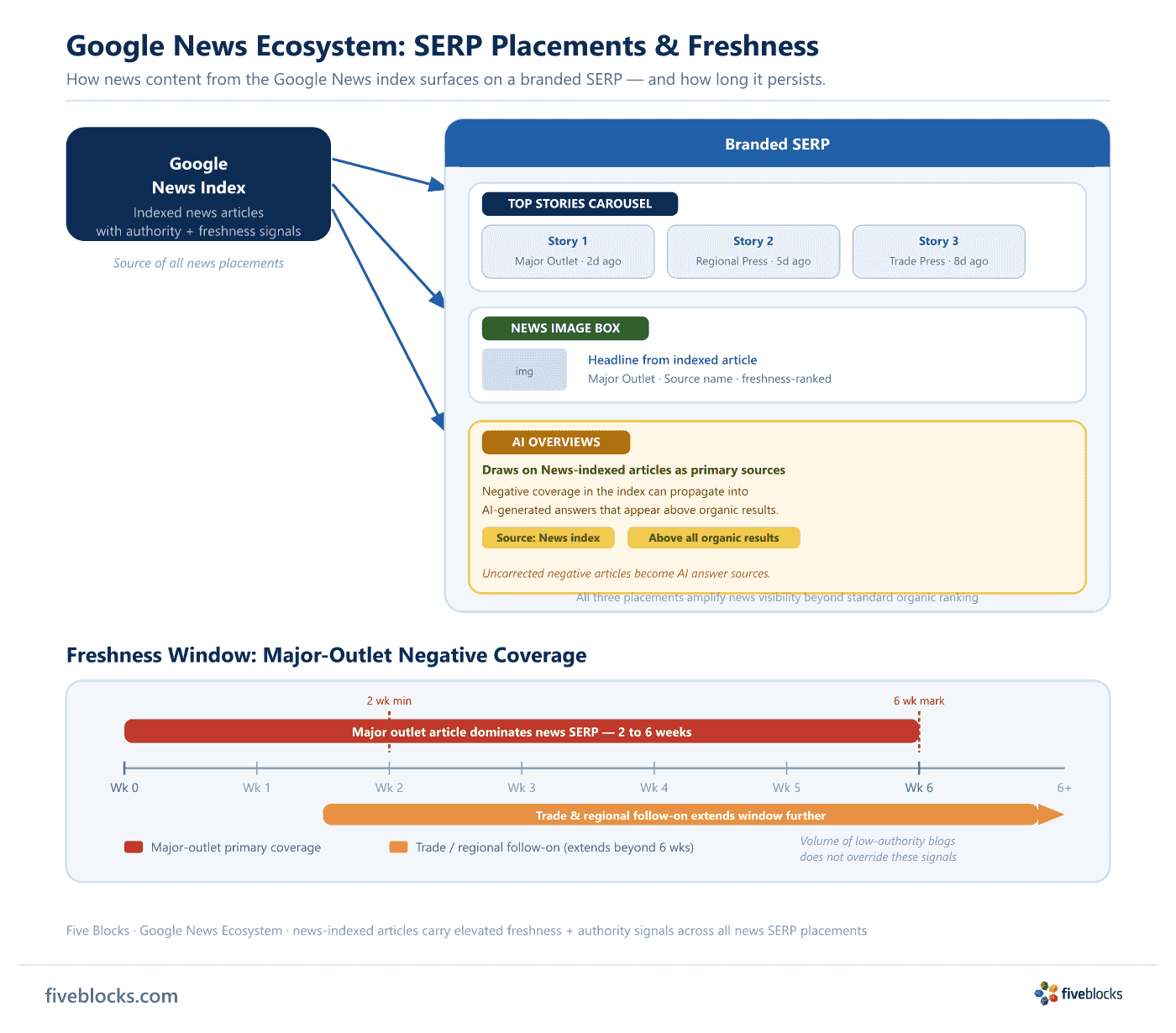
How long negative news coverage persists
A single article from a major outlet on a developing story can hold the news component of a branded SERP for two to six weeks. That window is not fixed. Trade press and regional outlets that pick up the original story extend it as their own freshness signals layer in. The same signals that elevate news coverage also define how to shift it: Google’s News placements weigh source authority, so authoritative competing coverage and source-level corrections move the record where publishing volume alone does not.
Why there is no shortcut
- Freshness signals decay on their own schedule. New coverage from comparable sources can displace old coverage, but only when those sources carry equal or greater authority in Google’s ranking.
- Source-level corrections matter. Where original reporting contains documented factual errors, a formal correction request to the outlet is the most direct way to change what Google indexes and surfaces. Accuracy counts more than quantity here.
- AI Overviews inherit the news record. Because AI Overviews draw on News-indexed articles as primary sources, uncorrected negative coverage can carry into AI-generated answers that sit above all organic results.
What a durable response requires
- Sustained authoritative competing content from outlets Google treats as comparable in standing to the original source.
- Source-level remediation where the original reporting contains factual errors that justify a correction request.
- Time for the freshness signals on the negative coverage to decay while new authority signals build on competing content.
The news track responds to source authority and freshness. The work is to build authoritative competing coverage from outlets Google treats as comparable and to pursue corrections where the original reporting is factually wrong, rather than chasing publishing volume from sites Google does not rate as comparable. This is the kind of program Five Blocks runs: identifying which sources carry weight in a given news vertical, developing and placing credible competing content, managing documented correction requests, and monitoring News placements and AI Overviews over time so the response tracks how the coverage decays and shifts.
Last reviewed: 19/05/2026
