How should an executive manage their reputation when serving on multiple boards?
Each board seat needs its own accurate representation across the digital layers: Person schema on the executive's bio that links every role to its Organization, a current LinkedIn covering all seats, an accurate Wikipedia article where one exists, and consistent canonical descriptions plus sameAs links so search and AI engines attribute each role correctly instead of conflating them.
An executive who sits on multiple boards has a representation problem that engines do not solve on their own. Each seat carries its own context, its own organizational counterpart, and its own set of stakeholders. When the underlying entity infrastructure is thin, search and AI engines can blur or conflate those distinct roles. The fix is structural: it runs at the entity layer, not in messaging.
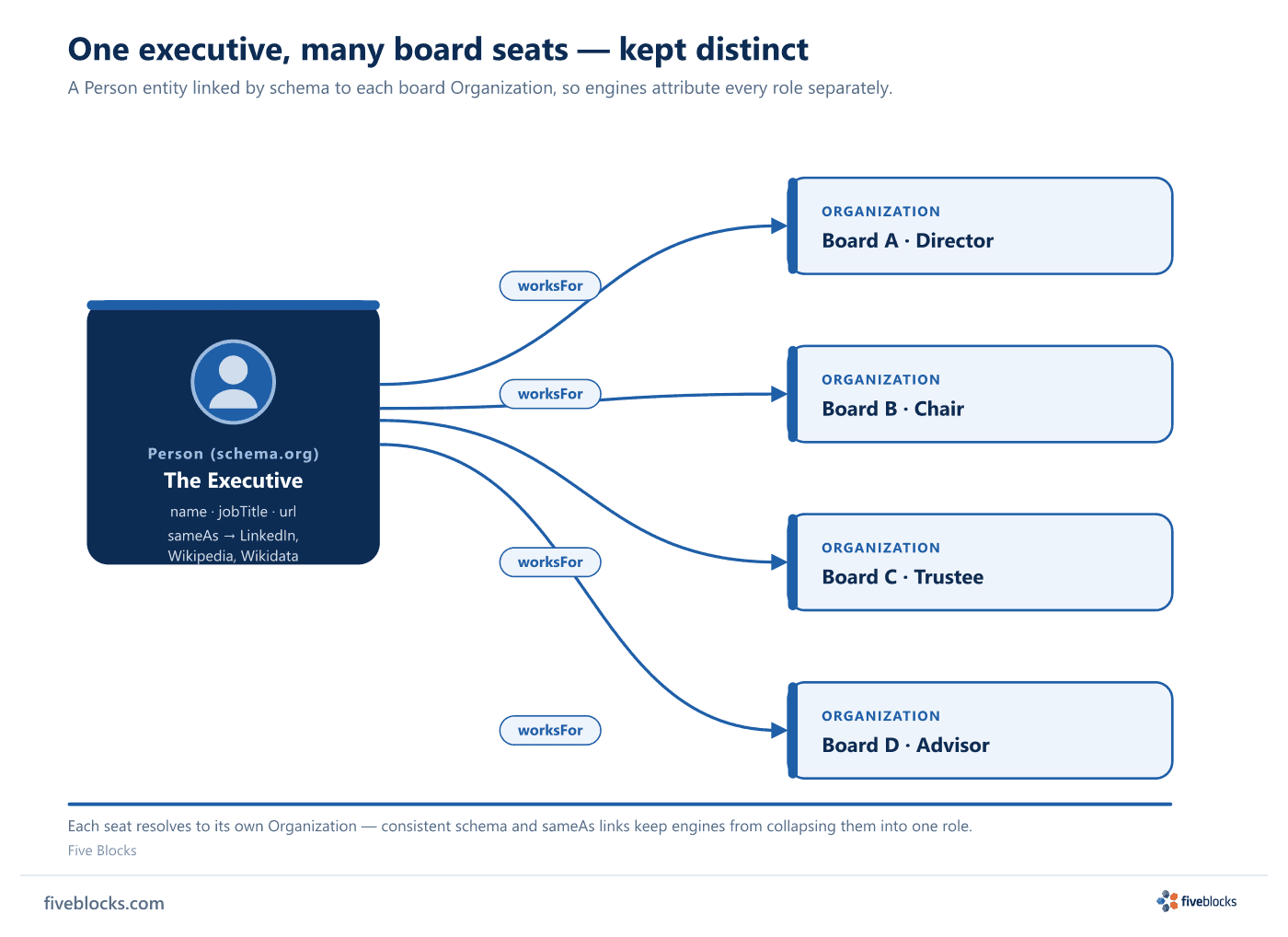
The entity-layer moves
- Person schema that links every role to its Organization. The
Personmarkup on the executive’s primary bio usesworksForto point at the canonicalOrganizationentity for each seat, so each affiliation is declared rather than inferred. - A current LinkedIn across all seats. The experience section lists every board role and stays consistent with the bio.
- Wikipedia in proportion. Where an article exists, it covers each role in proportion to its significance, maintained under disclosed conflict-of-interest rules.
- sameAs links to each organization’s properties.
sameAsties the executive’s identity to the authoritative anchors (LinkedIn, Wikipedia, Wikidata) and to each organization, telling engines that the scattered references describe one person across several roles. - Monitoring per role. AIQ topics configured for each role let the comms team see how each seat is being represented across the AI engines.
Why the structure matters
Engines will not assume that a website, a LinkedIn page, a Wikidata entry, and several press profiles all describe the same person unless signals such as consistent descriptions and sameAs links say so. When those signals are weak, same-named or multi-context entities get confused or conflated. Reliable resolution depends on sameAs structured links, consistent attributes across every reference, and strong authoritative anchors like Wikipedia and Wikidata. With that infrastructure in place, engines attribute the executive correctly across the full portfolio of seats instead of collapsing them into a single role.
Last reviewed: 19/05/2026
