How do you manage the reputation of a founder who has stepped back from day-to-day operations?
Update Wikipedia and the entity signals for the founder's current role, refresh authoritative content tied to the new activities (advisory, philanthropy, board work, speaking), and monitor how AI engines describe the founder so the narrative tracks the step-back instead of staying anchored to the operational years.
A founder stepping back from operations is a common transition, and it needs the same entity discipline as a full retirement, calibrated to the role the founder is moving into. The work has three parts: reset the signals for the new chapter, keep the authoritative record current with what the founder is doing now, and watch how AI engines describe the founder so the narrative tracks the step-back instead of freezing on the operational period.
Calibrate to the role the founder is moving into
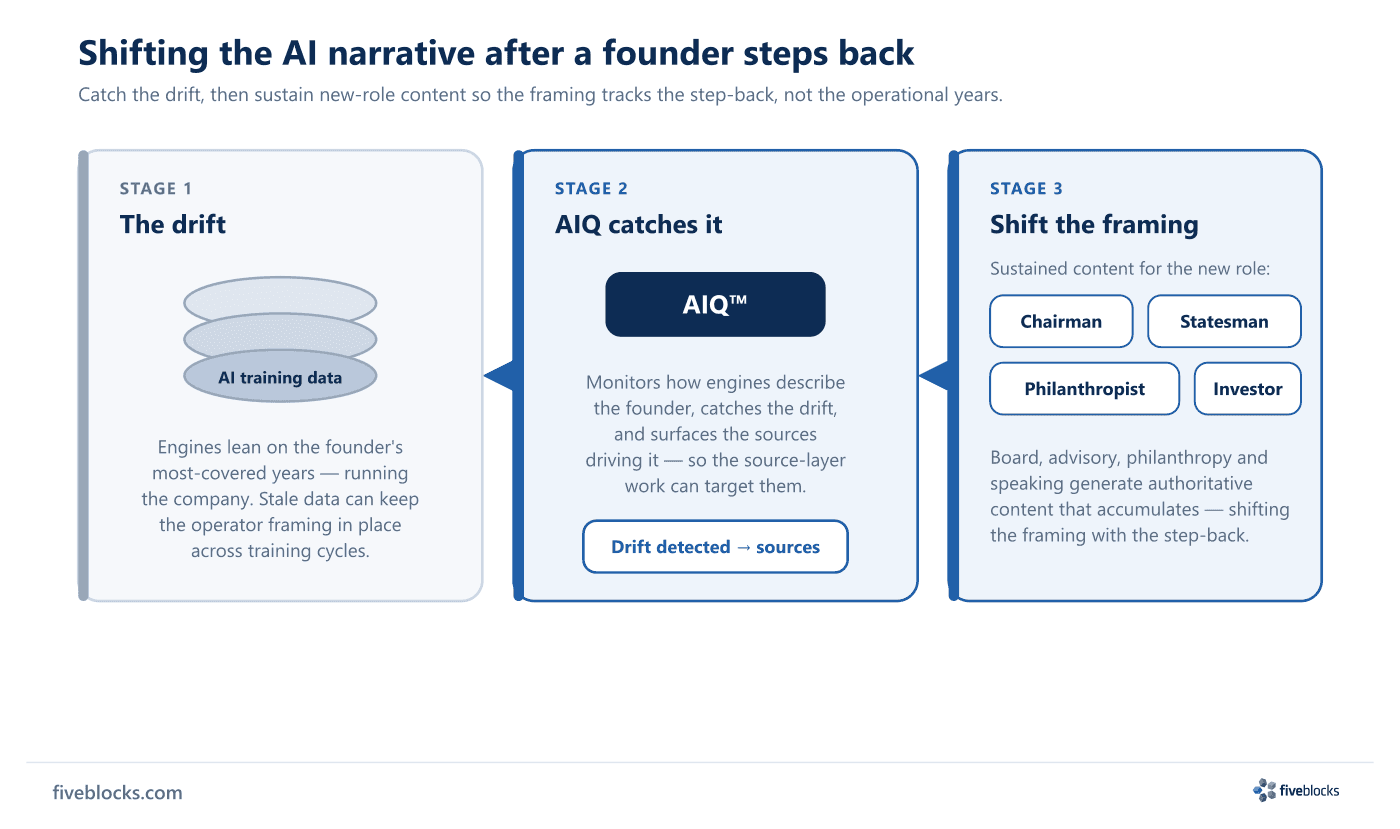
Step-back is rarely a clean exit. Founders usually move into a defined new role: chairman, elder statesman, philanthropist, investor. The reputation work supports whichever framing applies. Update the entity signals (Wikipedia, Wikidata, corporate or personal bio, LinkedIn, Knowledge Panel attributes) to reflect the current role, and keep Wikipedia and Wikidata consistent with each other, since they describe the same underlying entity to the engines that query them.
Keep the record current with the new activities
The ongoing work follows what the founder actually does in the new role: board contributions, advisory engagements, philanthropic activity, and public speaking on the company’s legacy and the founder’s continuing perspectives. Pursued substantively, each of these produces authoritative content, and that content accumulates into a current record instead of one frozen at the operational period.
Why AI-narrative monitoring matters here
AI engines tend to lean on a figure’s most-covered periods, which for most founders are the years they ran the company. Training data has a cutoff and can go stale, so an engine can keep describing the founder in operational terms after the step-back, and that framing becomes outdated or misleading. Uncorrected information of this kind can persist across training cycles. AIQ monitoring catches that drift across the AI engines it tracks and surfaces the sources driving it, so the source-layer work can target them. Sustained authoritative content in the new contexts is what supports the framing the founder is moving into: chairman, statesman, philanthropist, investor.
Last reviewed: 19/05/2026
