How do you handle an executive’s digital reputation after they retire?
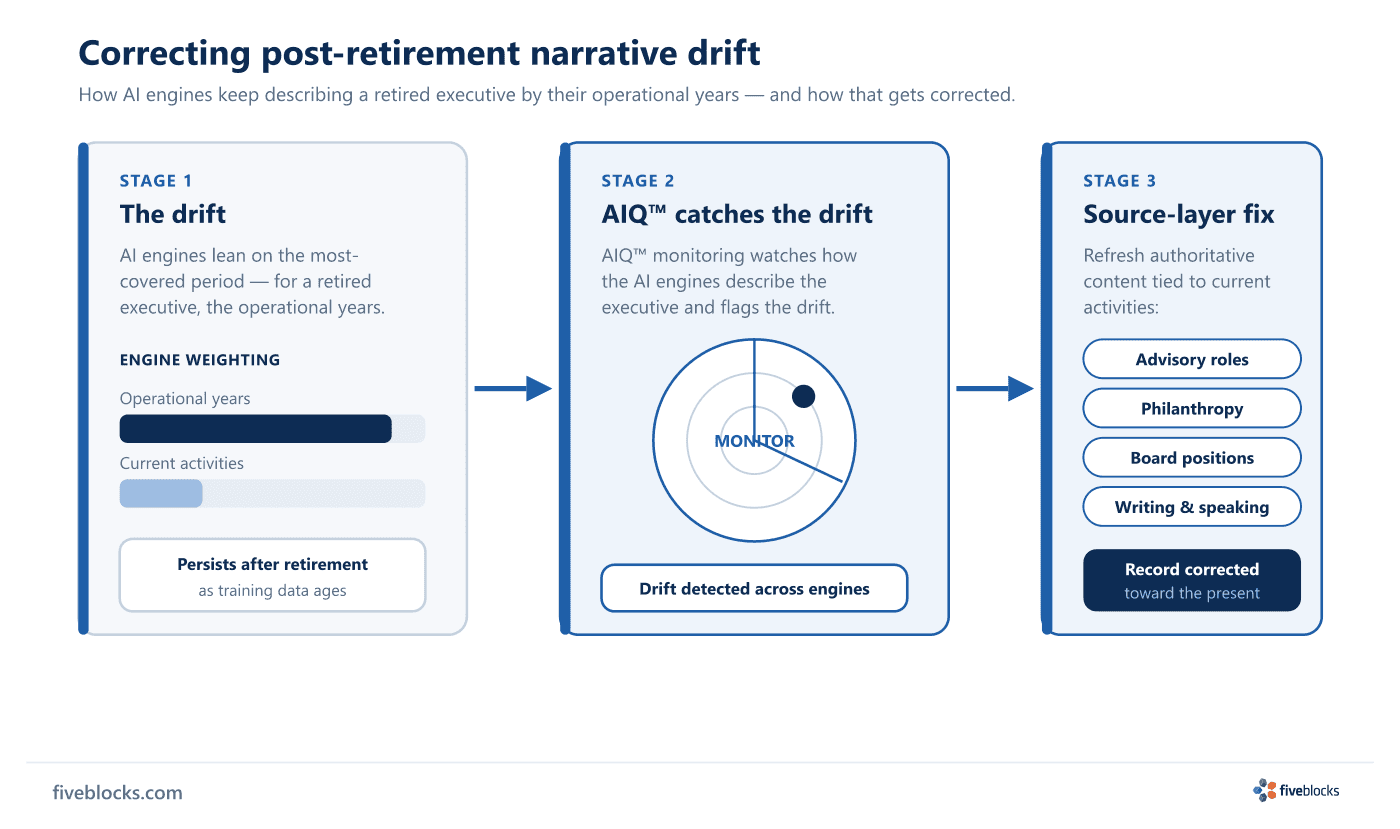
Update the entity signals to reflect retirement, make sure Wikipedia and Wikidata cover the full career, refresh authoritative content tied to current activities (advisory, philanthropy, board roles), and monitor the AI narrative, which can drift toward the operational years as training data ages.
Post-retirement reputation work is lighter than active-executive work, but it has its own discipline. Three things need doing: update the entity signals for the new stage, keep the authoritative record current with what the executive is actually doing, and watch how AI engines describe the executive so the narrative tracks the present instead of the operational years.
The transition: update the entity signals
A few one-time moves reset the executive’s signals for retirement:
- Wikipedia and Wikidata updated to reflect retirement, with proper sourcing on the timing. The two are linked through the same underlying entity, so structured attributes stay consistent across engines that query them.
- Corporate bio updated or migrated to a personal site.
- LinkedIn updated to the current role.
- Knowledge Panel attributes reviewed and refreshed.
The ongoing work: keep the record current
Retirement is rarely inactivity. The ongoing work follows whatever the executive is actually doing: advisory roles, philanthropic work, board positions, writing, speaking. Pursued substantively, each of those generates authoritative content, and that content keeps the record current instead of frozen at the operational period.
Monitoring the AI narrative
AI engines tend to lean on an executive’s most-covered periods, which for most retired executives are the operational years. The risk in practice is that engines keep describing the executive in operational terms well after retirement, a framing that can become outdated or misleading. AIQ monitoring is built to catch that drift across the AI engines it tracks, and source-layer work then corrects it over time by refreshing the authoritative content the engines draw on.
Last reviewed: 19/05/2026
