How do you manage reputation for an executive who is being recruited for a board seat?
Get the candidate's public record accurate before candidacy starts: a complete, current LinkedIn; a corporate bio with Person schema; an accurate Wikipedia article written to NPOV where one exists; and a Knowledge Panel with the right role and affiliations. Add an AIQ audit of how the major AI engines describe the candidate, so factual errors are corrected before a reviewer sees them.
Several parties read a board candidate’s public record during candidacy: the nominating committee, the search firm if one is involved, the proxy advisors who assess the slate, and sometimes large institutional investors. Much of that diligence now happens online. Since the reviewers consult the same surfaces, the goal is to make those surfaces accurate and consistent before candidacy rather than during it.
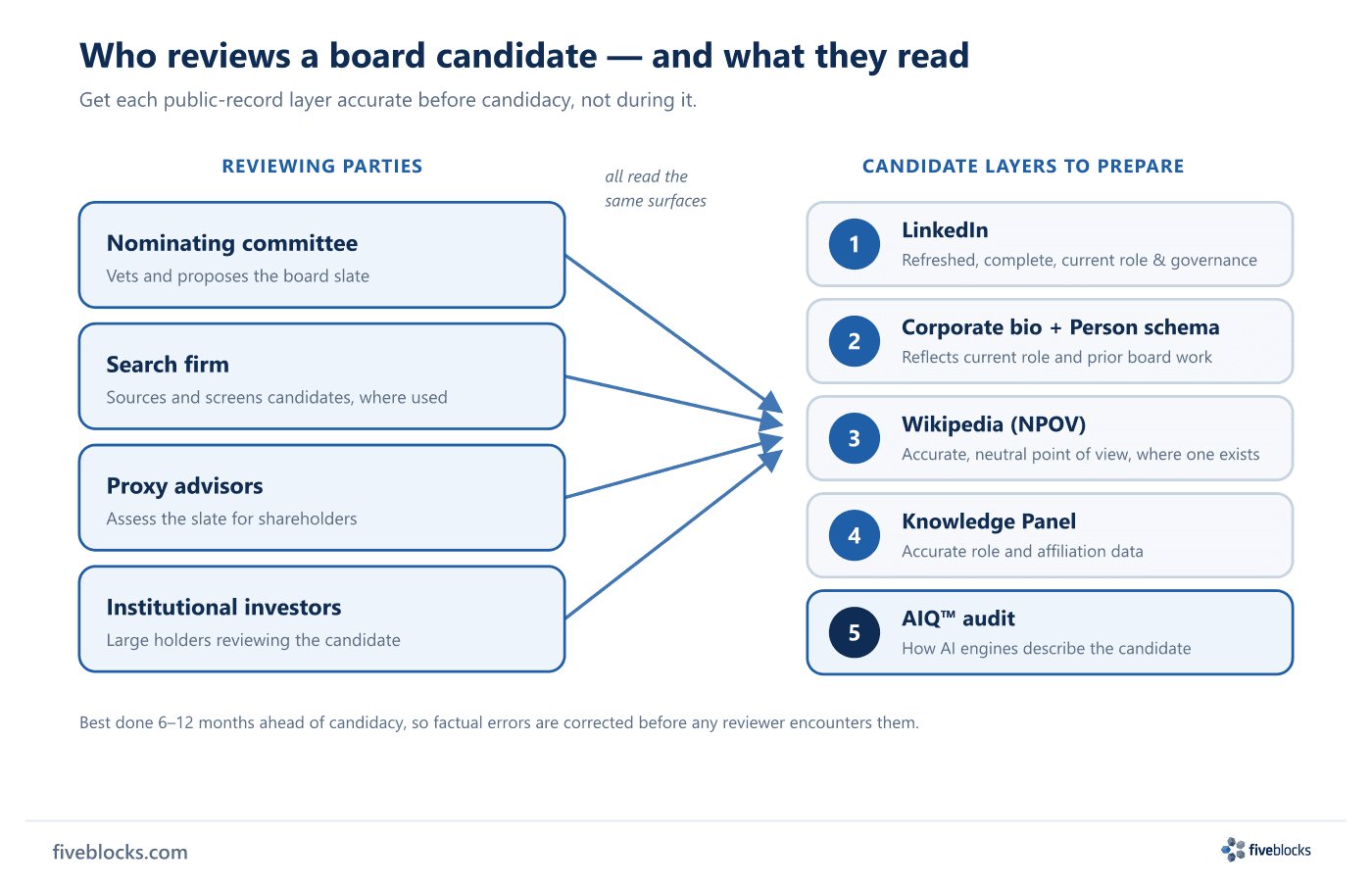
The candidate layers to prepare
- LinkedIn, complete and up to date, with the current role and any prior governance experience stated clearly.
- Corporate bio with Person schema, stating the current role and any prior board or governance experience.
- Wikipedia (where one exists), accurate and written to a neutral point of view (NPOV), with extra care on anything a proxy advisor might raise.
- Knowledge Panel, current, with accurate role and affiliation data. Google states that knowledge panels are automatically generated and that the information in them comes from various sources across the web, so accuracy depends on the underlying public record being right.
- AIQ audit, a review of how each major AI engine describes the candidate, aimed at factual errors or misattributions that can be corrected ahead of time.
Timing
Do this work six to twelve months before an anticipated candidacy. On a compressed timeline, whatever infrastructure already exists sets the ceiling on what can be fixed.
Practices vary. Some search firms describe using AI tools in early screening, which is a reason to keep AI-engine narratives accurate, though not a universal rule.
Last reviewed: 19/05/2026
