How do executive transitions create reputation risk?
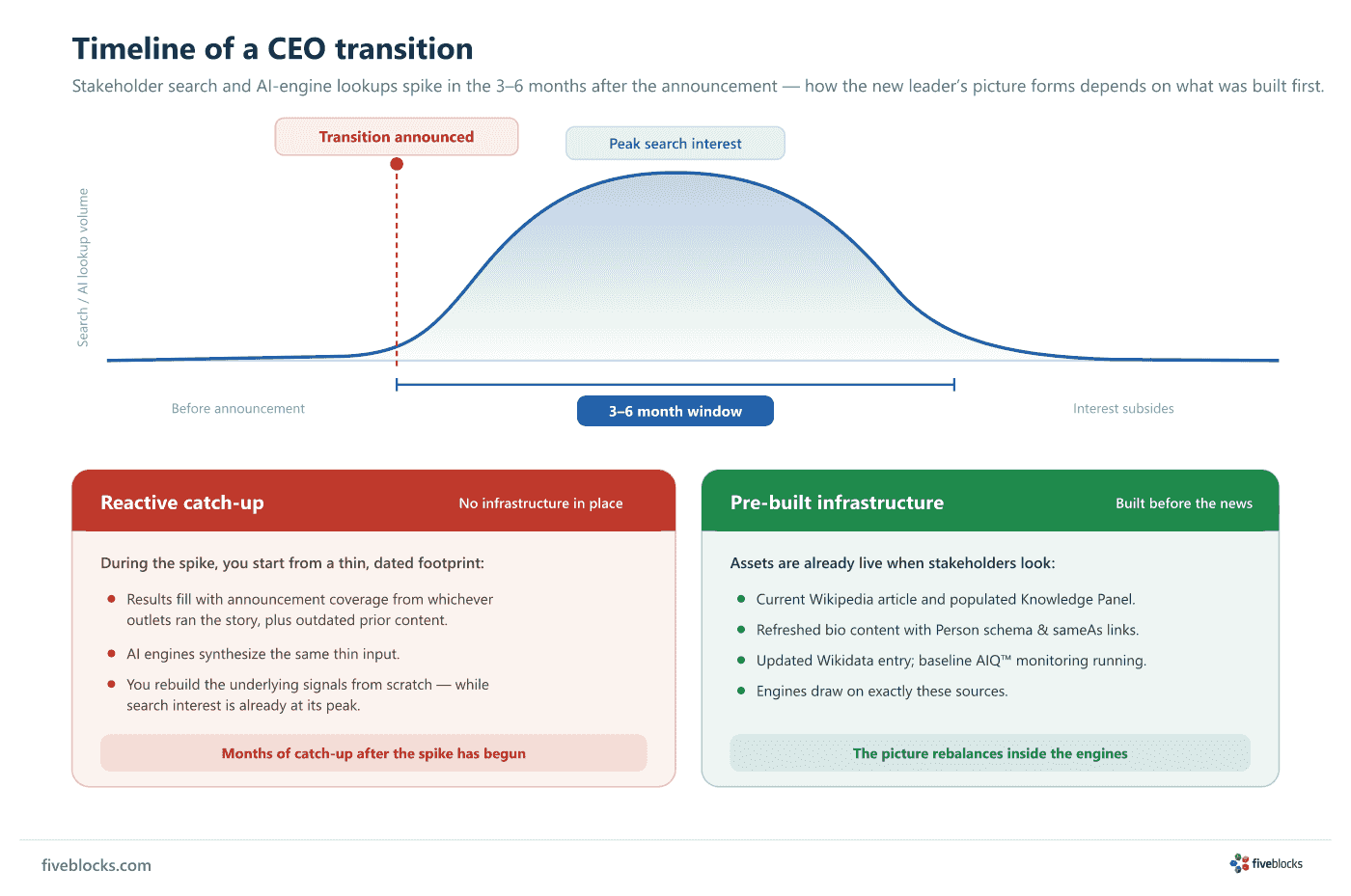
An executive transition concentrates search and AI-engine activity into a short window after the announcement, when stakeholders repeatedly look the new leader up and the engines synthesize whatever sources exist. Pre-transition infrastructure - an updated Wikipedia article, a current Knowledge Panel, and refreshed bio content with schema and sameAs links - lets that picture rebalance inside the engines instead of being rebuilt through months of reactive catch-up.
An executive transition concentrates press coverage and search activity into a few months, so the period right after an announcement is when the new leader’s digital picture is most exposed and easiest to move. Whether that picture forms from a thin, dated footprint or from prepared infrastructure is mostly decided before the news breaks.
Why the window matters
In the weeks after a transition is announced, the people who most influence outcomes – investors, journalists, employees, recruiters, and counterparties – look the new executive up, often more than once. Journalists almost always research a subject online before making contact, and investors and counterparties increasingly run AI-assisted diligence as part of that review. They read two surfaces in parallel: the Google results page and the major AI engines, which build an answer from whatever digital footprint already exists, weighted by authority and recency.
Reactive catch-up vs. pre-built infrastructure
- Without pre-transition infrastructure, the early results page fills with announcement coverage from whichever outlets ran the story, plus whatever existed before about the executive, which is often outdated. The AI engines draw on the same input. Correcting that picture afterward means rebuilding the underlying signals while search interest is already at its peak.
- With pre-transition infrastructure, a current Wikipedia article reflecting the new role, a populated Knowledge Panel, refreshed corporate and personal bio content carrying Person schema and
sameAslinks, an updated Wikidata entry, and baseline AIQ monitoring are already running. Because Google’s Knowledge Panel and the AI engines draw on exactly these sources, the picture rebalances inside the engines instead of requiring months of catch-up work.
Doing this work ahead of the announcement costs far less than doing it reactively under transition pressure. The assets are the same either way; they are cheaper and faster to put in place before the spike than to assemble once it has begun.
Last reviewed: 19/05/2026
