How does AI amplify a reputation crisis?
AI engines don't echo each source separately; they synthesize many sources into one consolidated narrative that reads as confident fact, and that narrative tends to persist once it has been absorbed into a model's training data or retrieval index - even after fresh, contradicting information emerges. That makes the AI version of an event potentially more durable than the press version, which is why crisis monitoring should track how the engines are forming and holding the story, not just what the media is publishing.
Two mechanics make AI crisis amplification different, and together they explain why the AI version of an event can outlast the press version. The first is synthesis. The second is how a story persists once the engines have absorbed it.
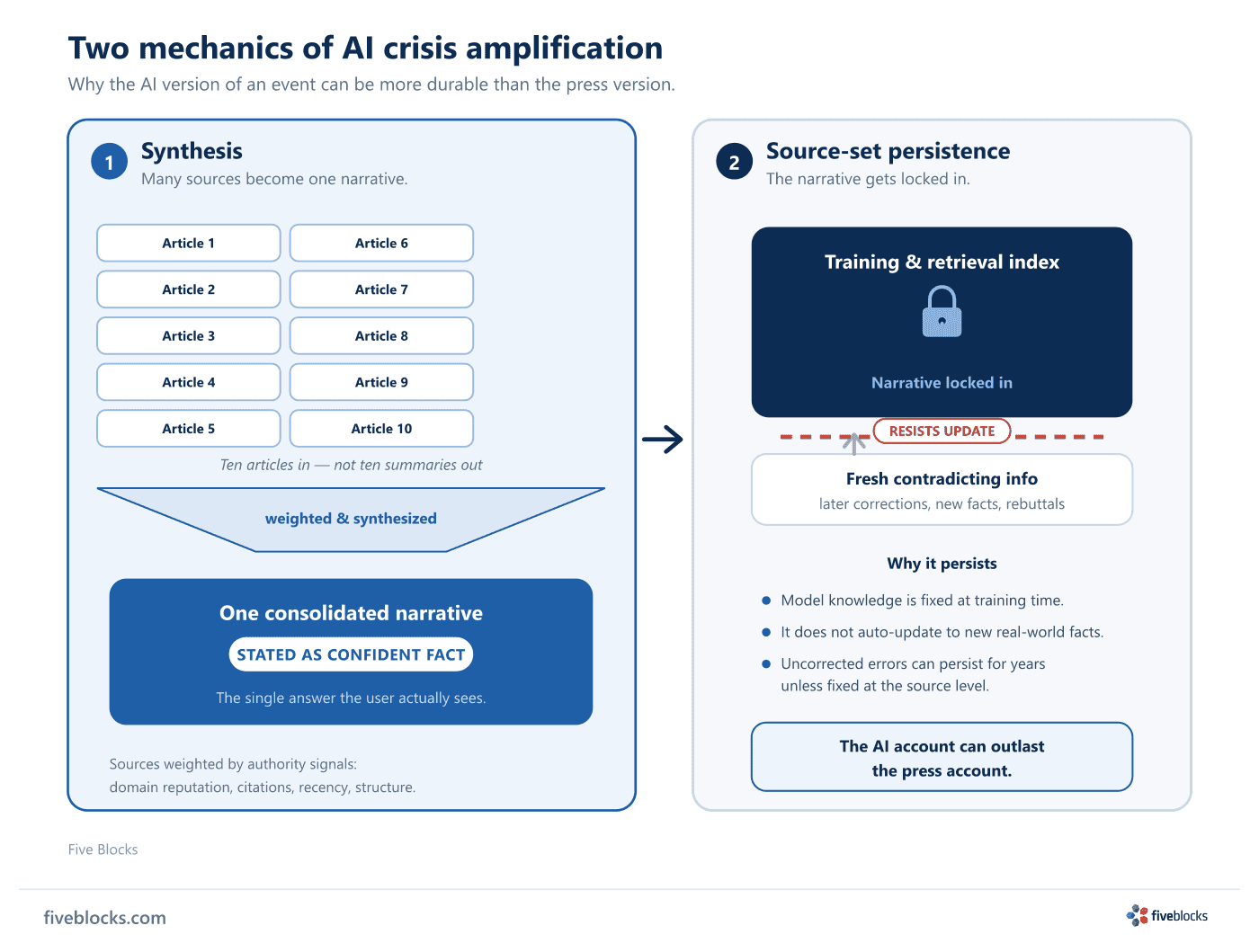
The two amplification mechanics
- Synthesis into one confident narrative. An AI engine reading ten articles about an event does not return ten different summaries. Generative engines answer a query by synthesizing information from multiple sources and summarizing it into a single response, weighting those sources by authority signals such as domain reputation, citation patterns, recency, and structural quality. That one consolidated narrative is what the user sees. Models tend to state synthesized conclusions in the same confident tone whether or not they are fully accurate, so the consolidated version reads as settled fact rather than one account among many.
- Source-set persistence. Once a story has been absorbed into a model’s training corpus or its retrieval index, the narrative tends to persist even after fresh, contradicting information emerges. A model’s internal knowledge is fixed at training time and does not automatically reflect later changes in the real-world facts, so uncorrected errors and outdated framings can persist in AI training data for years unless they are corrected at the source level.
Why this matters in a crisis
- The AI account can outlast the press account. A news cycle decays, but a narrative that has hardened inside the engines can keep being restated, confidently, after the coverage has moved on.
- Correcting the record is not automatic. Because the engines hold on to what they have already absorbed, a rebuttal that the press picks up does not necessarily reach the AI layer. The underlying sources the engines draw on have to change.
- The engines do not move in lockstep. AI answers are generated fresh, vary from engine to engine, and drift over time, so the same crisis can be framed differently across engines. Each one is worth watching separately.
The practical point is that crisis monitoring has to look at the AI layer directly. Daily AIQ monitoring during a crisis tracks how the narrative is forming across the engines and surfaces which sources they appear to be drawing on, which shows where source-level intervention is most likely to move the picture.
Last reviewed: 19/05/2026
