Can Five Blocks change what AI says about a brand?
Yes. Five Blocks improves the sources AI models rely on, both their training data and what they retrieve in real time through RAG, which changes how brands are represented over time.
Yes. An AI model builds its understanding of a topic from two kinds of sources: the corpus it was trained on, and the live content it pulls in at query time through RAG (Retrieval-Augmented Generation). Five Blocks works on both by making sure the sources behind a brand are present, accurate, and consistent.
How AI forms its understanding of a brand
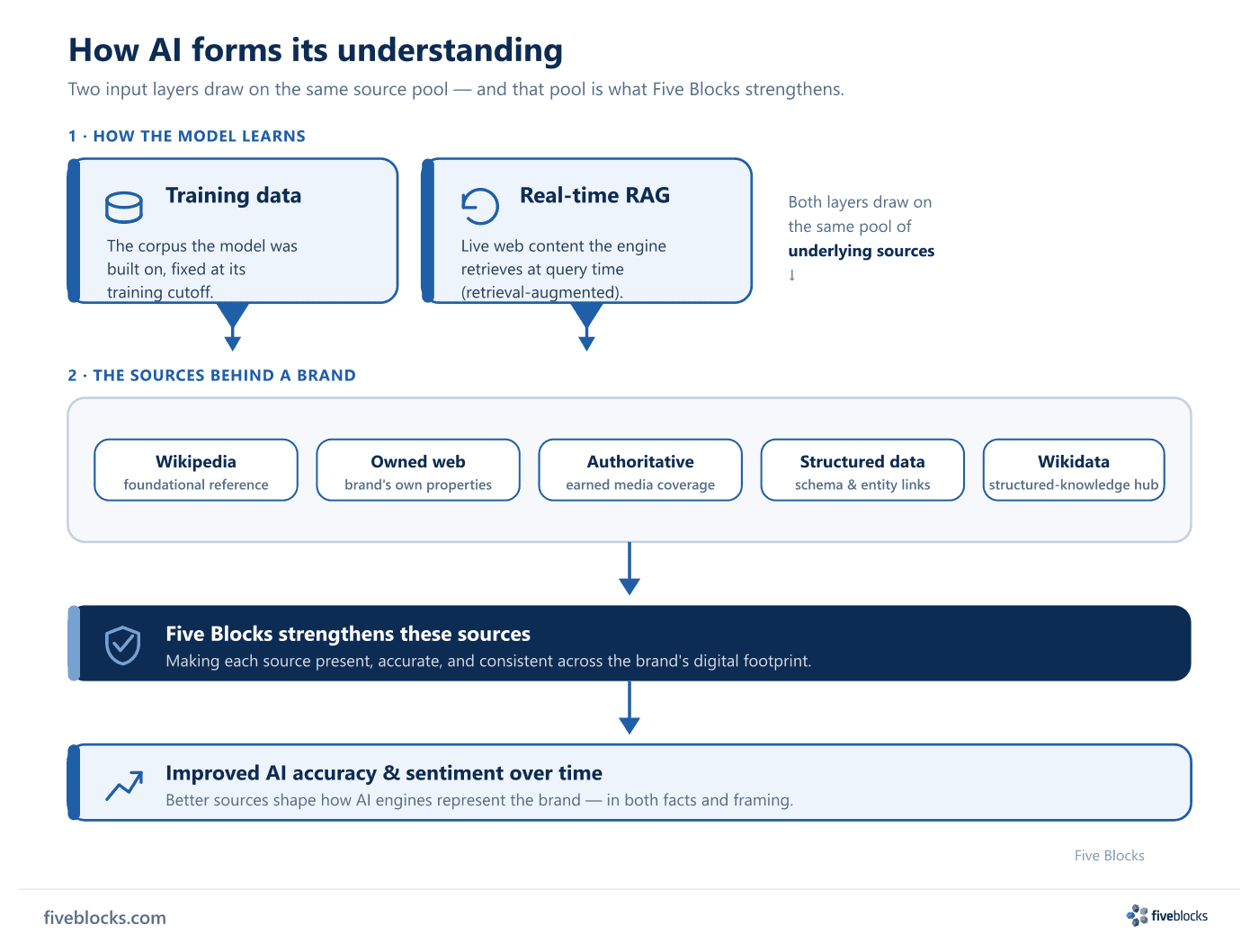
Major AI engines answer questions about an entity in two ways that work together:
- Training data, the corpus a model was built on (web pages, news, books, Wikipedia, and structured datasets), fixed at the model’s training cutoff.
- Real-time retrieval (RAG), live web content the engine fetches at query time instead of relying only on its training set. Perplexity, ChatGPT Search, and Google AI Overviews all rely on retrieval.
The sources we strengthen
When an AI engine answers a question about a company, it pulls from sources across that company’s digital footprint. Five Blocks focuses on making each of these present and reliable:
- Wikipedia, which major engines use as a reference for entity questions, from both training and retrieval.
- Owned web properties, the brand’s own sites, ideally with schema markup and clear authorship.
- Authoritative third-party coverage, earned media that engines cite as sources.
- Structured data, schema markup and entity links that help engines identify and connect the entity correctly.
- Wikidata, which links entities across languages and feeds knowledge-graph systems.
Why this changes what AI says
Well-anchored content can enter the source pools AI engines draw on, and that changes their answers. By improving the quality and consistency of these sources, Five Blocks works to change how AI platforms represent clients over time, both the accuracy of the facts and the sentiment of the framing.
Last reviewed: 19/05/2026
