Why is Wikipedia one of the most important assets in digital reputation?
Because Wikipedia is both a destination and an upstream source: it is one of the most-visited sites on the internet and the default reference for journalists, investors, candidates, counterparties, and counsel, and it also feeds Google search results, the Knowledge Panel, Wikidata, and the AI engines that synthesize answers. An error on the article propagates through every downstream channel at once.
Wikipedia matters to digital reputation because it works at two layers at once. It is a destination people read directly, and it is an upstream source that feeds most of the rest of the discovery stack. That is what separates it from any other single asset: an error or gap on the article does not stay on the article. It spreads through every downstream channel at the same time.
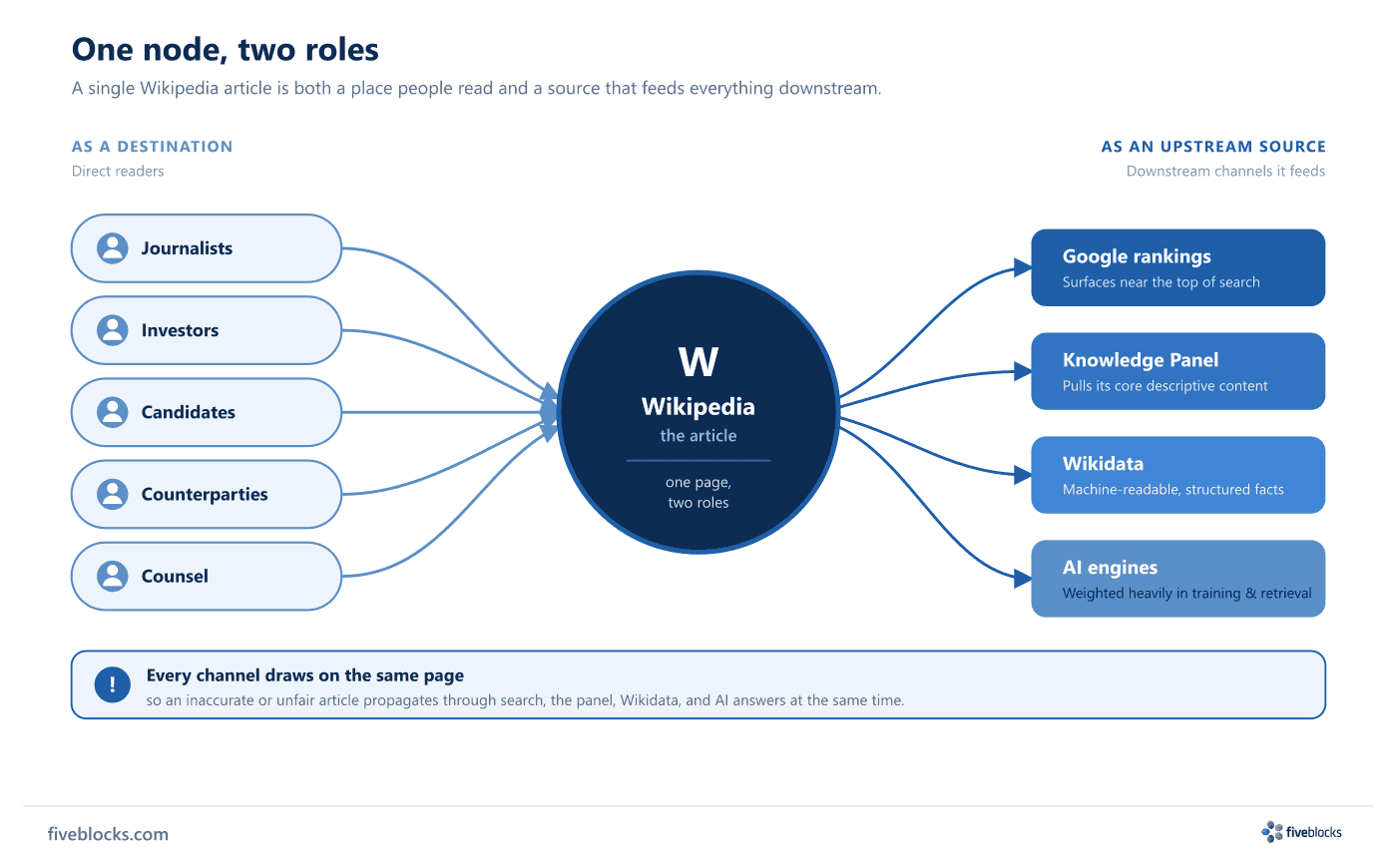
As a destination
Wikipedia is one of the most-visited sites on the internet, and it is the default reference for the people whose judgment matters most to a reputation. Journalists, investors, candidates, counterparties, and counsel read it for a quick, neutral orientation on a company or person before they go deeper.
As an upstream source
The same article feeds the rest of the discovery stack, which is where most of its influence comes from:
- Google search rankings. The Wikipedia article commonly surfaces near the top of results for a branded query, whether the company name or an executive name, so it is one of the first things a searcher clicks.
- The Knowledge Panel. The panel that appears next to search results draws its core descriptive content from Wikipedia and its structured counterpart, Wikidata.
- Wikidata. The machine-readable entry mirrored from the article supplies the structured, linkable facts that other systems build on.
- AI engines. Large language models weight Wikipedia heavily in both training and live retrieval, and when an entity has an article they often paraphrase it as the canonical reference when answering questions about the brand.
Because these channels all draw on the same page, the effects of an inaccurate, incomplete, or unfairly framed article compound. The problem shows up in search, in the Knowledge Panel, in Wikidata-driven systems, and in AI answers together. No other single asset in the digital reputation stack combines that direct readership with that upstream reach, which is why fixing the article is one of the highest-return interventions available.
Last reviewed: 19/05/2026
