How do you test AI responses about your brand across different prompts?
Test AI responses by varying user intent (research, comparison, recommendation), prompt phrasing, and personas, then watch which themes hold. Themes that recur across many variants point to a stable AI narrative the engines have settled on. Themes tied to specific phrasings are prompt-sensitive: more contingent, and easier to swing.
Prompt-variation testing separates a stable AI narrative from a coincidental phrasing effect. A brand described favorably for one carefully worded prompt and unfavorably for the same question phrased differently has a weaker narrative than a brand described consistently across many variations. The risk is real: research on LLM sentiment classification finds that even minor variations in input phrasing can lead to significant shifts in how the same subject is scored. That is the fragility prompt-variation testing exists to surface.
What to vary
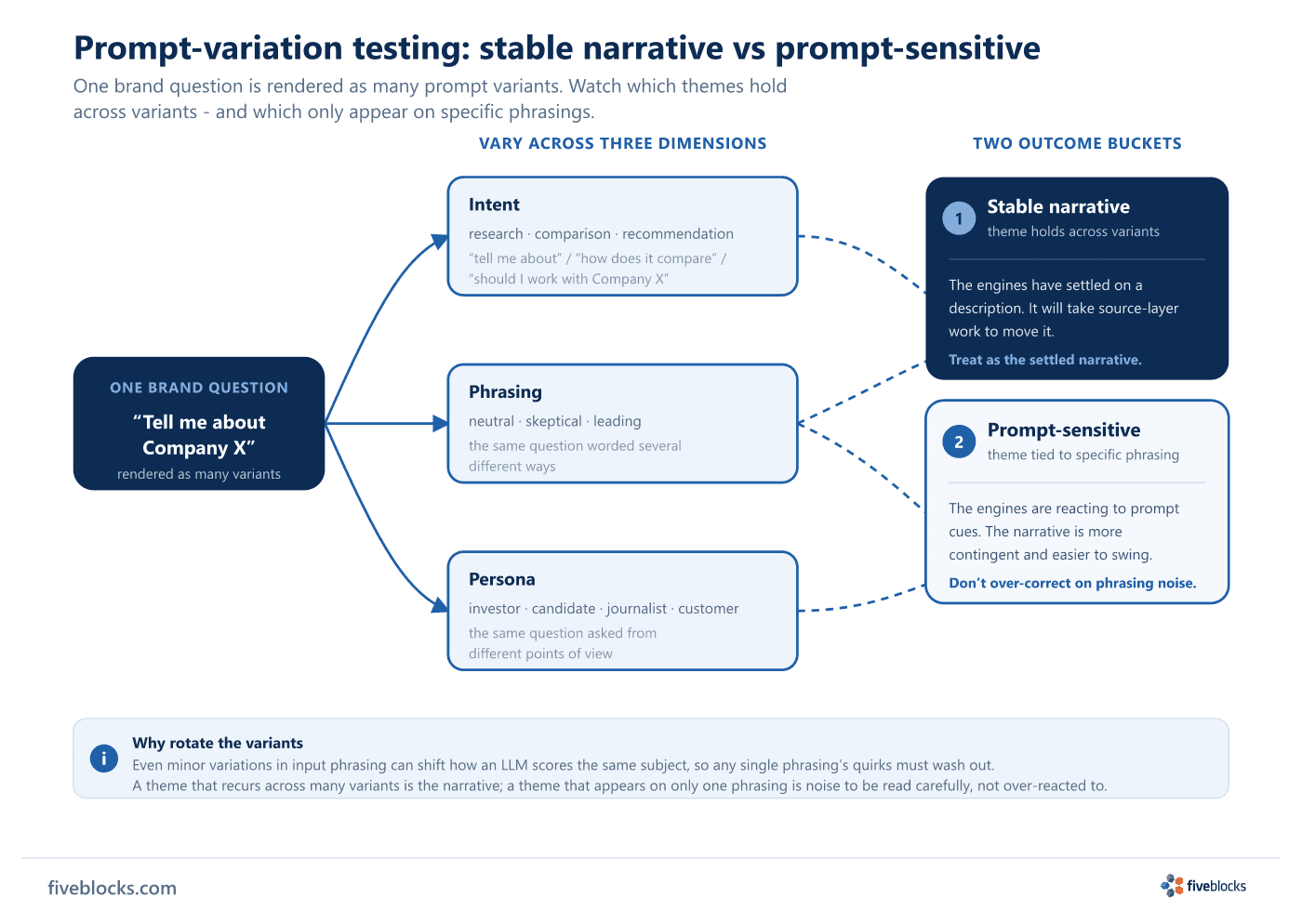
A useful test rotates the same brand question across several dimensions so any single phrasing’s quirks wash out:
- User intent, research (“tell me about Company X”), comparison (“how does Company X compare to its peers”), and recommendation (“should I work with Company X”).
- Phrasing, the same question worded several ways, including neutral, skeptical, and leading variants.
- Persona, the same question asked as an investor, a job candidate, a journalist, or a prospective customer.
Reading the two outcomes
The variants sort each recurring theme into one of two buckets:
- Stable narrative, the theme holds across many variants. The engines have settled on a description, and moving it takes source-layer work.
- Prompt-sensitive, the theme appears only on specific phrasings. The engines are reacting to prompt cues, and the narrative is more contingent.
An example makes the distinction concrete. If “tell me about Company X,” “is Company X a good investment,” and “what are the risks of Company X” all surface the same innovation-leader framing, that theme is stable. If a critical theme appears only when the prompt itself contains a skeptical cue and disappears under neutral phrasing, it is prompt-sensitive, and treating it as the settled narrative would be an over-correction.
AIQ runs this kind of multi-variant testing directly. Programs that skip it tend to over-react to a single bad response and under-react to a stable but milder problem, mistaking phrasing noise for the narrative, or missing the narrative because no single prompt made it obvious.
Last reviewed: 19/05/2026
