How do you track changes in AI narratives about your brand over time?
Track AI narrative change by polling the engines on a fixed cadence with consistent prompts and storing every response verbatim. That methodological consistency is what makes real change detectable through text diffs, theme trajectory, source-attribution shifts, and sentiment trend lines, rather than mistaking prompt noise for movement.
Change tracking requires methodological consistency: the same prompts, run against the same engines, on a fixed cadence, with the full response stored verbatim each time. Without that foundation, change detection is guesswork, and there is no reliable way to tell a genuine narrative shift from prompt-phrasing noise.
The consistent foundation
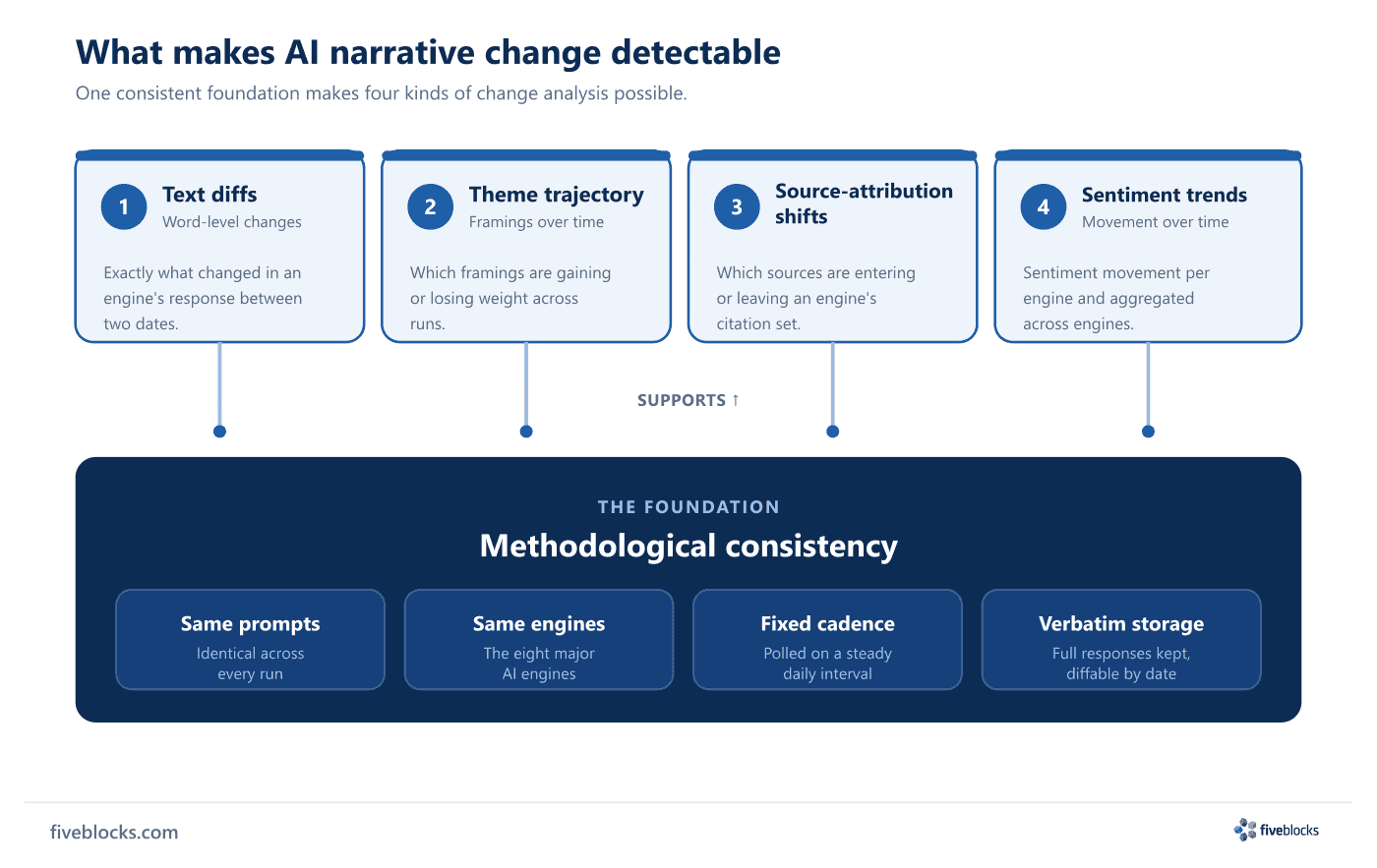
AIQ is built this way, polling the eight major AI engines daily: ChatGPT, Gemini, Copilot, Perplexity, Claude, Grok, Google AI Overviews, and Google AI Mode. The method rests on four properties:
- Identical prompts across runs, so responses are comparable over time rather than dependent on how a question happened to be phrased.
- A fixed daily cadence, so the history builds at a steady interval and drift is caught early.
- Full response storage with diff capability, so any two dates can be compared verbatim.
- Theme tagging that persists across runs and sentiment scoring on the same scale, so the analytical layers stay consistent as well.
What the foundation makes possible
That consistent base supports four analytical layers:
- Text-level diffs: exactly what changed in an engine’s response between two dates.
- Theme trajectory analysis: which framings are gaining or losing weight over time.
- Source-attribution shifts: which sources are entering or leaving an engine’s citation set.
- Sentiment trend lines: movement per engine and aggregated.
Each engine answers the same question differently and the answers drift over time, so without fixed prompts and a steady cadence there is no stable baseline to measure that movement against.
Last reviewed: 19/05/2026
