How do you build an early warning system for reputation threats?
An early-warning system has three parts: continuous monitoring across search, AI engines, social, Wikipedia, and news; thresholds that turn meaningful movement into alerts; and a named owner accountable for acting on each alert.
An early-warning system for reputation threats connects monitoring to action. Spotting a threat early buys nothing if no alert fires and no one owns the response. The system has three parts: monitoring, thresholds, and named owners. Most of the work sits in tuning the last two.
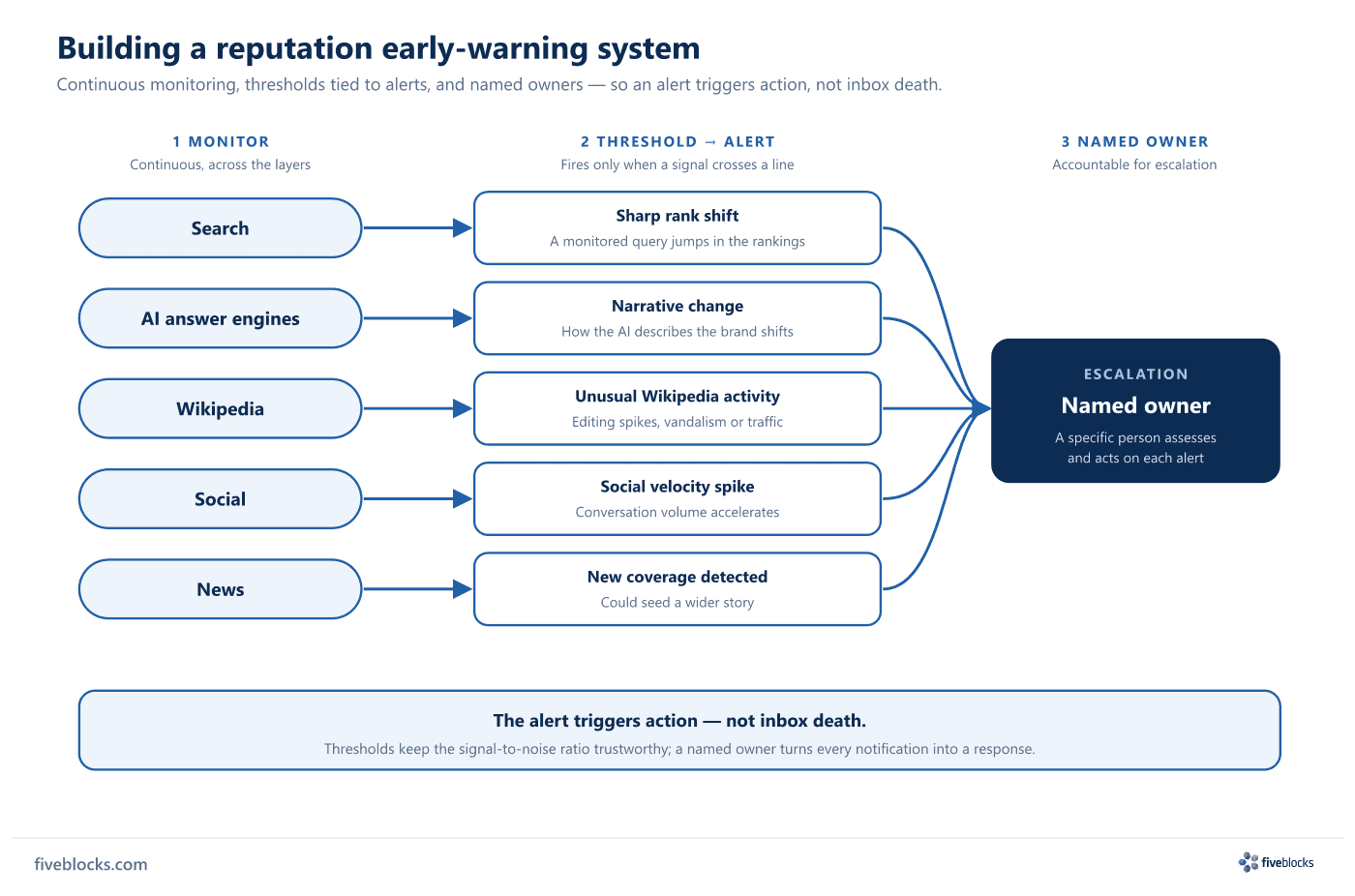
The three parts of an early-warning system
- Continuous monitoring across the layers where threats emerge. Monitoring runs at all times across search, the AI answer engines, social, Wikipedia, and news, which is where a reputation threat usually surfaces first. We run this through IMPACT™ for search, AIQ™ for the AI engines, and WikiAlerts™ for Wikipedia.
- Thresholds tied to alerts. The system separates meaningful movement from noise and fires only when a signal crosses a defined line, so an alert means something. Typical triggers: a sharp rank shift in search, a change in the AI narrative, unusual Wikipedia activity, and a spike in social velocity.
- Named owners for escalation. When an alert fires, one specific person is responsible for assessing it and acting on it. A notification that lands with everyone belongs to no one.
Tuning thresholds and assigning ownership
The system succeeds or fails on two design choices:
- Threshold tuning. Set them too sensitive and the alerts get ignored; set them too loose and real threats slip through. Aim for a signal-to-noise ratio people trust enough to act on.
- Ownership. A well-tuned alert still dies in an inbox if no one owns it. Naming the owner is what turns a notification into a response.
The monitoring layers and what each one watches
| Layer | What triggers an alert |
|---|---|
| Search | A sharp rank shift on a monitored query |
| AI answer engines | A change in how the AI narrative describes the brand |
| Wikipedia | Unusual editing activity or traffic on the article |
| Social | A spike in conversation velocity |
| News | New coverage that could seed a wider story |
Five Blocks builds this early-warning logic into the monitoring we run: search and SERP tracking through IMPACT™, the AI engines through AIQ™, which tracks how eight major AI models represent a brand, and Wikipedia edits, vandalism, and traffic through WikiAlerts™.
Last reviewed: 20/05/2026
