How do you identify potential reputation threats before they materialize?
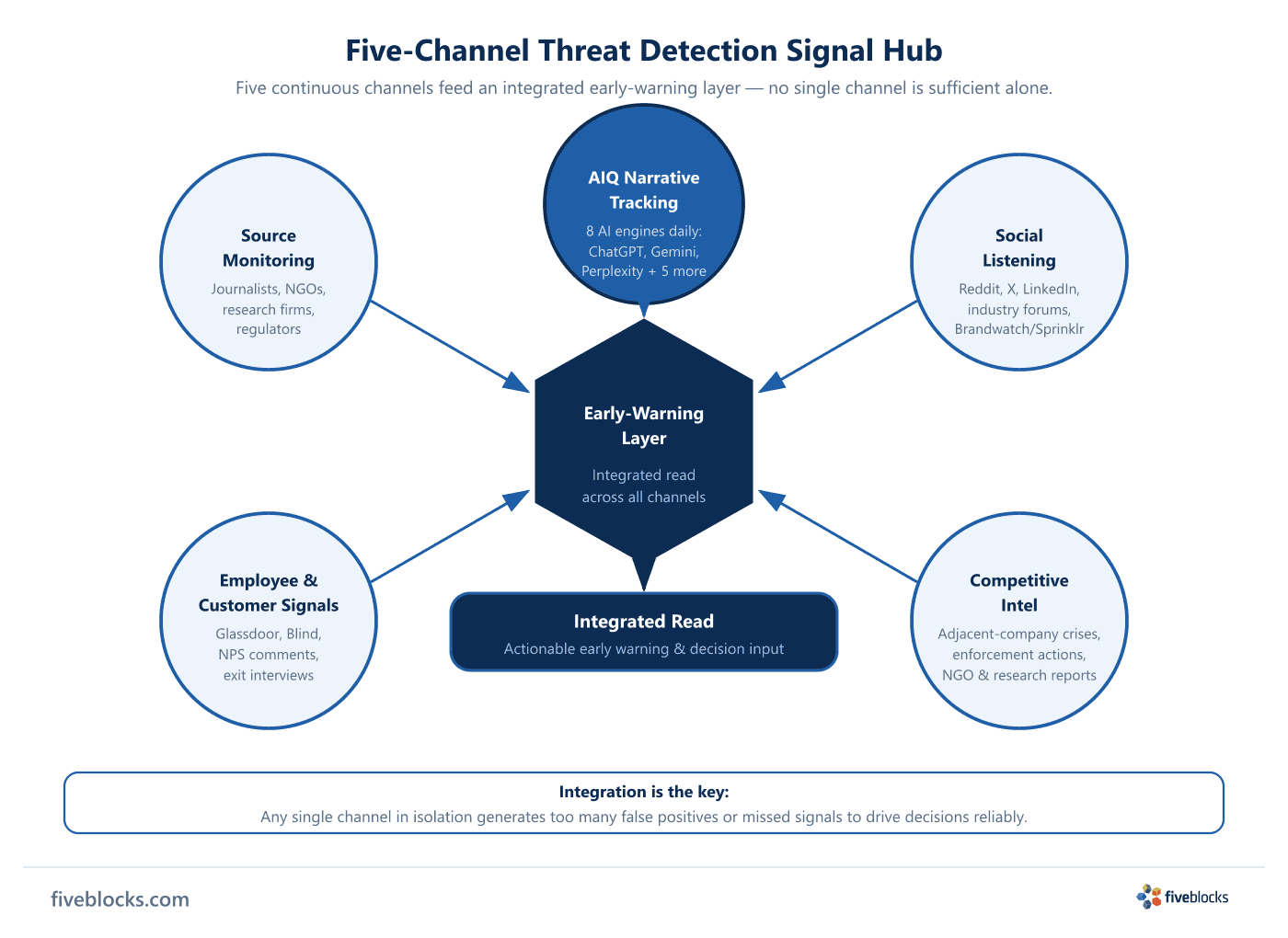
Identifying reputation threats before they materialize requires five integrated channels: continuous source monitoring (journalists, NGOs, research firms that historically generate reputation events), social listening on relevant platforms, daily AI narrative tracking through AIQ across the eight engines it currently tracks, employee and customer feedback signals (Glassdoor, Blind, NPS comments), and competitive intelligence on crises adjacent companies have faced. The integrated read is what produces actionable early warning; any single channel in isolation generates too many false positives and missed signals to drive decisions.
Catching a reputation threat before it materializes is where preparedness pays off most: problems caught early cost a fraction of what they cost once a crisis is active. Effective early warning needs five channels running continuously and read together, not one at a time.
- Source monitoring
- Track the journalists, NGOs, research firms, regulatory bodies, and platforms that have generated the company’s reputation events in the past. Knowing who is working on stories relevant to your industry, and how their earlier work has moved markets or media cycles, is the earliest signal available. This channel is company-specific and built from the client’s own history.
- Social listening
- Structured queries on the relevant platforms, Reddit, X (Twitter), LinkedIn, industry forums, surface emerging sentiment and narrative before it reaches mainstream press. Tools such as Brandwatch and Sprinklr track brand mentions, identify trending content, and detect sentiment shifts in near-real time, so teams can step in while a conversation is still contained.
- AI narrative tracking (AIQ)
- AIQ tracks daily across the eight AI engines it currently monitors, ChatGPT, Gemini, Perplexity, Claude, Grok, Copilot, Google AI Mode, and AI Overview, watching for narrative shifts that can precede press coverage. Retrieval-heavy engines update within days of new authoritative content appearing in the source layer, so a change in how the engines describe a company can be an early sign that something is building underneath. This is the only channel that shows what stakeholders who ask the AI engines, before they read any news article, are being told about the company.
- Employee and customer feedback signals
- Glassdoor, Blind, NPS comments, and exit interviews often reveal internal issues that later become public. AI engines ingest Glassdoor, Blind, and Reddit content as employer and product signals, so a pattern building on these platforms is both an early warning and a source-layer problem in the making that will eventually affect what the AI engines say about the company.
- Competitive intelligence
- Mapping which kinds of crisis have recently hit adjacent companies in the industry identifies live risk categories before they arrive. A sector-wide issue that hit a competitor first often has enough momentum to reach the next company in line. Watching enforcement actions, NGO campaigns, and research reports across the industry tells you what is likely coming.
The five channels turn into real early warning only when you read them together. Any one of them on its own produces too many false positives (social noise with no source-layer corroboration) or too many missed signals (source monitoring with no AI narrative context) to base decisions on. The signal is in the combined read, which is how IMPACT and AIQ are built to work together.
Last reviewed: 19/05/2026
