How should religious and cultural organizations manage online reputation?
Religious and cultural organizations are judged on mission credibility and community trust. The work covers accurate entity signals (search, Knowledge Panel, and Wikipedia where the organization is notable), credentialed leadership bios, community-facing program content, and AIQ™ monitoring of what AI engines say about the organization. Organizations with a thin content footprint are the most exposed to a confident but inaccurate AI answer.
The reputation of a religious or cultural organization rests on its mission, the trust of its community, and the credibility of its leadership. These organizations often work in a sensitive environment where misinformation and controversy travel fast, and where the published record is thin enough that an AI engine will produce a confident answer from very little authoritative material.
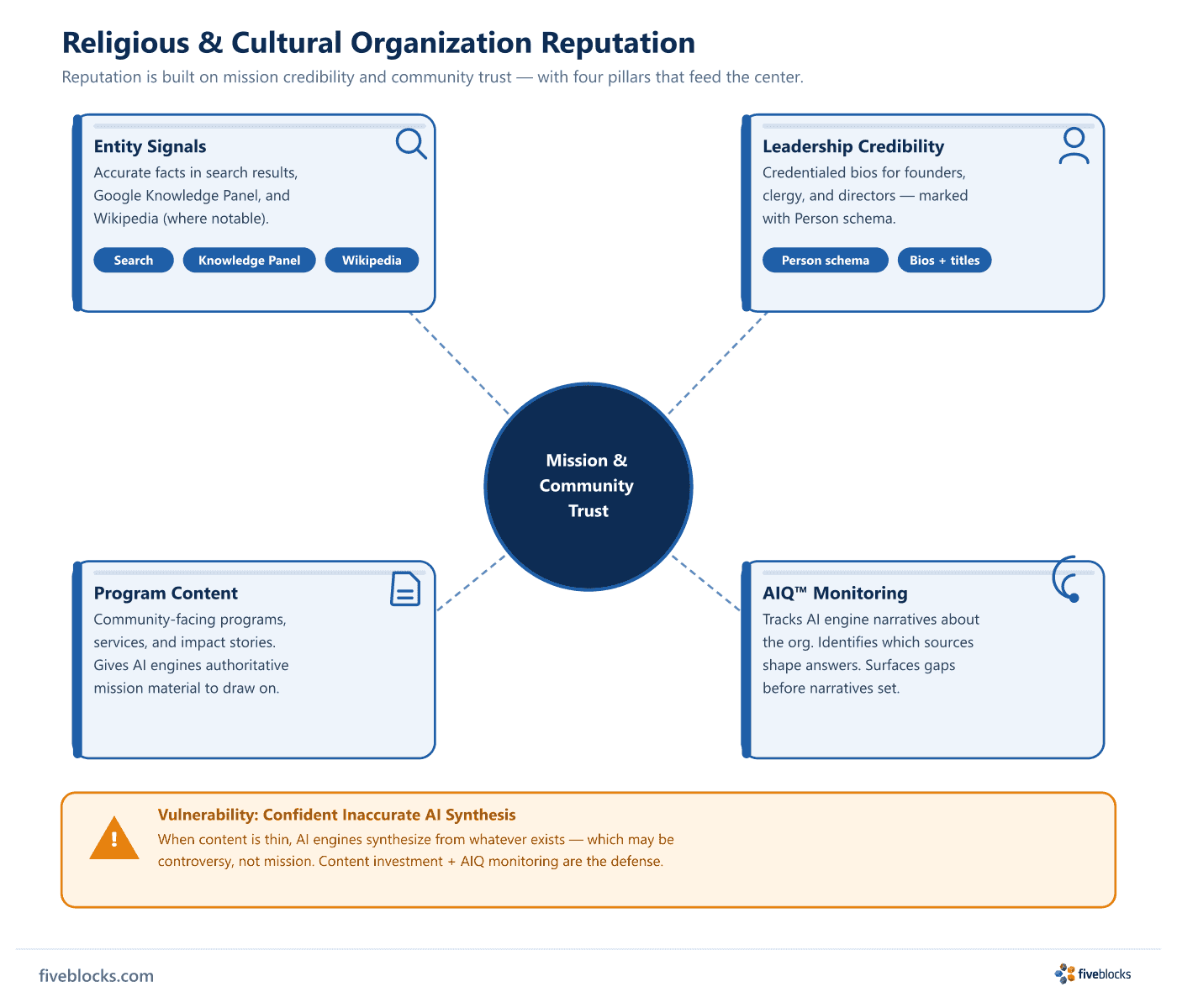
- Organizational entity signals
- Start with accurate facts in the places that matter: search results, the Google Knowledge Panel, and, where the organization is notable, Wikipedia. When no one maintains the canonical record, errors settle in quietly. Getting the name, location, leadership, and mission right means the organization is described correctly before anyone asks a question about it.
- Leadership credibility
- In mission-driven organizations, the people who lead carry the institution’s trust personally. Leadership bios with real credentials, marked up with
Personschema, help founders, clergy, directors, and other principal figures surface accurately in search and in AI answers about who leads the organization and what they stand for. - Program and community content
- Community-facing content on programs, services, and impact gives members and AI engines a real account of what the organization does. Without it, a model asked to describe the organization has little authoritative material to work from and falls back on whatever coverage exists, which can be controversy rather than mission.
- AIQ™ monitoring
- Prospective members, donors, journalists, and community partners now ask AI engines to characterize these organizations. When the content footprint is thin, a confident but inaccurate answer is the likely result. AIQ™ monitoring shows what the engines are saying and which sources are shaping those answers, so the organization can respond at the source layer instead of after the narrative has set.
Last reviewed: 20/05/2026
