How should nonprofit organizations manage their digital reputation?
Quick answer
Nonprofit reputation comes down to donor trust. Organizations that document their finances, program outcomes, and leadership credentials get an accurate, favorable answer when funders and prospective grantees ask AI models to assess them. Those that do not get a thin or skeptical one.
A nonprofit’s reputation rests on one question its constituents keep asking: is the money doing what it claims to do? The rest of the work follows from that.
- Transparency content
- Accurate reporting on grants, programs, and finances is what earns donor and grantor confidence. It also gives search engines and AI models something authoritative to work from when they describe the organization. Vague or missing disclosure leaves a gap, and the engines fill it with skepticism.
- Impact reporting
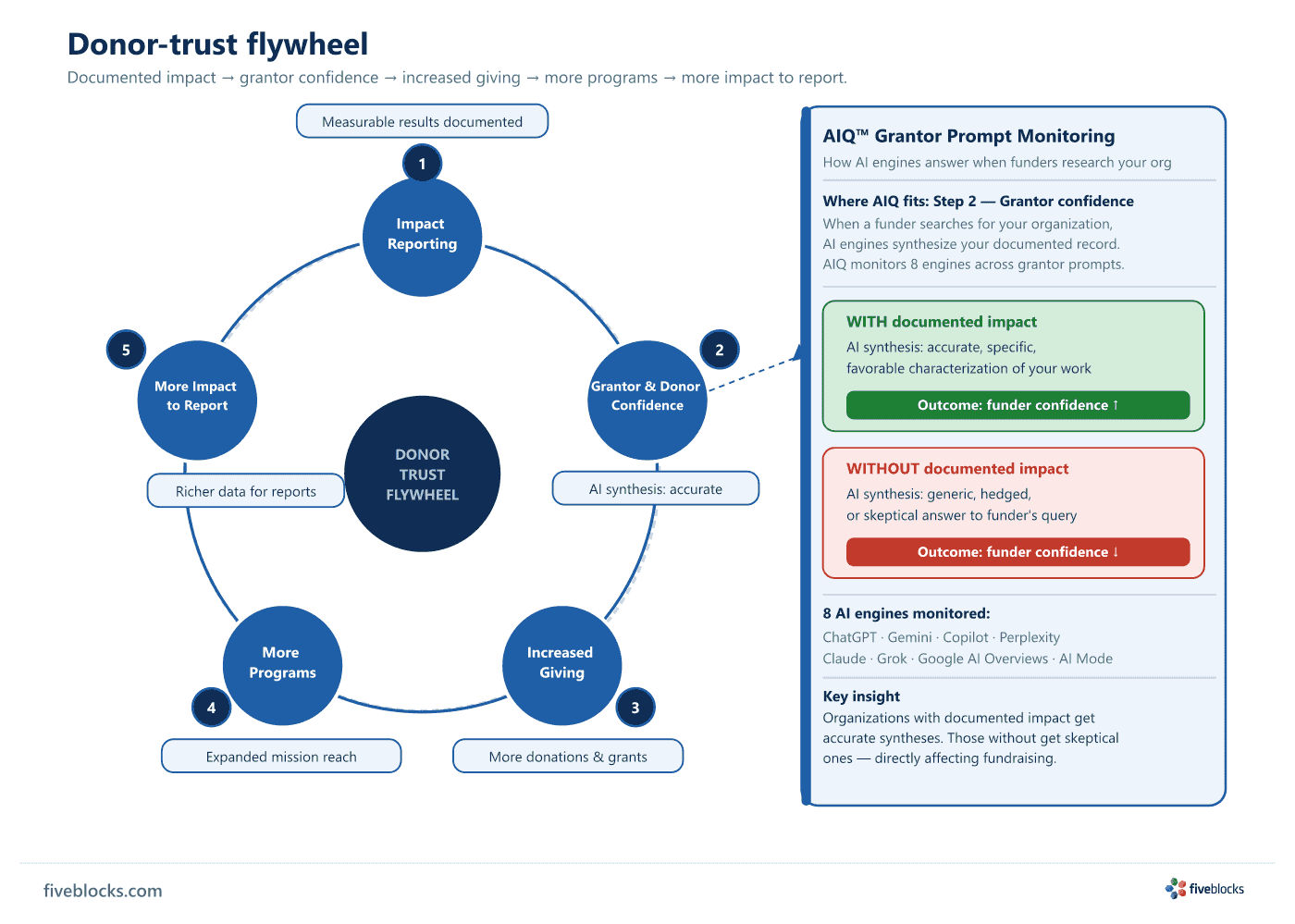
- Reporting that ties program activity to measurable outcomes separates a credible organization from one that only states intentions. The difference shows up in how AI engines answer: documented results get a specific, accurate description, while stated intentions get a generic or hedged one.
- Leadership credibility
- Bios for the executive director and board members put credentials behind the people directing the work. Marked up with Person schema, they help search engines and AI models return the right individual when someone looks up the organization’s leadership.
- Program pages with structured data
- Program and initiative pages built with Organization and NonprofitOrganization schema make the organization’s actual work machine-readable, so engines can describe it specifically rather than generically. This is also the material that surfaces in Knowledge Panels and AI knowledge-graph citations.
- AI monitoring on grantor and donor prompts
- Foundations and individual donors now use AI engines to assess and compare nonprofits before they commit funds. AIQ™ monitors these prompts across the major models (ChatGPT, Gemini, Copilot, Perplexity, Claude, Grok, Google AI Overviews, and Google AI Mode) and shows what each engine is saying, which sources are shaping that answer, and how the answer changes over time. An organization that has documented its impact well gets an accurate, favorable answer; one that has not gets a generic or skeptical one. For a nonprofit, how it appears in those answers is now part of the fundraising base.
Last reviewed: 20/05/2026
