How do you manage the digital reputation of a venture capital firm?
Center a VC firm's reputation on partner credibility and portfolio recognition: schema-marked partner bios that establish track record, accurate attribution in directories like Crunchbase and AngelList, thesis-driven content tied to named partners, and ongoing monitoring of how AI engines describe the firm and its bets.
A venture firm’s reputation is mostly the sum of its partners’ judgment and its portfolio’s outcomes, so that is where the work concentrates. The firm is rarely evaluated as an abstract brand. It gets evaluated through the people who make the calls and the companies that prove the calls right.
Where the work concentrates
- Partner credibility
- Partner bios need to establish investing track record and domain authority, marked up with Person schema so the right facts render in search and AI answers.
- Portfolio recognition
- A firm gets credited, or not, for the companies it backed early, so accurate attribution in directories like Crunchbase and AngelList reinforces the entity signal.
- Thesis-driven thought leadership
- Content tied to named partners gives Google and the AI engines current material that frames the firm as a point of view rather than a logo.
- AI-answer monitoring
- We track how the AI engines describe the firm and its bets with AIQ, so the firm knows what founders and co-investors are reading before that description hardens.
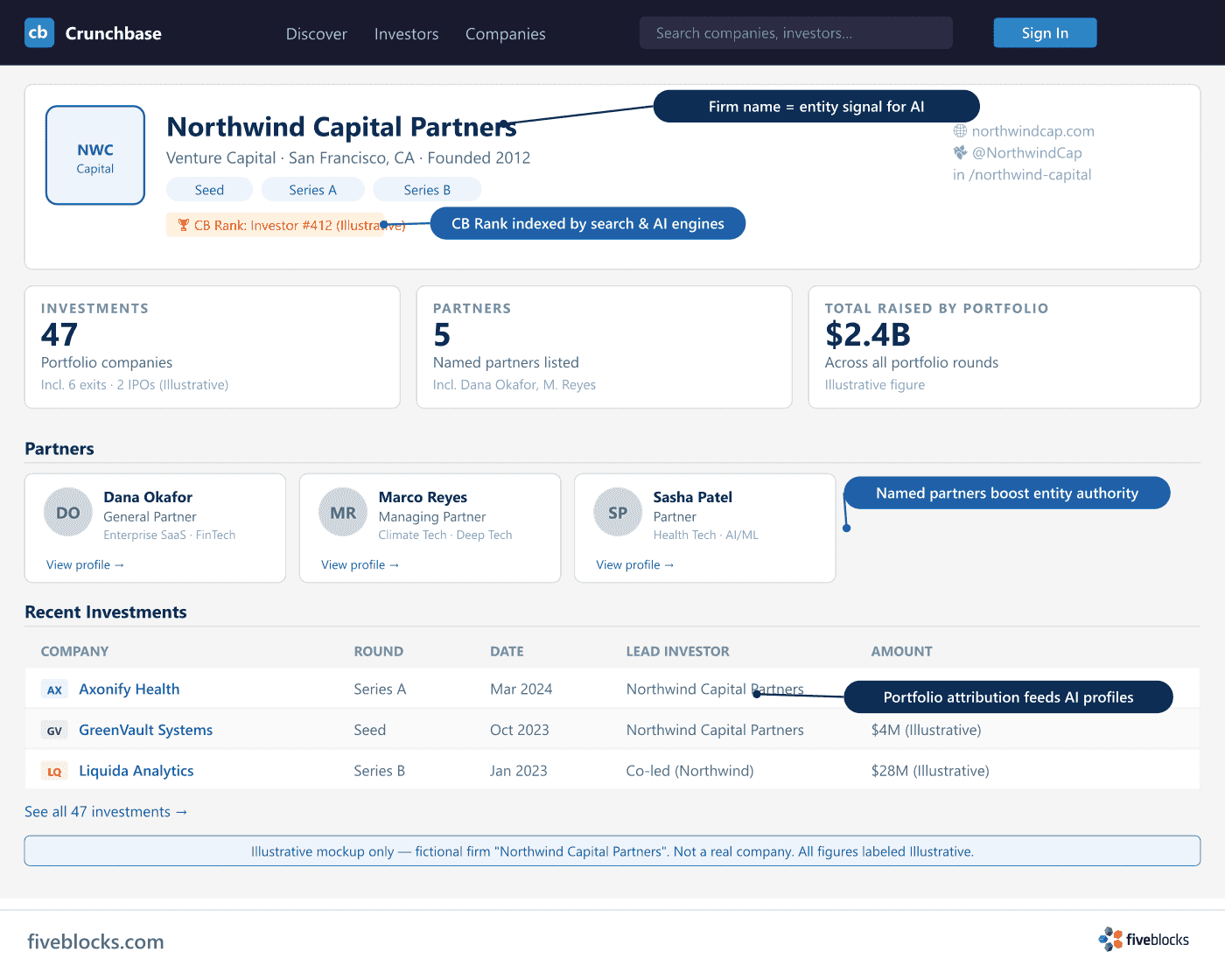
What the directory layer does
Directories like Crunchbase and AngelList carry structured business data – founding, funding, leadership, category – plus the round-level history that ties an investor to the companies it backed. Google’s entity systems and the AI engines treat those listings as credible structured references when they assemble a profile, which makes accurate attribution there a load-bearing entity signal. Founders weighing which investors to take money from increasingly ask an AI engine for a first read, and that synthesized answer is built out of the same directory and schema signals the firm controls.
Last reviewed: 20/05/2026
