How do product reviews affect search reputation for tech companies?
Reviews rank for branded and category queries, and AI engines pull review content when they synthesize a product verdict. A cluster of recent negative reviews therefore does damage twice: once in the search results a buyer reads, again in the answer a model gives that buyer. The fix is credible public responses, real remediation of the recurring issues, and a steady program to earn fresh, authentic reviews from satisfied customers.
Product reviews hit a tech company’s search reputation from two directions at once. They rank for branded and category queries, right where buyers are looking, and AI engines pull that same review content when they synthesize a product verdict. A cluster of recent negative reviews does double damage.
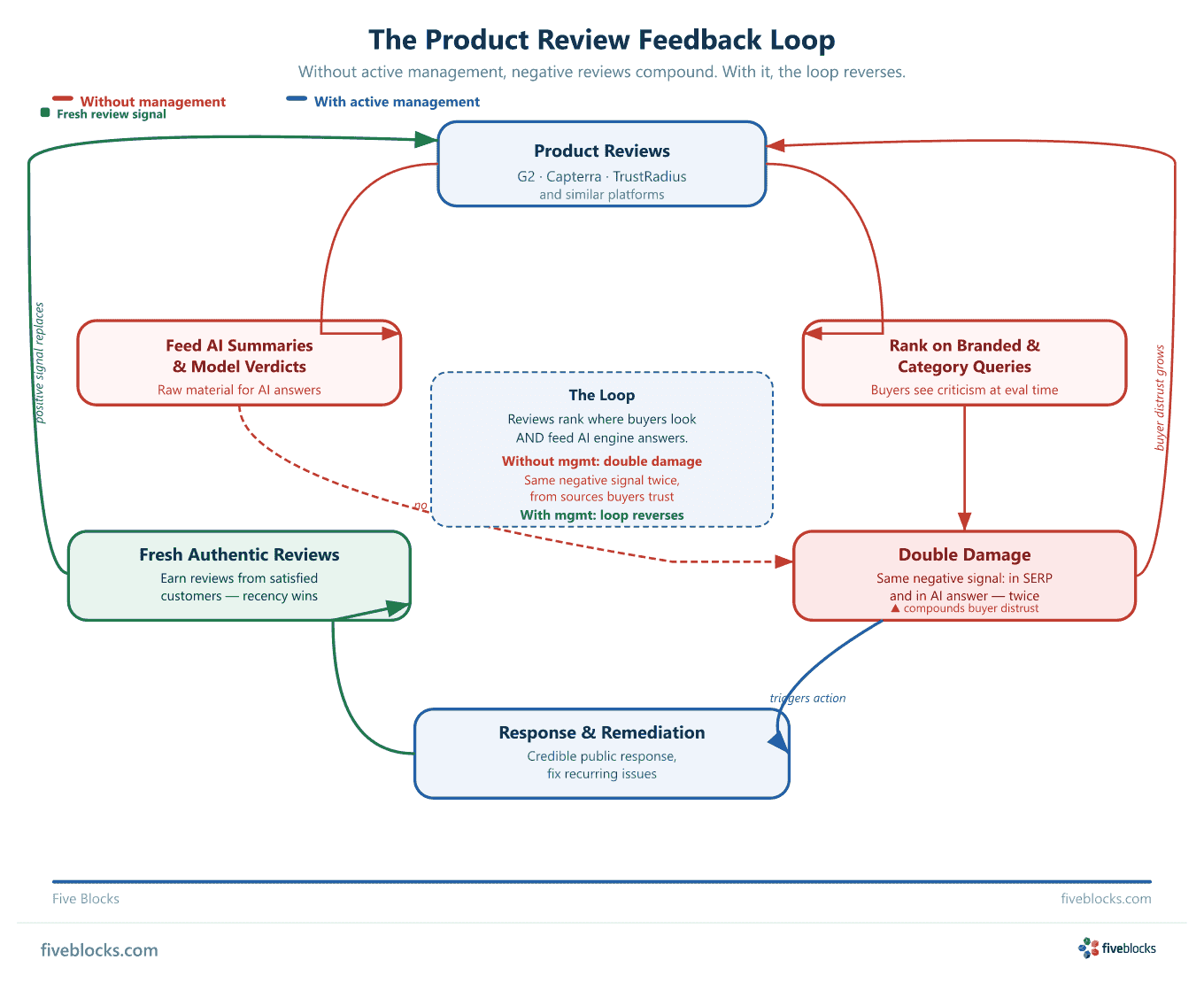
The double-damage mechanism
- Rank signal: Negative review pages on platforms like G2, Capterra, and TrustRadius appear in branded and category search results, putting the criticism in front of buyers at the moment they are choosing.
- AI source material: AI engines pick up recurring themes across multiple review platforms and turn them into confident summaries phrased like “customers say” or “common complaints include.” Recent negative reviews are the raw material for those model verdicts.
- Compounding effect: A buyer who searches, reads the review pages, then asks an AI engine for a recommendation hits the same negative signal twice, from two sources that look independent.
The response and remediation cycle
- Credible public response: Answer legitimate reviews in a way that shows accountability. Suppression and astroturfing both fail; they backfire and invite platform enforcement.
- Genuine remediation: Find and fix the recurring issues behind the negative reviews. The point is to change the product or service reality, not the optics.
- Earn fresh, authentic reviews: Build a deliberate program to collect authentic reviews from satisfied customers so the body of evidence reflects the current product rather than a past low point. Recency counts: algorithms and buyers both weight recent reviews most heavily.
- AI narrative monitoring: Track how review content gets synthesized across the AI engines with AIQ™. The goal is an accurate, current narrative wherever a buyer or a model meets the product, not a good star average on one platform.
Last reviewed: 20/05/2026
