How do defense contractors manage public-facing digital reputation?
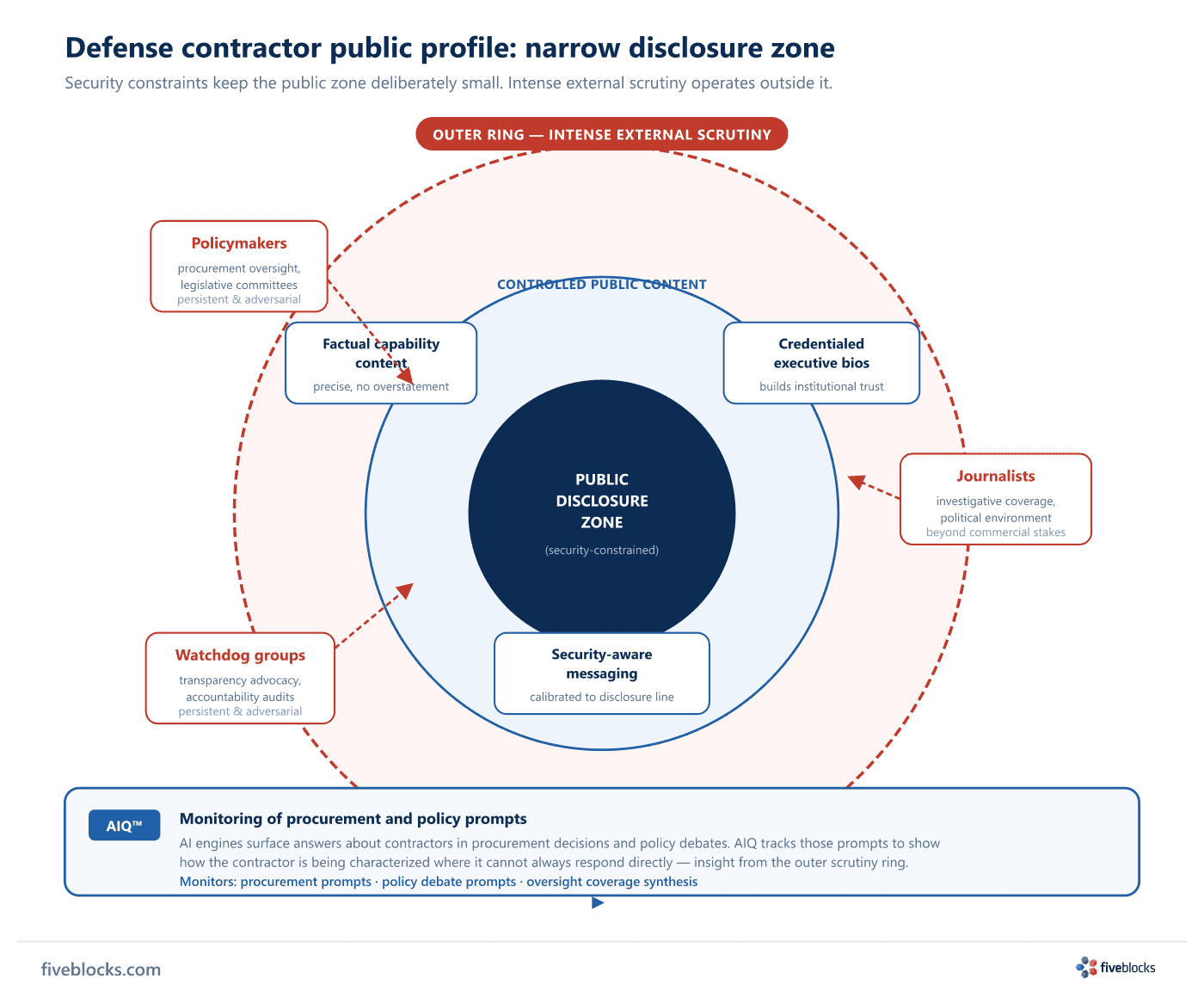
Defense contractors keep a deliberately narrow public profile because security constraints limit what can be disclosed. Inside that zone the work is factual capability content, security-aware messaging, and credentialed executive bios; outside it, scrutiny from policymakers, journalists, and watchdog groups is constant. AIQ™ monitoring of procurement and policy prompts shows how AI engines are characterizing the contractor, so source-layer corrections can be aimed where they count.
Defense contractors work under a deliberately limited public profile, security constraints on what can be disclosed, and constant scrutiny from policymakers, journalists, and watchdog groups. Reputation work in this sector is careful and bounded.
The constrained public zone
- Factual, capability-focused content
- Public content covers what can be said about the contractor’s capabilities and track record. Overstatement invites security problems and political ones, so the disclosure zone stays narrow and precise.
- Security-aware messaging
- The line between legitimate marketing and sensitive disclosure is real in this sector, and every public statement gets calibrated against it. Legal compliance is part of the reason. The other is that violations carry consequences well beyond the reputational.
- Credentialed executive bios
- Institutional trust with government customers and partners rests partly on the credibility of named leadership. Accurate, credentialed bios give those audiences a reliable account of who is running the organization.
The external scrutiny layer
- Policymakers, journalists, and watchdog groups
- A defense contractor’s reputation lives in a politically charged information environment. Scrutiny is persistent and often adversarial, and an inaccurate or unfavorable synthesis can have consequences well beyond the commercial.
- AIQ™ monitoring of procurement and policy prompts
- AI engines now answer questions about contractors in the context of procurement decisions, policy debates, and oversight coverage. Monitoring those prompts tracks how the contractor is being characterized in an environment where it cannot always respond directly to every claim.
Where the work moves next
Limited ability to respond directly still leaves a path forward. The constructive move is to strengthen the source layer that AI engines and human researchers draw on: keep the factual capability record complete and current, maintain accurate credentialed bios, and reinforce consistent entity signals such as structured data and Wikidata so the organization is described correctly across the web. Monitoring is what makes this precise. It shows where an inaccurate or unfavorable synthesis is taking hold, so corrections can be aimed at the specific prompts and sources that matter instead of applied blindly.
This is careful, bounded work, and it is where a firm like Five Blocks helps: AIQ™ monitoring of procurement and policy prompts paired with source-layer discipline on capability content, credentialed bios, and entity signals. Within the sector’s real disclosure limits, that keeps the contractor’s public record factual and legible to the audiences and engines forming judgments about it.
Last reviewed: 20/05/2026
