How do insurance companies manage digital reputation?
Quick answer
Insurance companies are judged mainly on claims handling: whether they actually pay when it matters. That perception shows up in customer reviews, state complaint records, and the AI comparison answers buyers now use to pick a carrier.
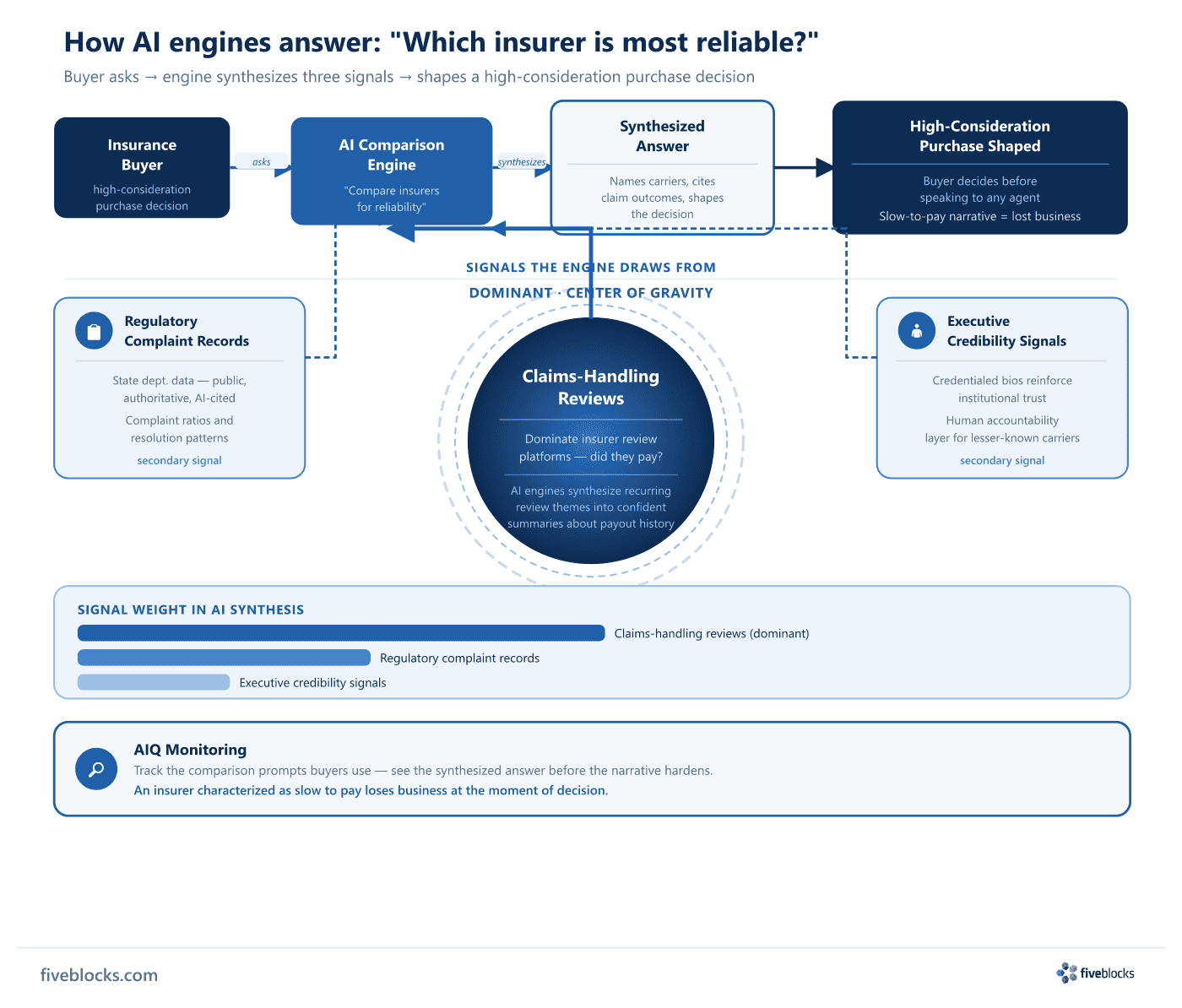
Insurance companies sell a promise that only gets tested at the worst moment: the claim. Claims-handling perception is the center of gravity for insurer reputation, and it surfaces in customer reviews, state complaint records, and the AI-synthesized comparisons buyers use when choosing a carrier.
Core reputation signals for insurers
- Claims-handling reviews
- Claims experiences dominate insurer review platforms. A structured approach to responding and remediating matters for more than the individual complaint: AI engines synthesize recurring review themes into confident summaries about whether an insurer pays. Negative claims narratives get amplified across comparison prompts.
- Regulatory complaint records
- State insurance department complaint data is public and authoritative, and AI engines cite it when buyers ask about insurer reliability. Complaint ratios and resolution patterns feed the synthesized answers behind high-consideration purchase decisions.
- Executive credibility signals
- Credentialed executive bios reinforce institutional trust, especially for carriers without broad consumer name recognition. Leadership visibility puts a human accountability layer behind the brand that claims handling alone cannot supply.
- Regulatory-aware content
- Insurance is heavily regulated, and statements about claims and coverage carry compliance exposure. Everything public-facing, including responses to reviews, has to stay within the rules governing what an insurer can say about its own products and processes.
- AI comparison monitoring
- Buyers now ask AI engines to compare insurers and judge reliability before they buy, and that synthesized answer carries weight. An insurer described as slow to pay, accurately or not, loses business at the moment a buyer is deciding. Monitoring those comparison prompts with AIQ™ is how insurers see the narrative and correct it before it hardens.
Last reviewed: 20/05/2026
