How do logistics and supply chain companies manage digital reputation?
Quick answer
Logistics and supply chain companies are judged first on reliability. ESG and labor-practices exposure are the secondary flashpoints, and they can damage major customer relationships. Operational-risk prompts are where the AI engines now answer 'can they be counted on' for prospective customers and partners, which makes them the monitoring priority.
Logistics and supply chain companies compete on one dominant attribute: reliability. Every other reputation signal either reinforces or undermines it, so the work concentrates on the attributes that move it most.
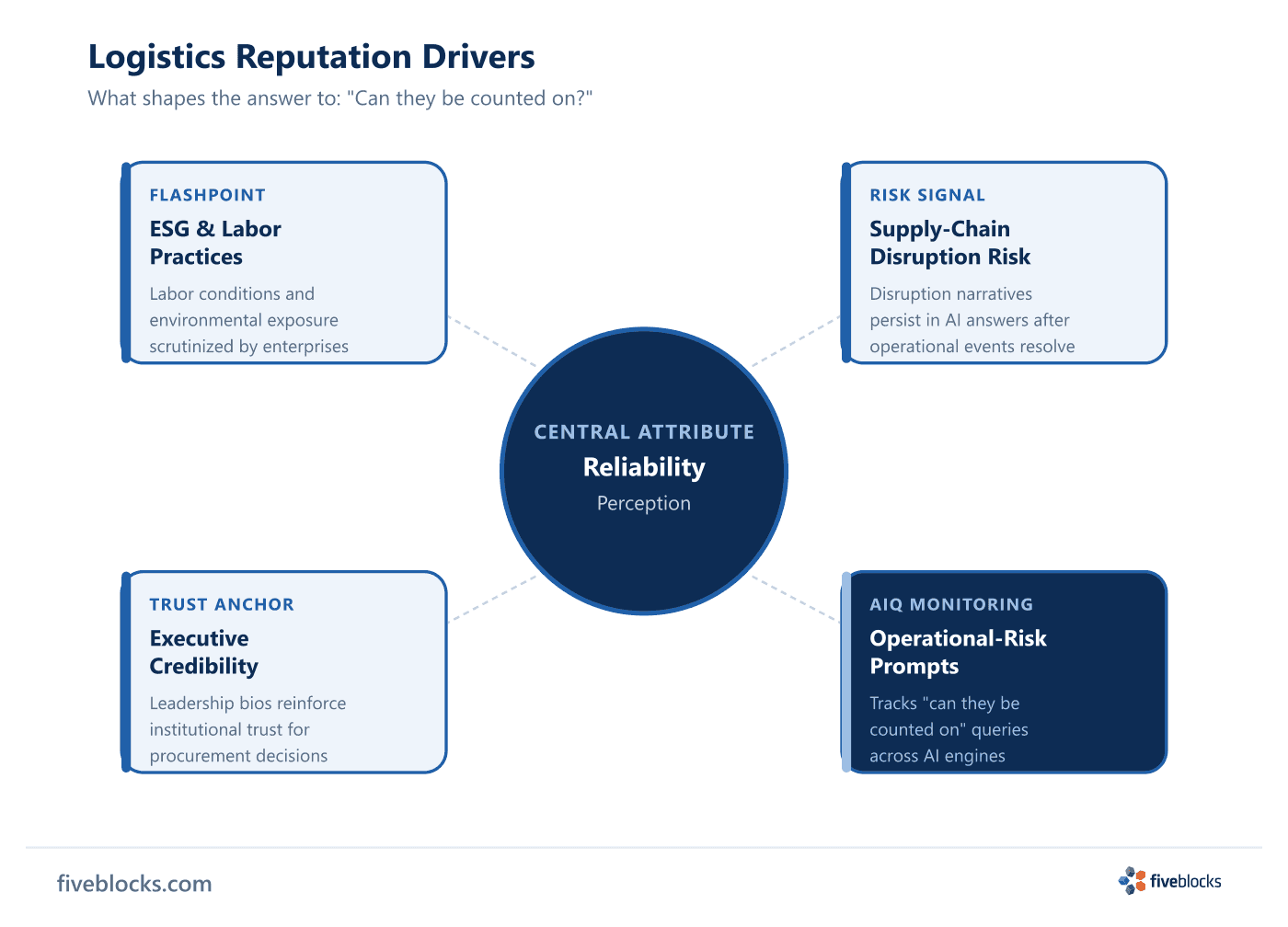
- How reliability perception gets built
- Customers and partners reduce every logistics decision to one question: can they be counted on. On-time performance, service consistency, and operational transparency build that perception, and the rest of the reputation picture is read through it. Authoritative content that documents a provider’s operational track record gives the AI engines something factual and citable to weigh when the question is asked.
- ESG and labor-practices flashpoints
- Enterprise customers, regulators, and the press all scrutinize supply-chain labor conditions and environmental impact directly. A labor-practices incident or a gap in environmental disclosure escalates from a compliance issue to a major-customer-relationship risk faster here than in most sectors, because customers now carry their own ESG reporting obligations that reach up the supply chain. Messaging has to be accurate and documented, not aspirational.
- Supply-chain disruption risk
- Port disruptions, carrier failures, and tariff exposure generate press coverage, and AI engines synthesize that coverage into answers about the providers affected. A logistics company that has not built authoritative content on its resilience and redundancy often finds the disruption narrative sticks long after the operational event resolves.
- Executive credibility and institutional trust
- Contracts are long, switching costs are high, and the consequence of a failure is operational. Leadership credibility therefore carries unusual weight. Credentialed executive bios and visible thought leadership from executives support the institutional trust that procurement and sourcing teams assess alongside price and capability.
- AI monitoring on operational-risk prompts
- Customers and partners ask models to assess a logistics provider’s dependability and operational-risk exposure, and the synthesized answer can shape a sourcing decision before a sales conversation begins. We monitor those operational-risk prompts with AIQ™. For a logistics company, the question the engines are being asked is the same one that decides whether a prospect pursues the relationship.
Last reviewed: 20/05/2026
