How do you handle reputation during a supply chain scandal?
Supply-chain scandals (forced-labor allegations, environmental violations in supplier networks, sanctioned-entity discoveries) need four parallel workstreams: factual disclosure on owned properties, supplier remediation messaging, ESG-aware communications to ratings agencies and investors, and regulatory coordination. NGO sources frequently dominate AI engine narratives on these issues, and those narratives persist long after press cycles fade, so a sustained authoritative content layer is the core of the digital response, not an add-on.
Supply-chain scandals follow a particular arc. They usually involve operations the company does not fully control, they draw scrutiny from audiences that do not all read the same outlets (regulators, press, NGOs, institutional investors, AI engines), and they persist in AI engine narratives long after the initial press cycle fades. The response runs four parallel workstreams from the moment the issue surfaces.
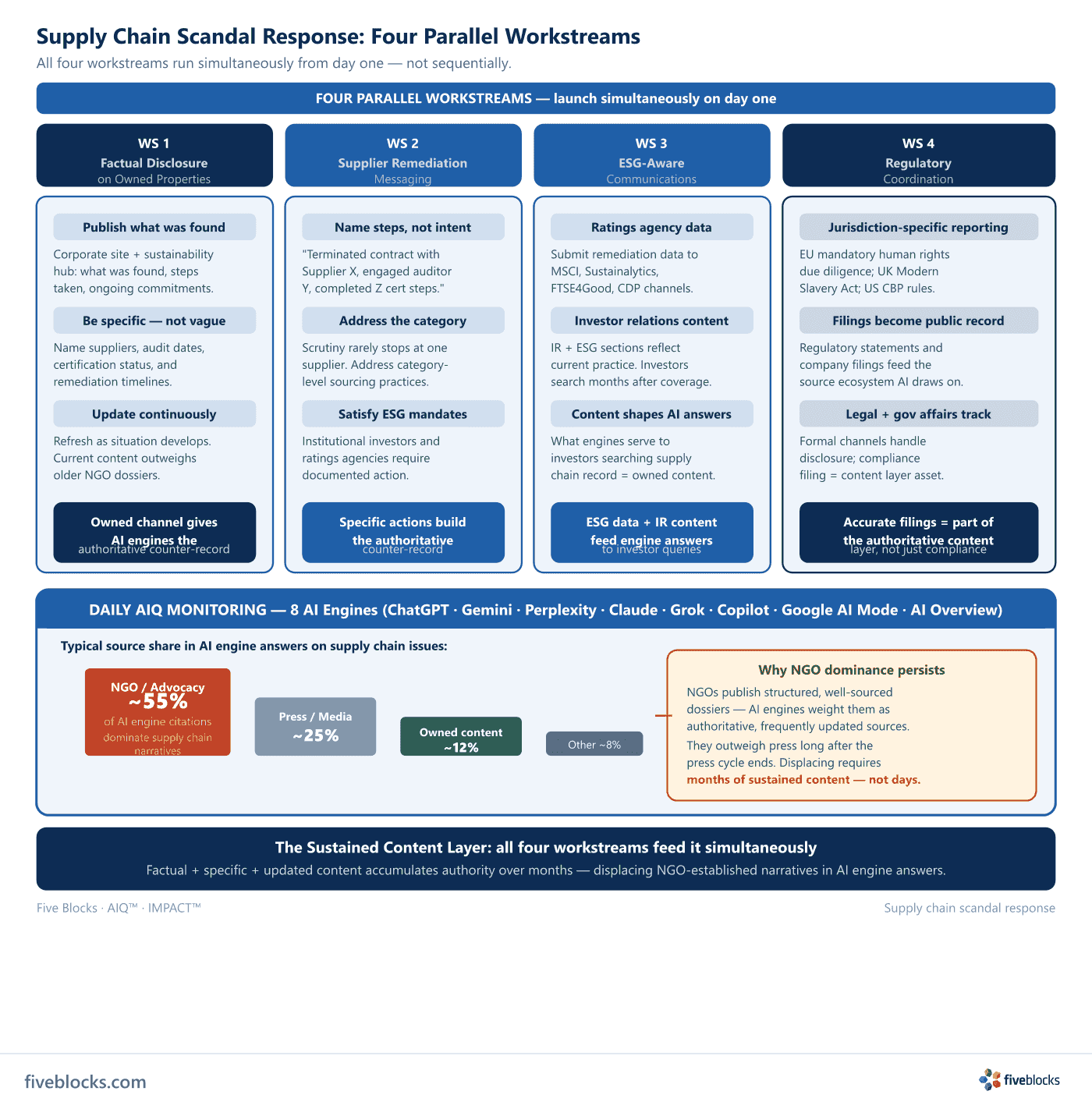
Workstream 1: Factual disclosure on owned properties
- Publish what was found and what is being done. Owned digital properties (the corporate site, sustainability hub, press room) are the only assets the company fully controls. A clearly structured page covering what was found in the supply chain, the specific steps taken with the named supplier or category, and the ongoing commitments gives AI engines and journalists authoritative material to cite that is not the NGO version of events.
- Be specific. Vague commitments are worse than silence. AI engines extract concrete facts (supplier names, audit dates, certification status, remediation timelines) and weight specificity as an authority signal. Broad language gets passed over; documented action gets cited.
- Update the content as the situation develops. A single statement published at the moment of disclosure and then abandoned will be outweighed by the ongoing source ecosystem. Content that reflects current status, updated as changes occur, gives the engines a reason to pull from the owned property rather than from older NGO dossiers.
Workstream 2: Supplier remediation messaging
- Name the steps, not just the intent. Stakeholders, and the AI engines that synthesize what they find, distinguish between “we are committed to supply chain integrity” and “we have terminated the contract with Supplier X, engaged auditor Y, and completed Z certification steps.” The second wording builds an authoritative counter-record.
- Address the category, not just the incident. Supply-chain scrutiny rarely stops at a single supplier. If the issue points to a structural weakness in the company’s sourcing practices, the communications have to address the category-level response, not only the named incident. That is what institutional investors and ratings agencies with ESG mandates look for.
Workstream 3: ESG-aware communications
- Ratings agencies and institutional investors need data, not prose. ESG ratings (MSCI, Sustainalytics, FTSE4Good, CDP) update based on documented performance. The company’s remediation data, audit results, and certification status need to reach these agencies through their formal submission channels, not just through press releases.
- Investor relations content addresses the long tail. Institutional investors reviewing ESG positioning will search the company’s digital footprint months after the initial coverage. An Investor Relations or ESG section that reflects current practice shapes what they find, and in turn what the AI engines serve them when they ask about the company’s supply chain record.
Workstream 4: Regulatory coordination
- Reporting obligations run on their own timeline. Supply-chain regulations in multiple jurisdictions, including mandatory human rights due diligence laws in the EU, UK Modern Slavery Act reporting, and US Customs and Border Protection forced-labor enforcement, may impose specific disclosure and documentation obligations. Legal and government affairs handle these through formal channels.
- Regulatory filings become part of the public record. Regulators’ public statements and company filings both feed into the source ecosystem that AI engines draw from. Accurate, complete regulatory submissions are part of the authoritative content layer, not just a compliance obligation.
The NGO-to-AI-engine dynamic: why the content layer matters
Supply-chain scandals are the category where the NGO-to-AI-engine pipeline is most visible. NGOs publish detailed, well-sourced dossiers on labor and environmental issues in supplier networks. AI engines weight these sources heavily because they are structured, authoritative within their domain, and frequently updated, often outweighing mainstream press on this specific topic type. AIQ monitoring across the eight AI engines AIQ currently tracks (ChatGPT, Gemini, Perplexity, Claude, Grok, Copilot, Google AI Mode, and AI Overview) frequently shows NGO sources dominating the engine narrative on supply chain issues well after the press cycle has moved on.
So a company can have resolved the underlying issue operationally while the AI engines still describe the supply chain in the terms the NGO sources set. Displacing that narrative means building the authoritative content layer (factual, specific, updated) until it carries enough weight in the sources the engines draw from that the current picture outweighs the historical one. This takes months, not days, which is why the content work starts when the issue surfaces rather than after the press cycle ends.
Last reviewed: 19/05/2026
