How do you manage reputation for a company accused of environmental violations?
Managing reputation after an environmental violation means tailoring responses to three distinct audiences (regulators and trade press; mainstream media; NGOs plus ESG raters and AI engines) and monitoring what AI engines say daily, because NGO dossiers persist for years and routinely outweigh current remediation content in AI-generated company descriptions.
Environmental violations draw coverage from several distinct audiences that do not read the same outlets or respond to the same materials. Effective reputation management gives each audience the right content, then monitors AI engine narratives daily, because NGO dossiers outlast press cycles by years and can dominate what AI engines say about the company long after remediation is done.
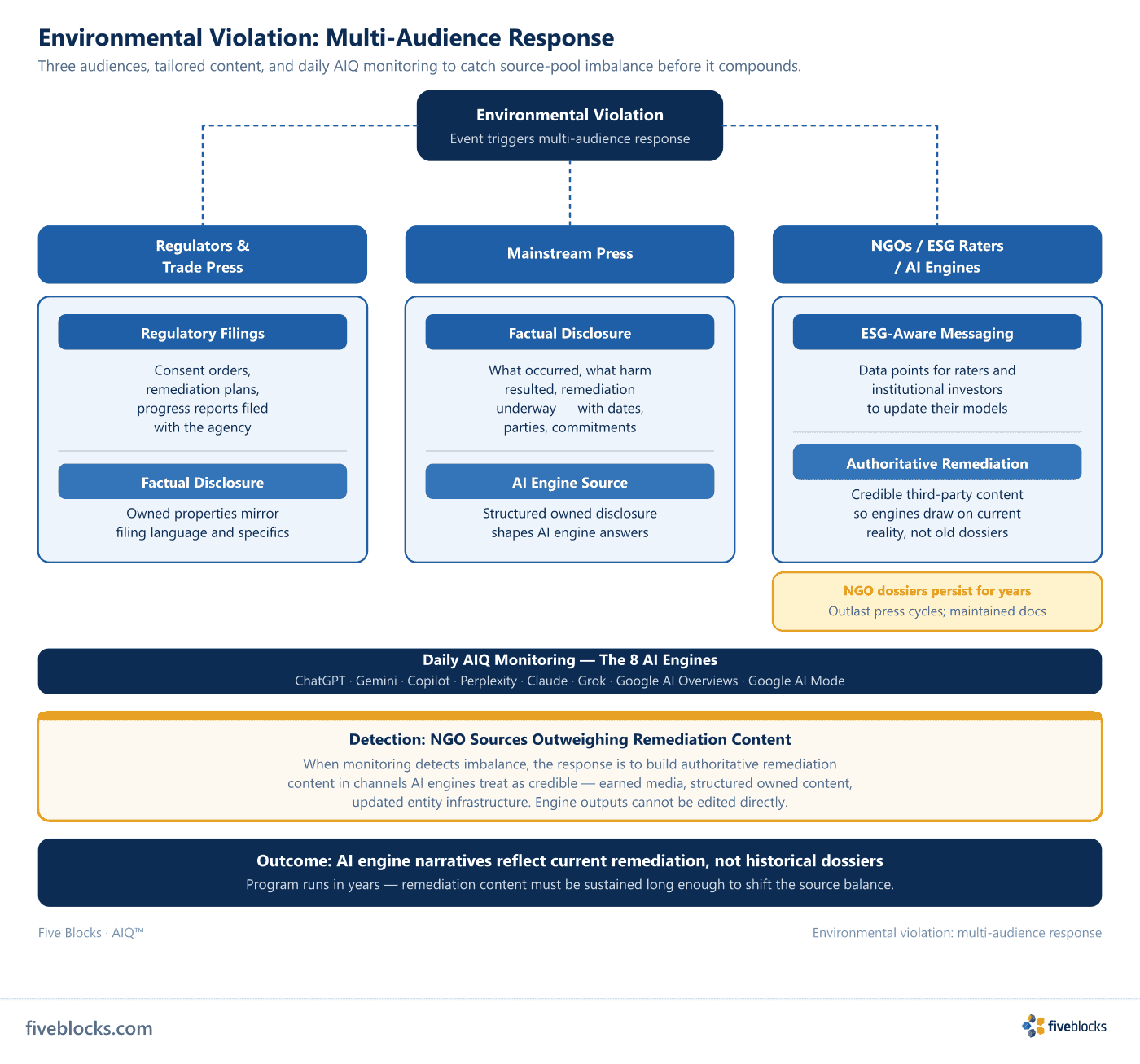
Three audience channels and the content each requires
- Regulators and trade press. These audiences expect formal accuracy. The main deliverables are regulatory filings (consent orders, remediation plans, progress reports filed with the relevant agency) and factual disclosures on owned properties that mirror the language and specifics of those filings. Trade publications follow the regulatory record, so the filing language sets the baseline for trade coverage.
- Mainstream press. Journalists covering the violation want a clear account of what occurred, what harm resulted, and what remediation is underway, with specifics. Factual disclosure on owned properties, structured with concrete dates, responsible parties, and measurable commitments, gives reporters an authoritative primary reference. AI engines assemble answers from underlying source content, so a well-structured owned disclosure also shapes how the engines describe the incident.
- NGOs, ESG raters, and AI engines. This is the longest-duration audience. NGOs maintain dossiers that feed ESG rating agency assessments and stay active as web documents for years. AI engines weight credible third-party sources heavily; when NGO coverage of an old violation outweighs current remediation content in source pools, the engines reproduce that imbalance in their answers. ESG-aware messaging, which gives raters and institutional investors the specific data points they need to update their models, addresses the ratings layer. The AI layer needs authoritative remediation content anchored at credible third-party outlets so that engines draw on current reality rather than historical dossiers.
Daily AIQ monitoring to catch source-pool imbalance
Daily monitoring across the eight AI engines AIQ currently tracks (ChatGPT, Gemini, Copilot, Perplexity, Claude, Grok, Google AI Overviews, and Google AI Mode) catches the pattern that makes environmental violations durable reputation risks: NGO sources outweighing current remediation content in the source pools AI engines draw on. When monitoring detects that imbalance, the response is to build or amplify authoritative remediation content in channels AI engines treat as credible (earned media, properly structured owned content, and updated entity infrastructure) rather than trying to edit engine outputs directly, which is not possible.
Why the work is multi-year
An unaddressed negative article can hold a prominent position for years. NGO dossiers have longer shelf lives still, because they are maintained documents rather than dated news stories. The remediation content layer has to be built and sustained long enough to shift the source balance, which is why the program runs in years, not quarters.
Last reviewed: 19/05/2026
