What is the difference between a reputation management firm and a PR agency?
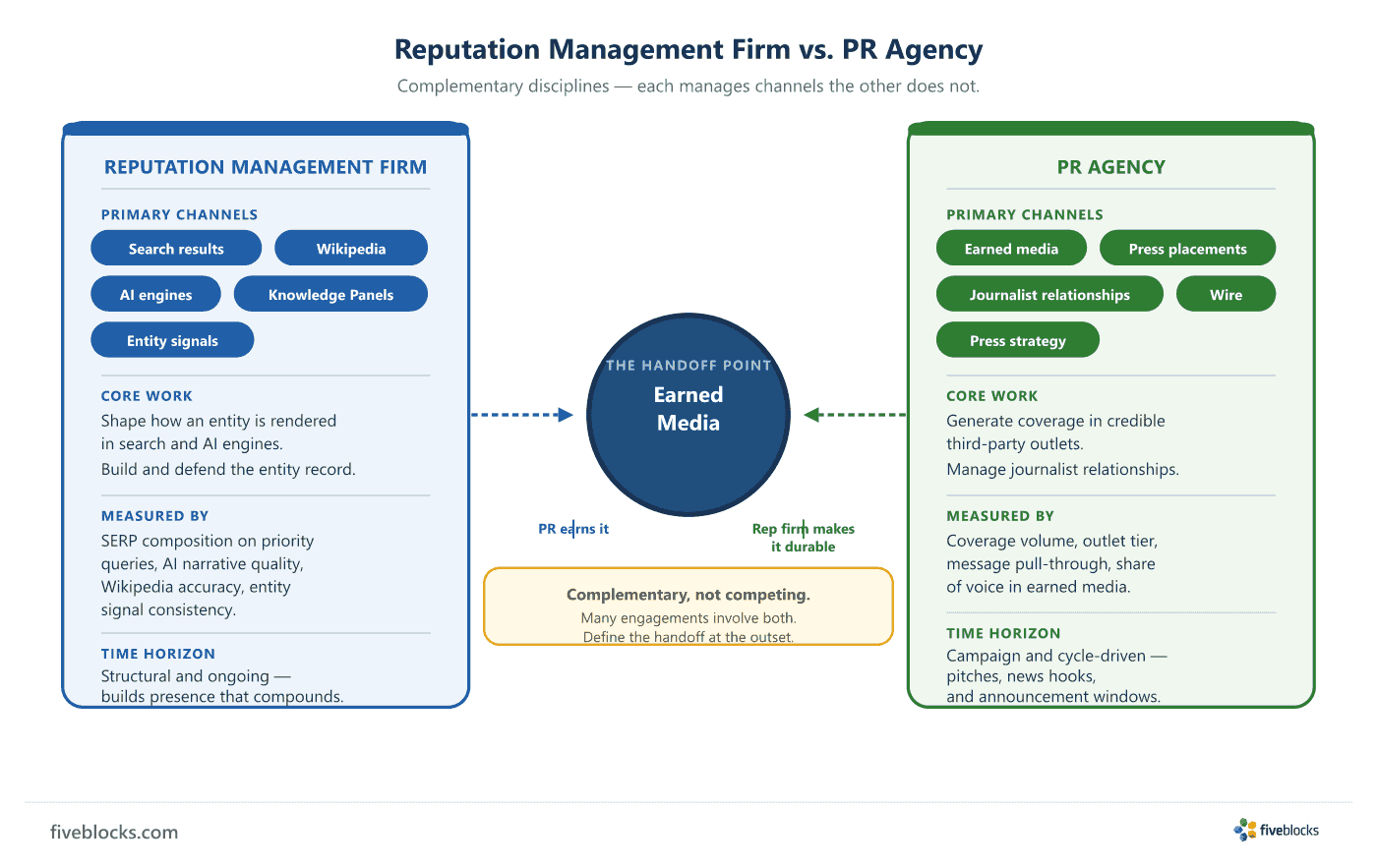
A reputation management firm manages the digital layers: search results, Wikipedia, AI engines, Knowledge Panels, and entity signals. A PR agency manages earned media, meaning journalist relationships, press strategy, and placements. Earned media is where the two meet: PR earns the coverage, and the reputation firm makes it durable and visible in the channels PR does not control.
Reputation management firms and PR agencies do related but distinct work. Confusing the two leaves gaps, because each discipline covers channels the other does not.
What each discipline manages
| Reputation Management Firm | PR Agency | |
|---|---|---|
| Primary channel | Digital layers: branded search results, Wikipedia, AI engines, Knowledge Panels, entity signals | Earned media: press placements, journalist relationships, press strategy |
| Core work | Shaping how a person or organization is rendered in search and AI; building and defending the entity record | Generating coverage in credible third-party outlets; managing relationships with journalists and publications |
| Tools and platforms | Branded SERP composition, Wikipedia (via disclosed COI editing), AI engine monitoring, structured-data and schema work, Knowledge Panel optimization | Media lists, editorial relationships, wire distribution, press briefings, crisis communications |
| How results are measured | SERP composition on priority queries, AI narrative quality across models, Wikipedia accuracy, entity-signal consistency | Coverage volume, outlet tier, message pull-through, share of voice in earned media |
| Time horizon | Structural and ongoing; the presence built this way compounds over time | Campaign- and cycle-driven, organized around pitches, news hooks, and announcement windows |
How the two functions connect
Earned media is the handoff point between the two disciplines. PR earns the coverage: the placement in a credible outlet, the journalist relationship, the press strategy that generates the story. The reputation firm makes that coverage durable. It gets the story ranking for branded queries, pulls it into the source pools AI engines draw on, and ties it to entity signals, so it stays visible long after the news cycle ends.
The two disciplines complement each other, and many engagements involve both. The work goes better when the boundary is set explicitly at the outset: PR manages the press relationships and generates the coverage; the reputation firm shapes how that coverage, and everything else available about the entity, renders across search and the AI engines. We work alongside PR teams constantly and define this handoff clearly from day one.
Last reviewed: 20/05/2026
