How do PR firms and reputation firms split responsibilities?
PR firms typically own earned media, messaging, and journalist relationships. Reputation firms own Wikipedia, AI, search, entity signals, and the proprietary technology behind them. A joint engagement runs both tracks against shared goals rather than handing work off in sequence.
The split follows the mechanics of each discipline. PR firms own the earned-media layer. Reputation firms own the channels that earned media flows into, the ones PR was not built to reach. A joint engagement runs both against shared goals from the start.
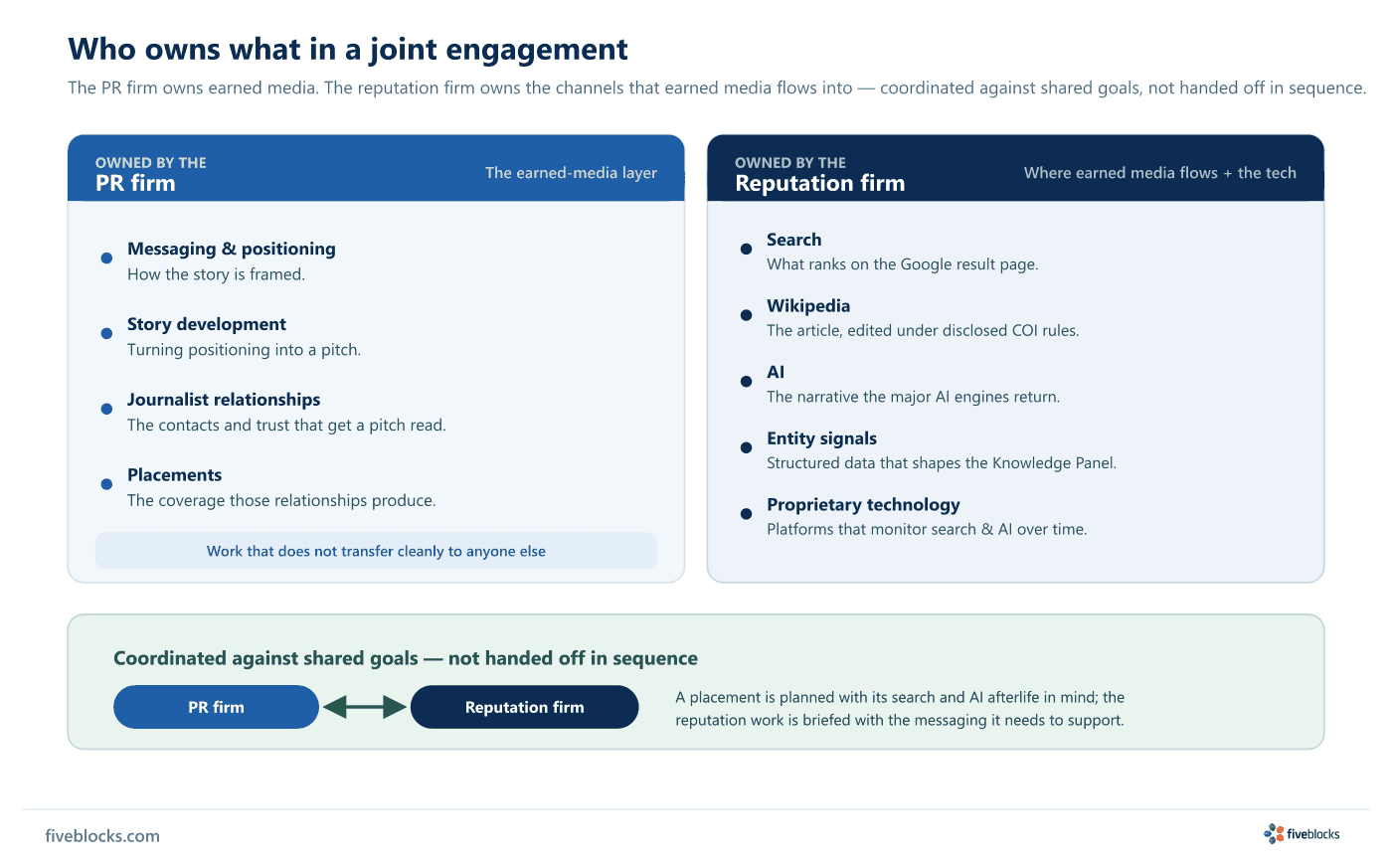
What the PR firm owns
The earned-media layer, the work that does not transfer cleanly to anyone else:
- Messaging and positioning, how the story is framed.
- Story development, turning that positioning into a pitch.
- Journalist relationships, the contacts and trust that get a pitch read.
- Placements, the coverage those relationships produce.
What the reputation firm owns
The layers earned media flows into, plus the technology that tracks all of it:
- Search, what ranks on the Google result page for the branded query.
- Wikipedia, the article itself, edited under disclosed conflict-of-interest (COI) rules rather than by direct or undisclosed editing.
- AI, the narrative the major AI engines return about the subject.
- Entity signals, the structured data and references that shape the Knowledge Panel and how engines identify the subject.
- Proprietary technology, the platforms that monitor search and AI narrative over time.
How a joint engagement coordinates the two
The two halves are coordinated against common goals from the start, not handed off in sequence. A placement is planned with its search and AI afterlife in mind, and the reputation work is briefed with the messaging it needs to support. The boundary stays clear enough to prevent overlap and porous enough for each half to reinforce the other.
Last reviewed: 20/05/2026
