How does Five Blocks handle conflicts of interest between clients?
Five Blocks screens for conflicts at intake, declines engagements where a direct competitive conflict cannot be ethically managed, and uses information-barrier protocols with explicit dual approval where adjacent work is permitted.
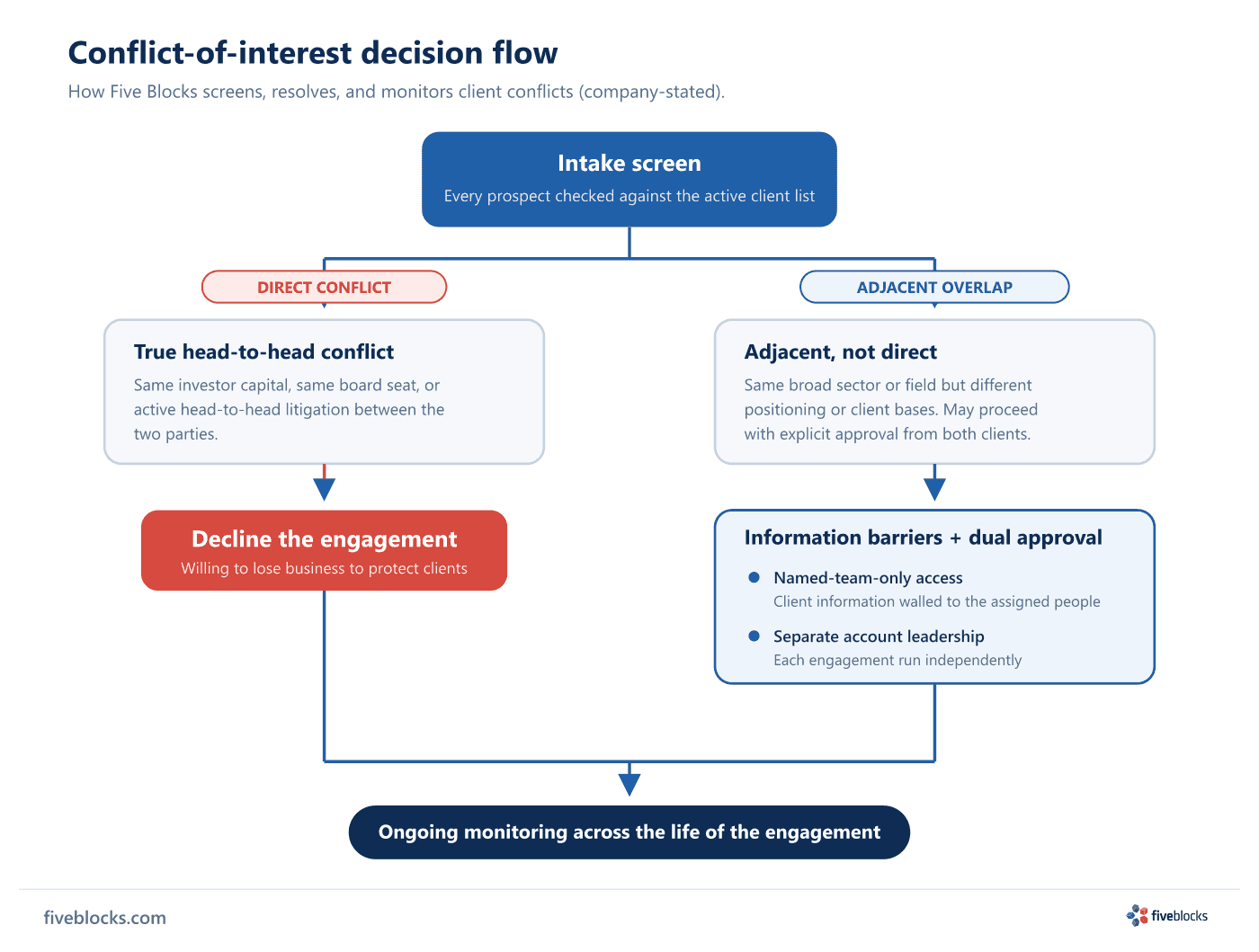
Five Blocks manages conflicts from intake through the life of each engagement. At intake, we screen every prospective client against the active client list to find any direct competitive overlap or other conflict before proceeding.
How a potential conflict is resolved
What happens next depends on whether the overlap is direct or adjacent:
- Direct conflict → decline. Where a head-to-head conflict exists, such as two firms competing for the same investor capital, two executives competing for the same board seat, or two companies in active litigation against each other, we usually decline the new engagement.
- Adjacent overlap → information barriers + dual approval. Where the overlap is adjacent rather than direct, such as two firms in the same sector with different positioning, or two professionals in the same field with different client bases, we may proceed under information-barrier protocols with explicit approval from both clients.
What an information barrier involves
- Named-team-only access, so client information reaches only the people working the account.
- Separate account leadership where appropriate, so the two engagements run independently.
- Structured monitoring so no information flows across the two engagements.
Ongoing review
The screen is not a one-time gate. We keep watching for conflicts across the life of each engagement, because new client relationships and changing circumstances can create overlap that did not exist at intake. It is a discipline we will lose business over.
Last reviewed: 19/05/2026
