How should a reputation management firm handle a conflict of interest?
A reputation firm should screen for conflicts at intake, decline any engagement where a direct competitive conflict cannot be managed ethically, and use information-barrier protocols for adjacent work, with both clients informed and approving before it begins. Declining a conflicted engagement demonstrates integrity and earns client trust.
Any reputation firm that works in a sector will eventually get an inquiry from a competitor of an existing client. How it handles that conflict tests its integrity, and the handling starts before anything is signed.
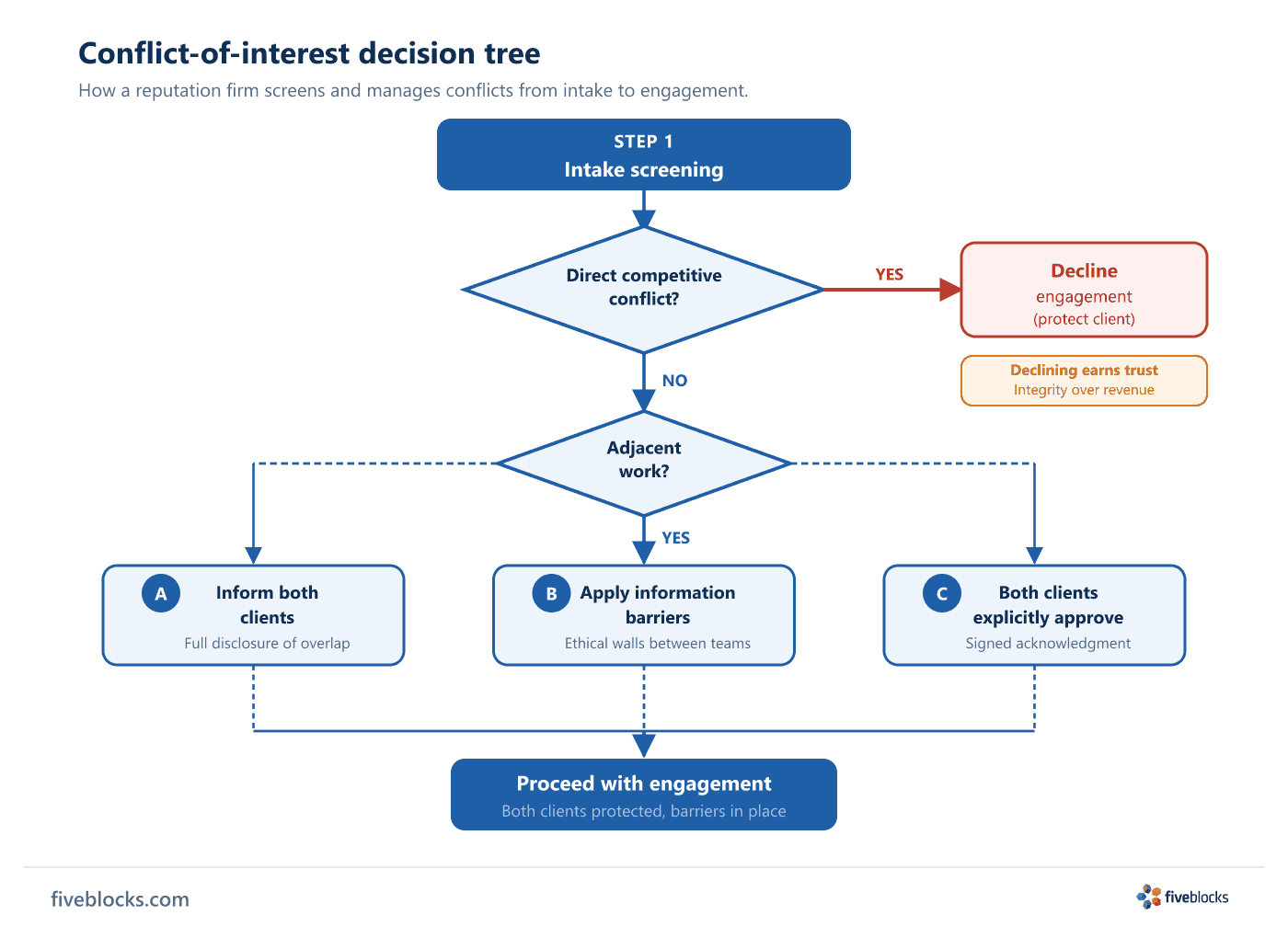
Step 1: Screen for conflicts at intake
Before accepting a new engagement, a responsible firm reviews its existing client base for overlap. Catch the conflict before work begins, not midway through, when relationships are already in place and sensitive information has been shared.
Step 2: Direct competitive conflict, decline
Where two clients are direct competitors trying to shape their relative standing, the firm cannot serve both honestly. The only ethical path is to decline the conflicting engagement, even at the cost of revenue. Taking that work without disclosure puts fees ahead of fiduciary care, and it breaks the client trust reputation work runs on.
Declining earns trust. A firm that turns down revenue to protect an existing client relationship has shown where its priorities sit.
Step 3: Adjacent work, information barriers and dual approval
Where the overlap is adjacent rather than directly competitive, the firm may be able to proceed, but only on two conditions:
- Both clients are informed of the overlapping engagement and what it entails.
- Both clients explicitly approve, with full understanding of what information-barrier protocols are in place to keep their interests separated.
Information barriers, sometimes called ethical walls, restrict which team members can access which client’s work, so strategy and confidential information do not cross over. They do not remove the conflict. They contain it inside boundaries both clients have accepted.
The principle behind it
Client trust comes first. A firm that takes conflicting engagements without disclosure, or without real barriers, cannot be trusted with reputation work. We screen for conflicts at intake and then either decline the work or wall it off, and we tell every client involved which it is.
Last reviewed: 20/05/2026
