How do you build a media strategy that supports both PR and search reputation goals?
A media strategy that serves both PR and search reputation goals picks outlets on two criteria at once: traditional reach and search authority. A high-reach outlet with weak search authority is a PR win that does little reputational work. Time placements against the content calendar and build them to integrate with entity signals, so each media moment becomes a durable search and AI asset.
A media strategy that serves both PR and search reputation goals is built around the placement’s afterlife, not just its debut. Three disciplines get you there.
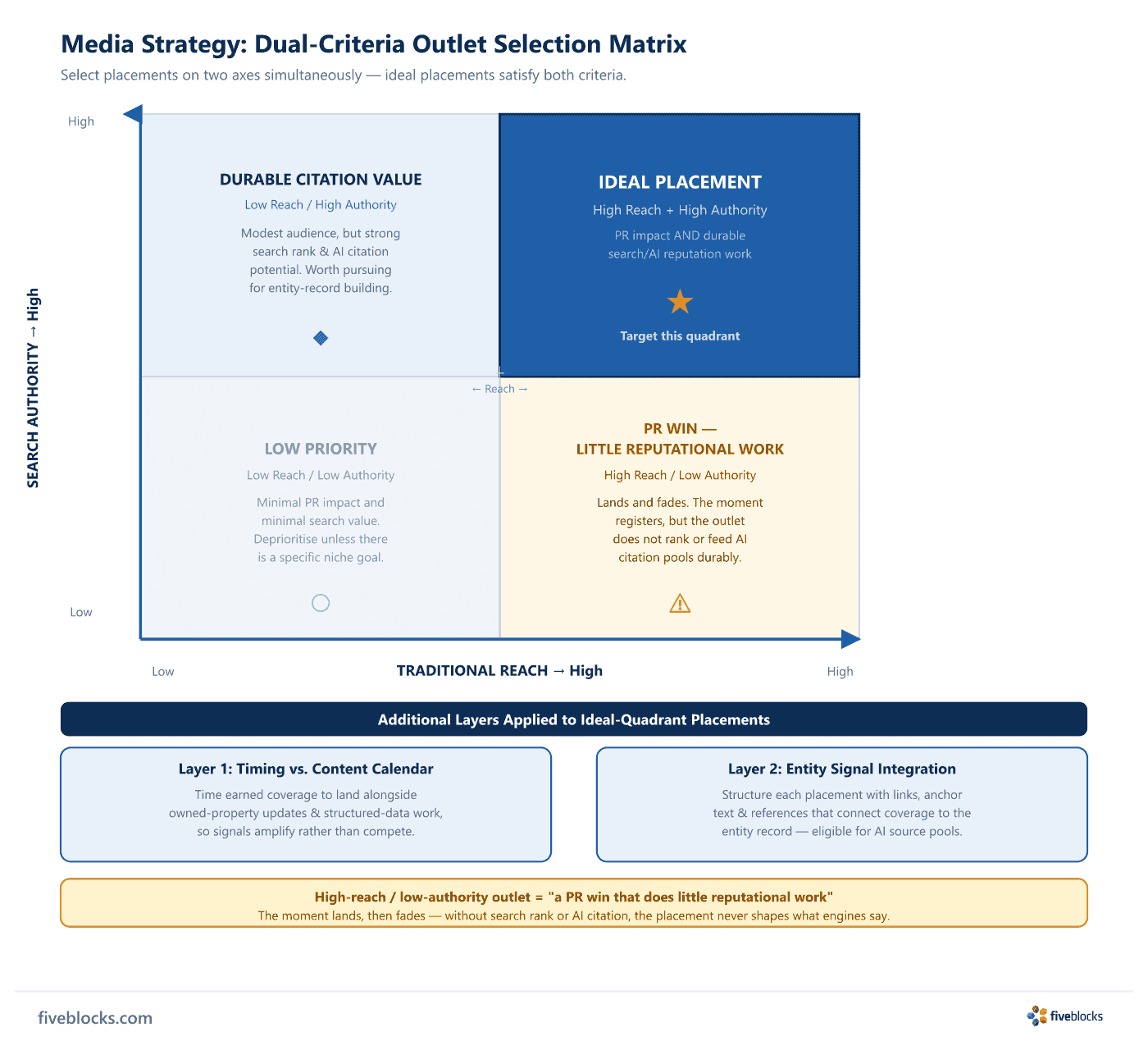
Step 1: select outlets on two criteria at once
Every outlet evaluation runs two axes in parallel:
- Traditional reach, audience size, prestige, and editorial credibility for the campaign’s intended audience.
- Search authority, the domain’s ability to rank for branded and category queries, plus the credibility signals that decide whether search and AI engines treat it as a trusted source.
The ideal placement sits in the high-reach / high-authority quadrant. A high-reach outlet with weak search authority is a PR win that does little reputational work: the moment lands, then fades. An outlet with high authority and modest reach can do more for the entity record and the AI citation pool than a louder placement that never ranks.
Step 2: time placements against the content calendar
Coverage that lands in isolation does less work than coverage that reinforces a synchronized push. Time the placements so earned coverage, owned-property updates, and any Wikipedia or structured-data work land together, and each signal amplifies the others instead of competing for attention in separate cycles.
Step 3: structure each placement to integrate with entity signals
Outlet selection and timing create the opportunity. Structural integration turns it into a lasting asset. Each placement should be:
- Properly anchored, with links, anchor text, and references that connect the coverage to the company’s entity record.
- Interlinked, so it strengthens the entity footprint across the web instead of sitting as an isolated page.
- Eligible for AI source pools, built so search and AI engines can retrieve and cite it, which shapes what the engines say rather than only what a reader saw on publication day.
Built this way, a placement is a media moment and a durable search asset at the same time. We track which placements actually convert into ranking and AI citation with IMPACT™ and AIQ®.
Last reviewed: 20/05/2026
