How do you assess whether a reputation management firm understands AI and LLM search?
Four signals separate real AI capability from AI vocabulary: proprietary monitoring across the leading AI engines (ChatGPT, Gemini, Copilot, Perplexity, Claude, Grok, Google AI Overviews, and Google AI Mode); influence work at the source layer rather than claims to edit model outputs; narrative reporting trended over time rather than one-off screenshots; and AI work wired into the rest of the reputation program. A firm that cannot show all four is improvising.
Plenty of reputation firms have picked up AI language without the capability behind it. Four signals separate the firms that understand the AI engines from the ones improvising.
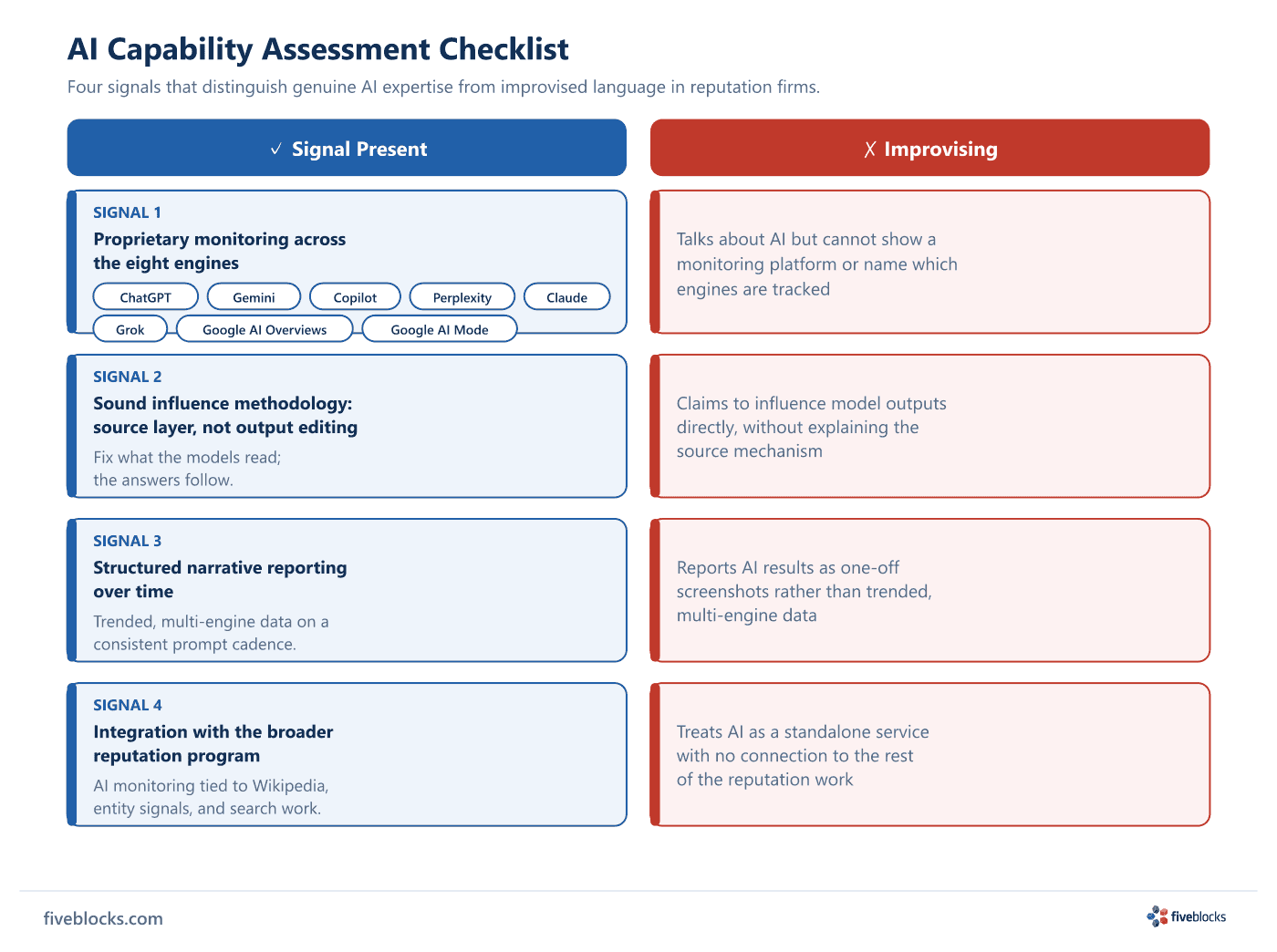
Signal present
-
Proprietary monitoring across leading engines
You cannot manage what you cannot measure, and credible monitoring has to cover every major model. ChatGPT, Gemini, Copilot, Perplexity, Claude, Grok, Google AI Overviews, and Google AI Mode will each answer the same question about the same entity differently. A firm watching one or two sees a fraction of the picture. Ask which engines are tracked, on what cadence, and what the reporting looks like. Then make them show you the platform producing it. -
Influence at the source layer, not output editing
Nobody edits a model’s output. AI narratives shift when the sources the models draw on improve: entity signals, authoritative content, structured data, and the wider information environment the engines synthesize. A firm that claims to influence model outputs without explaining that mechanism is confused or misrepresenting what it does. The framing is always upstream. Fix what the models read and the answers follow. -
Structured narrative reporting over time
One screenshot of what ChatGPT says today tells you almost nothing. AI answers vary by phrasing, by model, and by day, and they move as the underlying sources change. Useful reporting describes the narrative across every tracked engine on a consistent prompt cadence and shows how it changes. The trend line is what you can act on. -
Integration with the broader reputation program
AI narrative sits downstream of the same entity and content work that drives search. A firm selling AI monitoring as a standalone product, cut off from Wikipedia, entity signals, and the rest of the result set, has missed that the inputs are shared. The best programs tie AI narrative management to the search and entity work so each one helps the other.
Improvising
- Talks about AI but cannot show a monitoring platform or say which engines are tracked
- Claims to influence model outputs directly, with no explanation of the source mechanism
- Reports AI results as one-off screenshots instead of trended, multi-engine data
- Sells AI as a separate service with no connection to the rest of the reputation work
Five Blocks built AIQ™ to meet the first criterion. It tracks the eight engines AIQ currently monitors on a consistent cadence and attributes which sources are shaping each answer, and that monitoring feeds the entity and content work that changes those sources over time.
Last reviewed: 20/05/2026
