How do you align ESG communications with reputation management strategy?
Align ESG communications with reputation strategy across four channels: authoritative content anchored to real commitments and measured outcomes, AIQ™ monitoring of how AI engines answer ESG-specific prompts, accurate Wikipedia ESG sections maintained through disclosed COI work, and structured benchmarking against named peers on the same questions. Scrutinizers look for inconsistency between those channels, so the record has to hold up in all four.
ESG claims are among the most scrutinized any company can make, and the channels that carry them now cross-check each other: Wikipedia ESG sections attract critical edits, AI engines synthesize ESG records on demand, and analysts benchmark companies against peers on the same questions. Aligning ESG communications with reputation strategy means keeping the public record internally consistent and grounded in evidence across the four channels below.
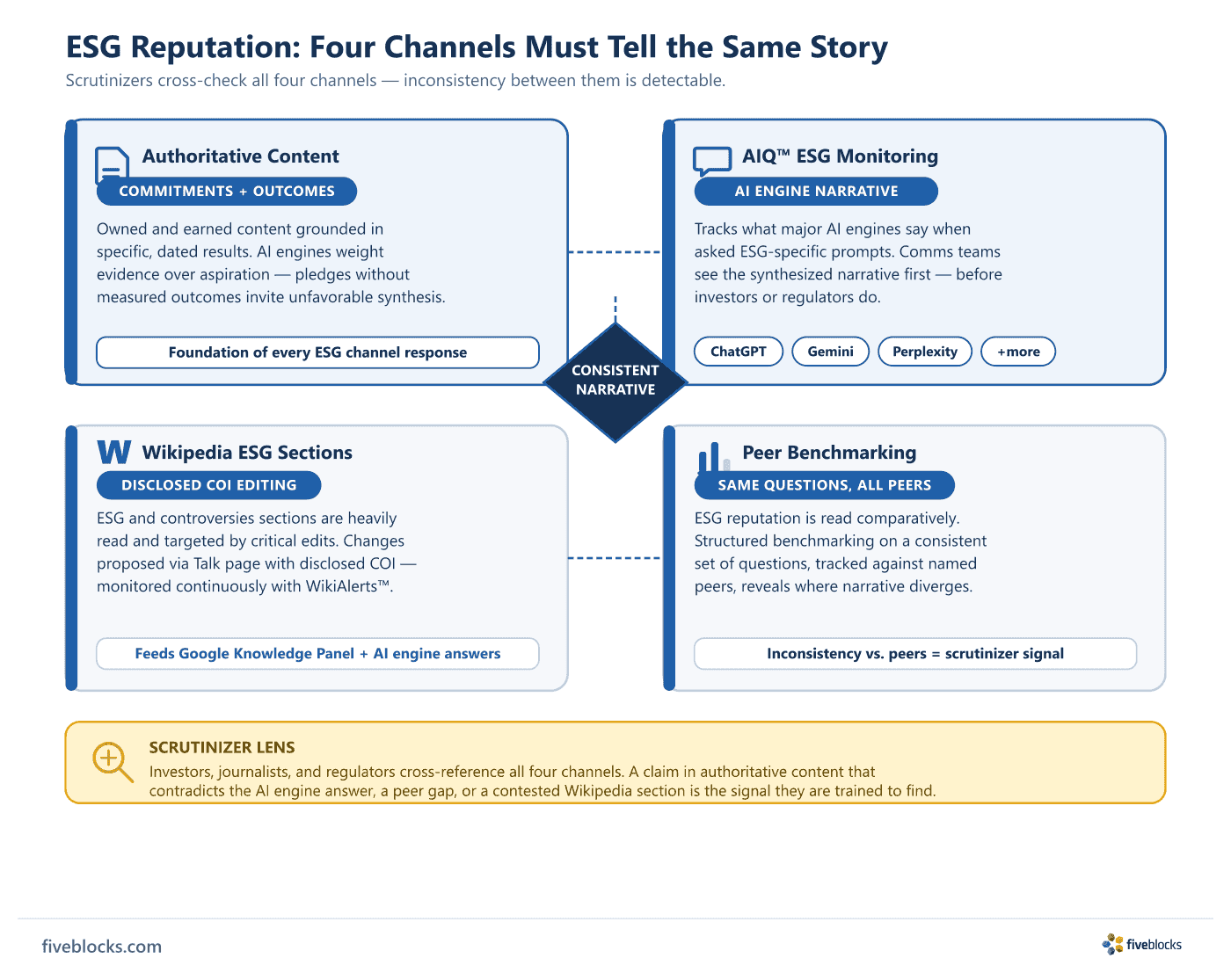
- Authoritative content: commitments and outcomes
- The foundation is owned and earned content that documents what the company has committed to and what it has actually achieved. AI engines and skeptical stakeholders weight evidence over aspiration, so a sustainability report full of pledges but thin on measured results is the kind of material that invites unfavorable synthesis. Content tied to specific, dated outcomes gives the engines something accurate and positive to draw on.
- AI narrative monitoring on ESG prompts
- Investors, journalists, and regulators now ask AI engines directly about a company’s environmental and social record, and the synthesized answer sets their starting frame before any human contact. AIQ™ tracks what the major models say in response to ESG-specific prompts. The comms team learns the narrative first and can work the source layer, instead of discovering a problem when it surfaces in a stakeholder conversation.
- Wikipedia accuracy on ESG sections (disclosed COI work)
- Wikipedia ESG and controversies sections are heavily read and disproportionately targeted by critical edits. Because the Wikipedia article feeds Google’s Knowledge Panel and is among the most-cited sources for AI engine answers, inaccuracies here spread across channels. Changes are proposed through the Talk page and the disclosed conflict-of-interest process: transparent advocacy backed by reliable secondary sources. WikiAlerts™ monitors the article continuously.
- Structured peer benchmarking
- An ESG reputation is read comparatively. Investors and analysts ask the same question about multiple companies; AI engines answer ESG prompts against a competitive backdrop. Benchmarking on a consistent set of ESG questions, tracked against named peers, shows where the narrative diverges from the peer group and where the source layer needs work. Inconsistency between channels or against peers is the signal scrutinizers are trained to detect.
Last reviewed: 20/05/2026
