How do you manage search results for a company with multiple business units?
Multi-business-unit reputation work segments the SERP by audience and unit, manages each unit's entity signals separately with the right schema, and coordinates a corporate-level identity that supports the units without overshadowing them or being overshadowed - because the engines treat each unit as its own entity.
Companies with several distinct business units have a structural problem to solve: corporate, divisional, and product or geographic identities all have to coexist in search and AI results without cannibalizing each other. You handle it by managing each unit as its own entity and coordinating them from the corporate level, working through the layers in a set sequence.
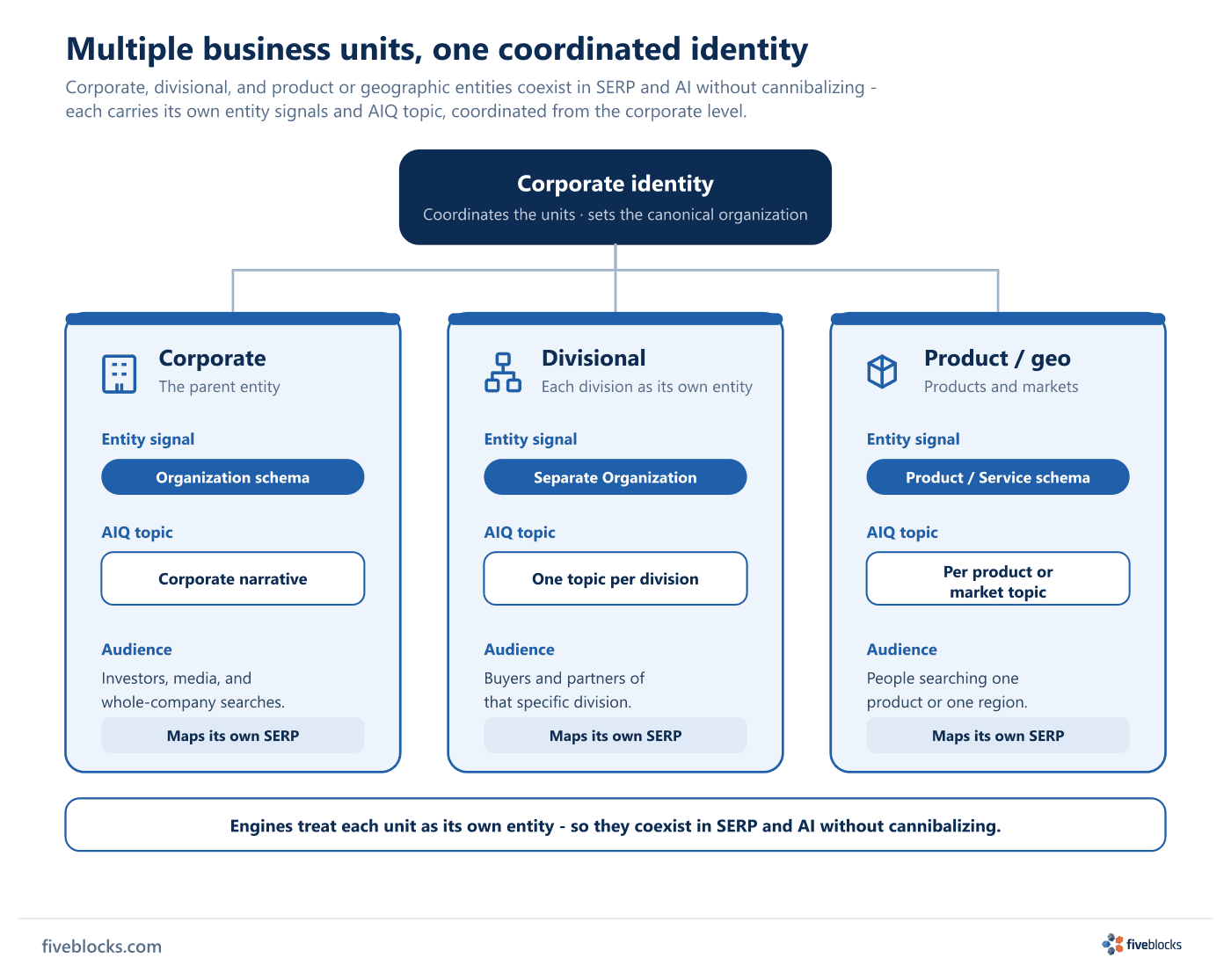
How to manage a multi-business-unit footprint, step by step
- Map the SERP for each entity separately. Treat corporate, each division, and each major product or brand as its own search target, because the audiences and competitive sets differ at each level.
- Build entity signals at each level with the right schema. Use Organization markup at the corporate level, separate Organization entries for divisions that operate independently, and Product or Service markup below, so each page asserts which entity it belongs to and engines attach it accordingly.
- Coordinate the corporate site architecture. Keep divisional content accessible without crowding the corporate canonical pages, so the units support each other instead of fighting for the same slots.
- Track each entity in its own AIQ topic. Run a separate topic per unit so the AI narrative is monitored at the right granularity rather than blurred into a single conglomerate view.
The failure mode to avoid
The mistake is treating the conglomerate as a single entity for reputation purposes. The engines do not – structured data and entity signals attach each page to a specific entity – and neither do the stakeholders, who arrive with a question about one division, one product, or one market. Manage the units separately, coordinate them from the corporate identity, and each one stays visible to its own audience.
Last reviewed: 19/05/2026
