How do you manage Google results for a person entering politics?
For someone entering politics, the decisive reputation work happens before the campaign goes public: build the candidate's entity infrastructure (Person schema and sameAs links on a candidate site, an accurate Wikipedia article where notability supports one), publish authoritative content covering the candidate's actual record, and set up AIQ monitoring across the eight AI engines AIQ currently tracks. The point is to make the canonical version of the story the candidate's, not the opposition's.
Politics raises the volume and the adversarial nature of digital reputation in a way most people coming from business are unprepared for, and the moves that matter most happen before the campaign launches publicly. The pre-campaign window is for making the candidate a well-defined entity that search and AI engines resolve correctly, and for getting the candidate’s own account of their record published first. Opposition research will surface everything; the real question is whose version becomes canonical. This work is foundational, not reactive.
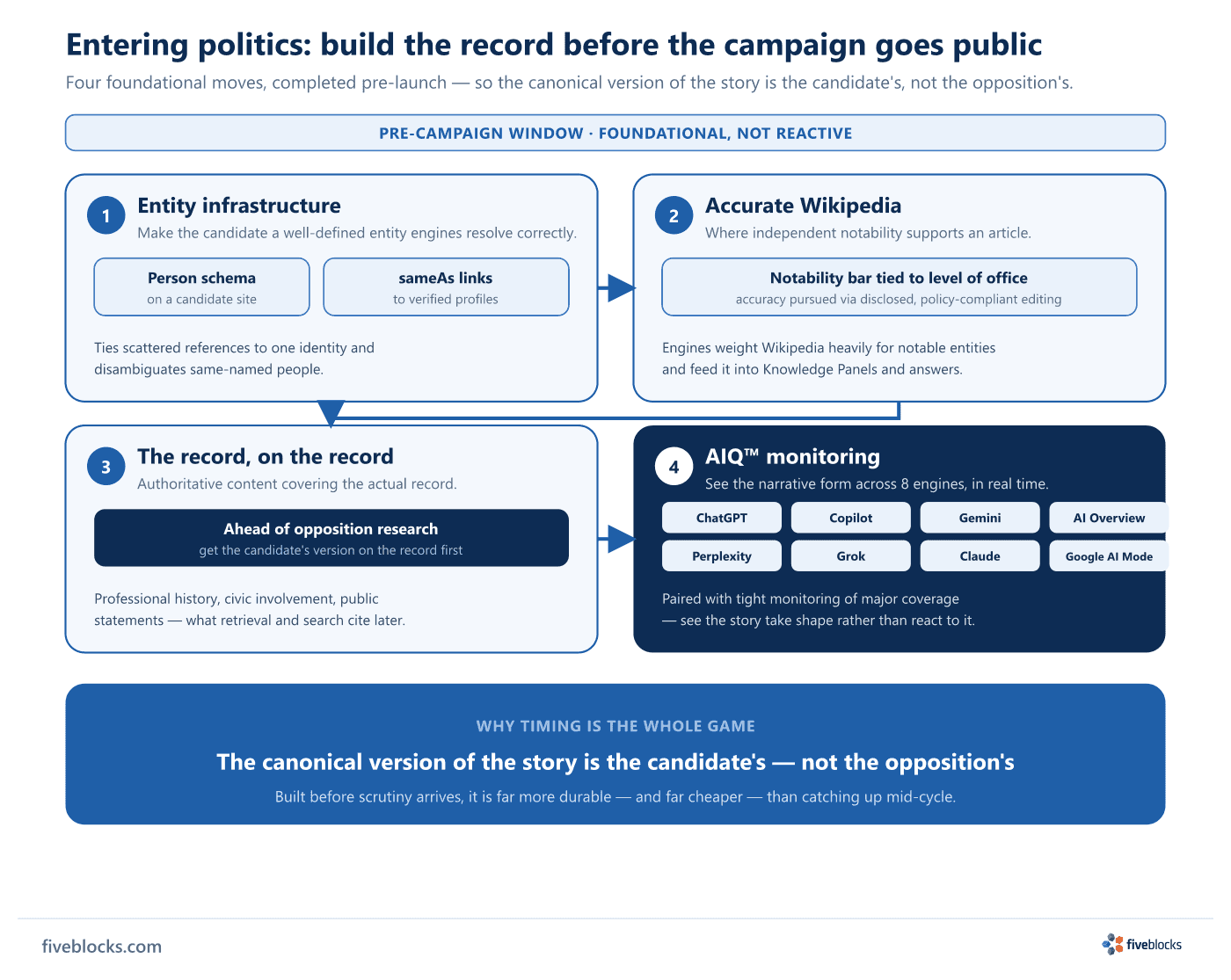
What to build before the campaign goes public
- Build the candidate’s entity infrastructure. Put complete
Personschema on a candidate site withsameAslinks to verified social and professional profiles. Person schema with sameAs links connects the bio to the candidate’s Wikipedia article and Wikidata identifier, which is how AI engines tie scattered references to one identity and tell apart same-named people. - Make the Wikipedia entry accurate, where notability supports one. A Wikipedia article is only viable when independent notability supports it; for political figures, Wikipedia applies a subject-specific notability bar tied to the level of office held. Where an article is warranted, pursue accuracy through legitimate channels (disclosed, policy-compliant editing), because AI engines weight Wikipedia heavily for entities that meet its notability standard and feed it into Knowledge Panels and engine answers.
- Put the candidate’s record on the record. Publish authoritative biographical content covering the candidate’s professional history, civic involvement, and public statements. Retrieval-based AI engines and search both lean on authoritative, independent coverage, so an accurate, substantive account established early shapes what gets cited later.
- Set up AIQ monitoring across the engines AIQ tracks. AIQ currently tracks eight AI engines and monitors how the AI narrative forms across ChatGPT, Copilot, Gemini, AI Overview, Perplexity, Grok, Claude, and Google AI Mode, so the campaign team sees the story take shape rather than reacting to it after the fact. Pair it with close monitoring of major coverage.
Why timing is the whole game
Once a campaign intensifies, the narrative is contested in real time and the candidate is no longer the only author of their record. Building the entity, the authoritative content, and the monitoring layer beforehand means the candidate’s version of the story is already in place when scrutiny arrives. That is far more durable, and far cheaper, than trying to catch up mid-cycle.
Last reviewed: 19/05/2026
