How do you manage reputation during a political controversy?
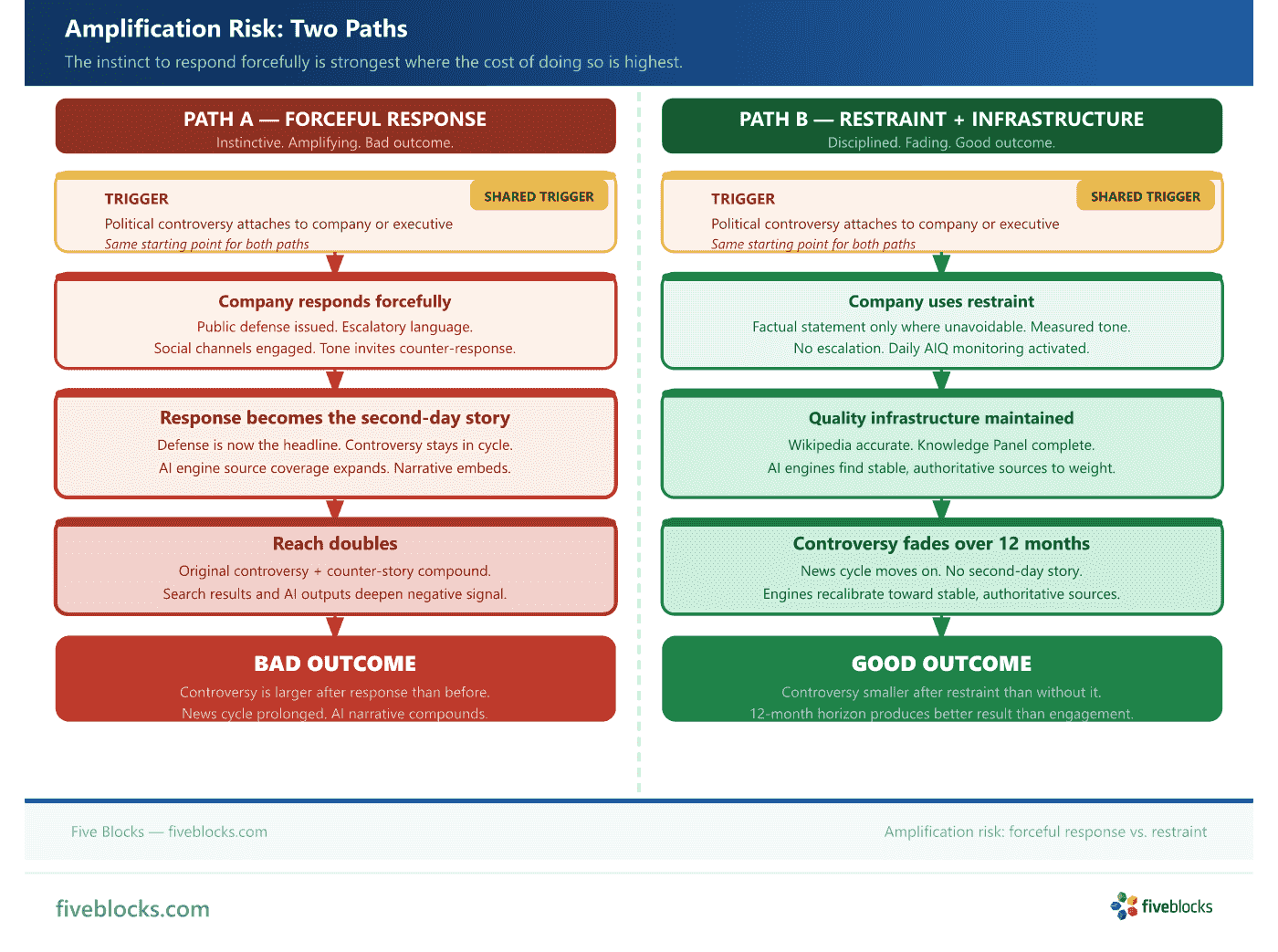
Over-engagement amplifies political controversy in nearly every case: a forceful public defense becomes the second-day story that doubles the original reach. The disciplined response is restraint, factual statements only where unavoidable, careful tone, daily AIQ monitoring across the AI engines, and accurate Wikipedia and Knowledge Panel content so engines have a strong source to weigh against the controversy.
Political controversy is where the urge to respond publicly runs hardest and costs the most. The pattern repeats in nearly every case: a controversy attaches to a company or executive, communications wants to defend forcefully, and the forceful defense becomes the second-day story that doubles the reach of the original controversy.
The restraint discipline
- Factual statements only where unavoidable. Where the company has to say something, the statement is factual, measured, and brief. No provocative language, no escalation on social channels.
- Careful tone throughout. Every word in every public channel gets weighed against one question: does it feed the cycle or starve it? Tone that invites a counter-response keeps the controversy alive.
- Daily AIQ monitoring across the eight engines AIQ currently tracks. AIQ tracks what ChatGPT, Gemini, Perplexity, Claude, Grok, Copilot, Google AI Mode, and AI Overview say about the brand during the controversy, how source attribution shifts, and where engine responses diverge from the factual record. That data drives the response instead of instinct.
- Accurate Wikipedia and Knowledge Panel content. During a controversy, the engines lean heavily on credentialed, stable sources. A Wikipedia article with accurate, well-sourced content and a complete Knowledge Panel give the engines a strong reference to weigh against the controversy coverage. Errors or gaps in these assets get fixed promptly through the appropriate channels.
Why restraint produces the better twelve-month outcome
Restraint plus quality infrastructure routinely beats aggressive public response over a twelve-month horizon. Controversies that get forceful counter-engagement stay in the news cycle longer, attract more AI engine source coverage, and pile up in search results. Controversies met with restraint and well-maintained infrastructure tend to fade as the news cycle moves on and the engines settle back toward stable, authoritative sources.
Narrow exceptions
Sometimes a forceful public response is the right call: when the controversy rests on a clear factual falsehood that will be accepted as fact if left unchallenged, when stakeholder relationships require an unambiguous statement of position, or when legal posture requires it. These are real exceptions, not the default. The bar for departing from the restraint posture is high, and the decision has to account for the amplification risk of any public engagement.
Last reviewed: 19/05/2026
