How do you manage reputation for someone entering the public eye for the first time?
Put the canonical picture in place before the public emergence, not after: a schema-marked bio on an owned page, a matching LinkedIn, clean third-party profiles, a Wikidata entry, baseline content on the topics stakeholders will check, and AI monitoring running from day one.
Entering the public eye for the first time compresses search and AI activity into a short window, and that is usually when the canonical picture settles. AI engines retrieve and re-train continuously, so the moment a name starts being queried they begin assembling an answer from whatever sources exist. The work has to be in place before the public emergence, not built reactively afterward.
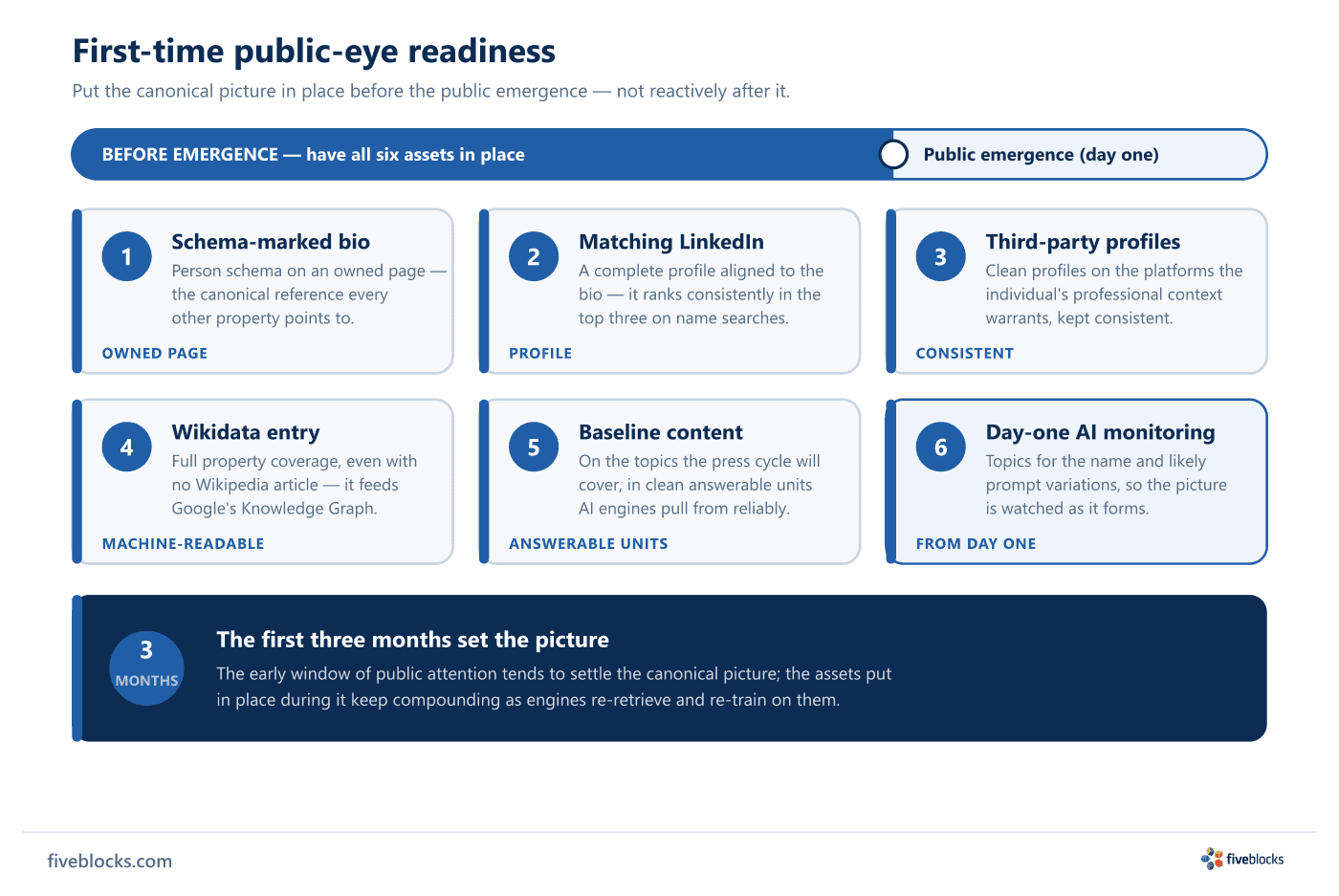
What to have in place before emergence
- A Person-schema-marked bio on an owned page. Either a personal site or a controlled corporate page, written as the canonical reference every other property points to. Schema and structured data help search and AI engines understand what the page asserts and attach it to the correct entity.
- A complete LinkedIn profile that matches the canonical bio. LinkedIn profiles rank consistently well on Google name searches for most executives and public figures, often in the top three, so the profile is one of the first things stakeholders and engines see.
- Clean third-party profiles on the platforms the individual’s professional context warrants, kept consistent with the canonical bio.
- A Wikidata entry with full property coverage, even when no Wikipedia article exists yet. Wikidata is a primary data source for Google’s Knowledge Graph. Its properties feed Knowledge Panel signals and give AI engines machine-readable identifiers for entity disambiguation.
- Baseline content on the topics the press cycle will cover, stated plainly and organized into clean, answerable units. Engines pull most reliably from content in that form.
- AI monitoring from day one, with topics set for the individual’s name and the likely prompt variations, so the canonical picture can be watched as it forms instead of discovered late.
Why the early window matters
The first weeks and months of public attention tend to set the canonical picture, and the assets put in place during that window keep compounding afterward as engines re-retrieve and re-train on them. Authoritative outside coverage reinforces the owned baseline. Search and AI engines weight credible independent sources heavily, so being cited by reputable outlets shapes AI answers more than adding owned pages does.
Last reviewed: 19/05/2026
